

Introduction
In this article, we will explore about machine learning and its different types. Machine learning (ML) is a subset of artificial intelligence(AI) that focuses on creating systems that can learn and improve from experience without being explicitly programmed. It's based on the idea that systems can learn from data, identify patterns, and make decisions with minimal human intervention.
By developing Machine learning algorithms, we can use them in the below task.
- Analyze large amounts of data
- Detect patterns or trends
- Use these patterns to make predictions or decisions on new data
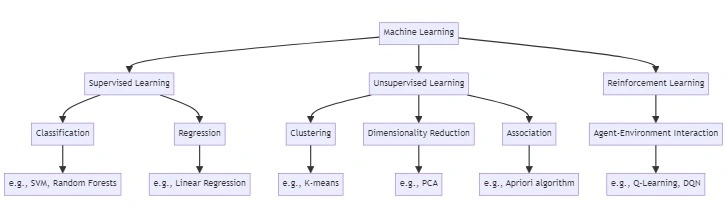
Types of machine learning
1. Supervised Learning
Supervised learning is the most common type of machine learning. In this approach, the algorithm is trained on a labeled dataset, where each example in the training data is paired with the correct output.
Key characteristics
- Requires labeled data
- The goal is to learn a function that maps inputs to outputs
- Used for classification and regression tasks
Examples of supervised learning algorithms
- Linear Regression
- Logistic Regression
- Support Vector Machines (SVM)
- Decision Trees and Random Forests
- Neural Networks
Use cases
- Spam email detection
- Image classification
- Sentiment analysis
- Price prediction
2. Unsupervised Learning
Unsupervised learning deals with unlabeled data. The algorithm tries to find patterns or structures in the data without any predefined outputs.
Key characteristics
- Works with unlabeled data
- Aims to discover hidden patterns or structures
- Used for clustering, dimensionality reduction, and association tasks
Examples of unsupervised learning algorithms
- K-means clustering
- Hierarchical clustering
- Principal Component Analysis (PCA)
- Autoencoders
- Generative Adversarial Networks (GANs)
Use cases
- Customer segmentation
- Anomaly detection
- Topic modeling in text analysis
- Recommendation systems
3. Reinforcement Learning
Reinforcement learning is inspired by behavioral psychology. An agent learns to make decisions by performing actions in an environment and receiving rewards or penalties.
Key characteristics
- Involves an agent, environment, states, actions, and rewards
- The agent learns through trial and error
- The goal is to maximize the cumulative reward
Examples of reinforcement learning algorithms
- Q-Learning
- Deep Q-Network (DQN)
- Policy Gradient Methods
- Actor-Critic Methods
Use cases
- Game playing (e.g., AlphaGo)
- Robotics
- Autonomous vehicles
- Resource management
Summary
Machine learning is a powerful tool that's transforming numerous industries. By understanding the different types of machine learning, we can better appreciate its capabilities and limitations. As technology advances, we can expect machine learning to play an increasingly important role in solving complex problems and driving innovation across various fields.
Join the conversation! Your thoughts help the community grow.