

Introduction
Things in machine learning are repeated over and over and hence machine learning is iterative in nature. Therefore, to know machine learning, one has to understand the machine learning process. The machine learning process is a bit tricky and challenging. It is very rare that we find the machine learning process easy. The reason for it being so complex is very clear - a large amount of complex data is involved in this process and out of which we try to find out meaningful predictive patterns and models.
That’s why, as I mentioned in my last article that this is dealt with by data scientists who are actually specialists in this space. In my last article, I also mentioned how rewarding a machine learning process could be. The benefits out of this process could be outstanding, but we should also keep in mind that the process may not always succeed but can fail, but that’s too rare. Let’s focus on the processes and scenarios used in Machine learning in this article.
Series
We’ll try to cover the topic and Machine Learning concepts, processes, and scenarios including terminology in a form of series. This is the second article of the series and will largely focus on machine learning processes and scenarios. The following are the articles that we’ll follow to know about machine learning.
- Introduction to Machine Learning
- Machine learning processes and scenarios
- Machine learning: Deep dive
Baseline the need
In machine learning, asking the right question and knowing the correct answer is most important. We should know what questions to ask; it is the most important part of the process. And after that, we should ask ourselves a question of ourselves: do we have enough and correct data to answer that question. If you ask the wrong question or you do not have enough or correct data, the answer you get could never be what it should be and what exactly is expected. For example, if we again take an example of Internet banking transaction frauds, we ask the question, "how can we predict that the transaction is going to be fraudulent?" Maybe it could be a case where a large piece of predictive data is based on which city the customer resides in or what is his occupation/business or how long has he lived at his current address.
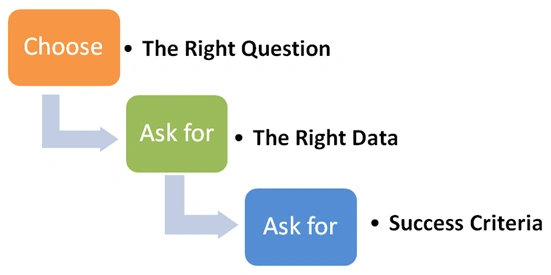 We might not have all this complete data, and we may also not get this data to some point. In that case, we should ask ourselves, do we have enough data to start or correct data at least. If we don’t have then we are not going to get the result or answer that we are looking for from the machine learning process. We also should then ask ourselves what would be the criteria to define success.
As at the end of the process we only get the model out of data that predicts and not exactly gives us the answer. So we should ask the question of how best those predictions should be so that the entire process could be tagged as a success. In the case of our example, if we find that we are sure about the fraud prediction in maybe 16 out of 20 cases, then is this fair enough? Or what about 14 out of 20 or should it be 18 out of 20? How do we decide this? Knowing correct answers to these questions is really important, as without it we won’t get the desired result and would never know that the process is complete and we are done with getting actual predictive model.
Machine Learning: Process
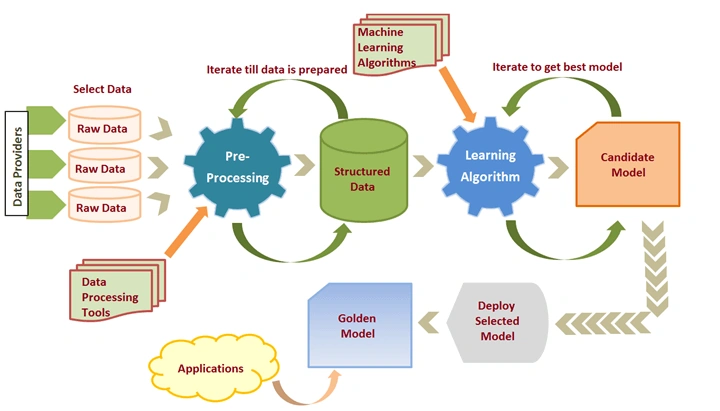
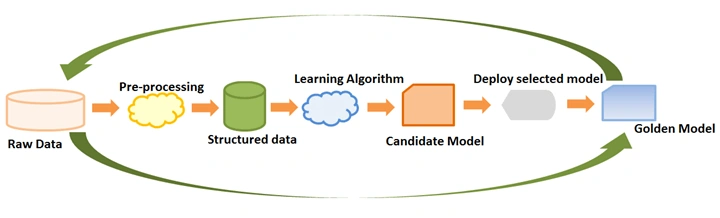
If we go into the details of the machine learning process, firstly we identify, choose and get the data that we want to work with. For our example, we would often need to work with the domain experts in this area that are people who know a lot about fraudulent transactions or we would work with these people for the actual problem that we need to solve. These people being experts know that what data or data model that we get from the process is predictive. But since the data with which we start is raw and unstructured data is never in the correct form as needed for actual processing. It could have duplicate data or the data that is missing, it could have lots of extra data that is not needed.
The data could be formed from various sources which may also eventually end up being duplicate or redundant data. In this case, there comes the requirement for pre-processing the data so that the process could understand the data, and the good thing is that the machine learning products usually provide some data pre-processing modules to process the raw or unstructured data. For e.g. in Capital markets there is always a need of price predictions for instruments or equities/assets and an algorithm is applied to the huge amount of unstructured data coming from various feed providers, in that case, multiple feed providers could provide the same data or some feed providers may provide the missing data and some the complete data. So to apply the actual algorithm to the data, we need to have that complete unstructured data into a structured and shaped data for which a process of pre-massaging is required, through which the data is passed and we get a candidate copy of data which could be processed through the algorithm to get the actual golden copy.
Ramzanali MominPosted Oct 7, 2018, 11:35 PM
Good Article
Mukesh ShahPosted Jun 1, 2017, 12:16 PM
Nice article ......................