

Artificial Intelligence is no longer just generating content, writing code, or answering questions. A much bigger shift is quietly happening, one that may fundamentally change how software interacts with the economy.
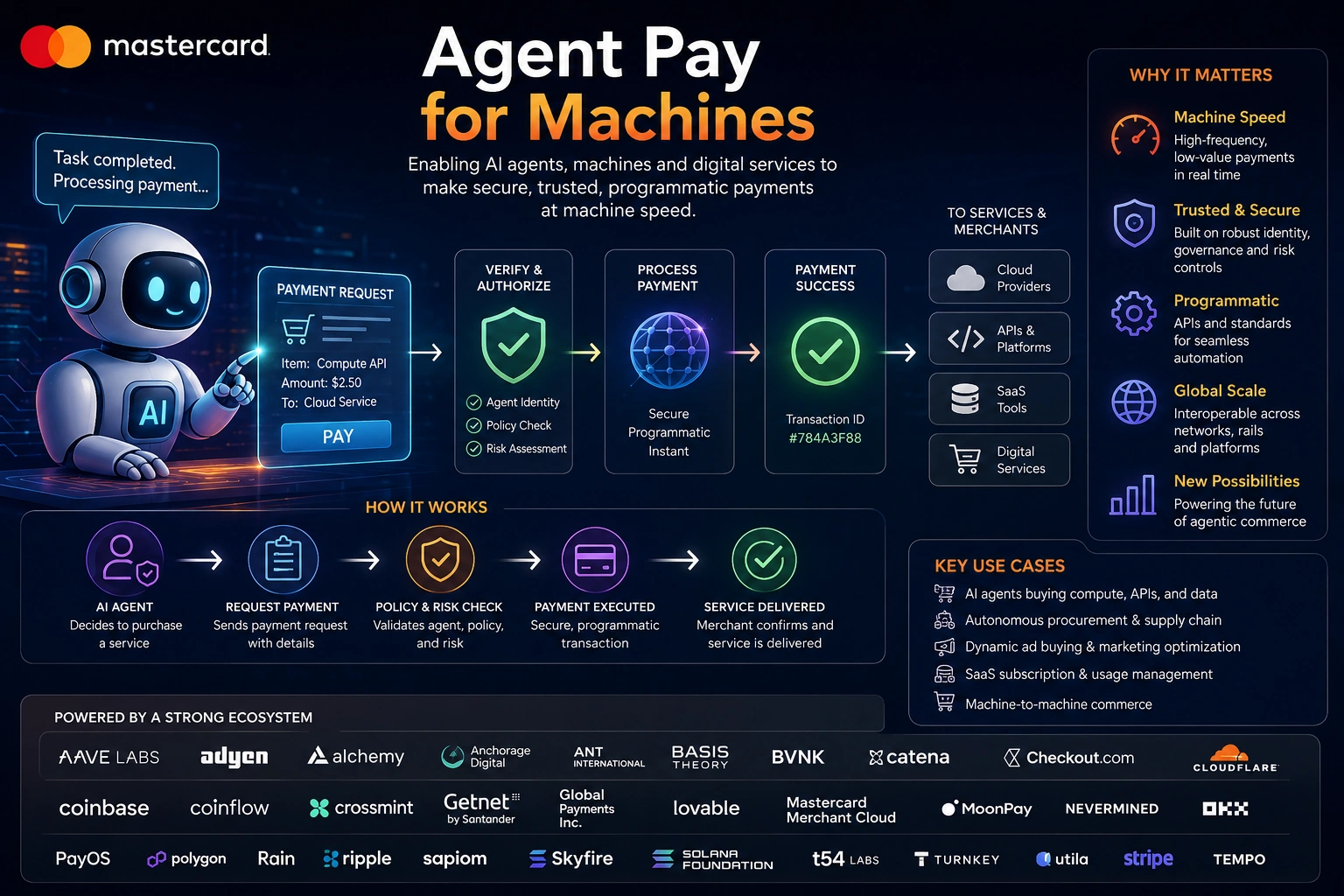
Recently, Mastercard announced “Agent Pay for Machines”, a new initiative designed to allow AI agents, machines, and digital services to make secure, trusted, programmatic payments at machine speed. On the surface, this may sound like just another fintech announcement, but if you look deeper, this could mark the beginning of a completely new economic model where software becomes an active financial participant.
In simple words, we are moving from AI that assists humans to AI that transacts on behalf of humans.
And that changes everything.
From Prompts to Payments
For the last two years, AI has mostly been about prompts.
We ask ChatGPT questions, use Claude to summarize research, let Copilot generate code, and increasingly rely on AI assistants to help us make decisions.
But what happens when an AI agent no longer just gives advice and instead actually executes actions?
Imagine an AI agent saying:
"I found a better hosting provider, migrated your workloads, canceled the old subscription, negotiated pricing, and paid the invoice."
No human clicked a button.
No employee processed procurement.
No finance person manually approved a payment.
The AI handled everything within rules you previously defined.
This is the world Mastercard appears to be preparing for.
AI agents are evolving from assistants into economic actors.
What Is Mastercard Agent Pay for Machines?
At a high level, Mastercard’s Agent Pay for Machines creates trusted payment rails that allow AI agents, machines, and digital services to perform high-frequency, low-value financial transactions securely and autonomously.
Think of it as giving AI agents a secure financial identity and permission system.
Instead of requiring humans to manually approve every small payment, the system allows intelligent software to transact within defined limits, policies, and trust frameworks.
This matters because AI systems increasingly need to:
Pay for APIs
Purchase compute resources
Subscribe to SaaS tools
Execute business purchases
Buy digital services
Handle machine-to-machine transactions
Today, most of these interactions still depend on humans being somewhere in the approval chain.
That model does not scale.
If AI agents are expected to work at machine speed, payments also need to operate at machine speed.
What Is Agentic Commerce?
A new term is emerging: Agentic Commerce.
This simply means commerce executed by autonomous software agents.
Instead of humans opening browsers, comparing vendors, entering credit cards, and clicking checkout buttons, AI agents will increasingly do these tasks automatically.
Think about where this could go.
1. AI Software Engineers
Imagine an AI coding platform building an application.
During the process it may decide:
Buy additional cloud credits
Subscribe to a testing API
Purchase monitoring tools
Pay for premium documentation access
The AI does not ask permission every five minutes.
Instead, it operates inside predefined spending limits and security policies.
This is particularly interesting for platforms building AI-native developer ecosystems.
2. Enterprise Procurement
Large enterprises spend enormous amounts of time on procurement.
An AI procurement agent could:
Compare vendors
Negotiate pricing
Validate contracts
Select suppliers
Make approved payments
Instead of weeks, procurement could happen in minutes.
3. Healthcare Systems
Healthcare operations are full of administrative friction.
Imagine AI agents:
Scheduling medical services
Paying verified vendors
Ordering supplies automatically
Managing recurring healthcare infrastructure subscriptions
The operational efficiency gains could be enormous.
4. Marketing and Advertising
AI marketing agents may soon:
Purchase ad inventory
Optimize budgets in real time
Switch vendors automatically
Negotiate better performance pricing
Instead of monthly media buying cycles, optimization could happen every second.
5. Autonomous Finance Teams
AI finance agents could monitor SaaS spending and decide:
"This subscription is overpriced. I found a comparable service that saves 35%, migration completed, payment updated."
That sounds futuristic, but much of the technology already exists.
The missing piece has been trusted payment infrastructure.
Why Traditional Payment Systems Don’t Work for AI Agents
Current payment systems were designed for humans.
Humans authenticate.
Humans approve.
Humans enter payment information.
Humans click buttons.
AI agents break this model.
Here are some major limitations:
Human Dependency
Traditional workflows assume a human is always involved.
AI automation becomes slow if humans must approve every microtransaction.
High Transaction Friction
Many AI transactions are low-value but high-frequency.
For example:
$0.20 API calls
$3 compute usage
$5 cloud storage increases
$8 software add-ons
Humans cannot realistically manage thousands of tiny approvals daily.
Lack of Identity
How do you trust an AI agent?
Who owns it?
Who is accountable if something goes wrong?
Without trusted identity systems, autonomous payments become risky.
Security Risks
Giving an AI unrestricted financial access sounds dangerous.
And frankly, it is.
That is why governance becomes critical.
How AI Agent Payments Will Likely Work
While details will evolve, most secure AI payment systems will require several architectural layers.
1. Agent Identity Layer
Every AI agent will need a verifiable identity.
Think of this like a digital passport.
Questions systems must answer:
Who owns the agent?
What organization authorized it?
What permissions does it have?
What risks are allowed?
Without identity, trust collapses.
2. Wallet or Payment Layer
Agents need controlled access to funds.
This may include:
Payment tokens
Virtual cards
Enterprise wallets
Stablecoins
Escrow systems
Many companies will likely prefer programmable payment accounts with policy controls.
3. Policy Engine
No enterprise will allow unlimited autonomous spending.
Instead, rules will define behavior:
Allowed vendors: Microsoft, AWS, Stripe only
Monthly budget: $2,000
Single transaction limit: $50
Human approval required: Any transaction above $500
This creates guardrails for autonomous systems.
4. Trust and Verification
AI systems will likely require:
Identity verification
Vendor reputation checks
Fraud detection
Behavioral analysis
Compliance validation
Before money moves.
5. Auditability
Every decision must be explainable.
Enterprises will ask:
"Why did this AI spend $8,400 yesterday?"
The system must provide a full audit trail.
Why Crypto and Blockchain Partners Matter
One interesting aspect of Mastercard’s announcement is the broad ecosystem of partners involved, including organizations across payments, crypto, blockchain, and infrastructure.
Partners connected to ecosystems like Polygon, Ripple, Solana, Coinbase, MoonPay, and OKX suggest that programmable digital assets may play an important role in the future of machine-to-machine payments.
Why?
Because traditional banking infrastructure was never designed for:
24/7 programmable payments
Global instant settlement
Microtransactions
Autonomous commerce
Machine-speed execution
Blockchain-based systems offer advantages such as:
Programmability
Payments can execute automatically when conditions are met.
Transparency
Every transaction can be tracked and audited.
Global Reach
AI systems can transact globally without traditional banking barriers.
Microtransactions
Very small payments become economically feasible.
This does not necessarily mean crypto replaces traditional finance.
More likely, we will see hybrid systems where traditional payment rails and blockchain infrastructure coexist.
The Security Problem Nobody Is Talking About
Here is where things get interesting.
AI making payments sounds exciting, but it also creates entirely new attack surfaces.
Prompt Injection Attacks
Imagine a malicious webpage manipulating an AI agent into making unauthorized purchases.
This is already becoming a real concern in AI security.
Rogue Agents
What happens if an AI behaves unexpectedly?
Bad decisions at machine speed can become very expensive.
Vendor Spoofing
Attackers may impersonate trusted vendors.
AI agents could accidentally pay fraudulent services.
Budget Abuse
Without governance, AI spending could spiral out of control.
An aggressive optimization agent may over-purchase resources.
Compliance Risks
Industries like healthcare and finance face strict regulations.
AI agents handling payments will require deep compliance controls.
This is where human oversight will remain important.
The future is likely human-supervised autonomy, not fully unrestricted autonomy.
What Developers Should Start Building Today
If you are a developer, architect, or founder, this trend matters more than it appears.
We are likely entering an era where applications are no longer just software.
They become autonomous workers.
Developers should begin thinking about:
AI identity systems
Permission-based agents
Spend governance
Agent wallets
Audit systems
Secure payment APIs
Human approval workflows
The biggest winners in the next wave of AI may not just build smarter models.
They will build trusted autonomous systems.
The Bigger Picture: Software Is Becoming Economic
For decades, software has been passive.
Humans made decisions.
Software executed instructions.
AI flips this model.
Software will increasingly:
Make recommendations
Negotiate contracts
Compare vendors
Purchase services
Execute transactions
Optimize spending
In other words, software is becoming economic.
Mastercard’s Agent Pay for Machines may ultimately be remembered as one of the early signals that AI agents were no longer simply assistants, they had started becoming participants in the economy.
The future may not be humans using apps.
The future may be AI agents using other services, tools, and financial systems on behalf of humans, securely, autonomously, and at machine speed.
And if that happens, payments infrastructure will need to evolve just as dramatically as AI itself.
Join the conversation! Your thoughts help the community grow.