

As enterprise applications transition from basic chatbots into autonomous AI systems, managing state and context across complex, multi-step workflows has emerged as a core software engineering challenge. Unlike stateless API interactions or simple chat interfaces that lose coherence as conversations grow, enterprise-grade agents must reliably track information across distributed microservices, long-running business processes, and disparate data silos.
For developers building next-generation software, mastering context management architectures—and the orchestration frameworks like LangChain designed to handle them—is crucial for moving AI projects from prototype to production.
1. The Core Architecture of Enterprise Context Management
In an enterprise environment, a single user request or automated event often triggers a cascade of sub-tasks. AI agents maintain context across these complex execution chains using a layered memory hierarchy:
In-Context Working Scratchpads (Short-Term Memory): Operating directly within the model's active context window, this layer manages immediate task execution logs, active tool parameters, and short-term reasoning loops (often implemented using patterns like ReAct: Reasoning + Acting).
Vector and Knowledge Graph Memory (Long-Term Memory): External databases preserve persistent domain knowledge and historical interactions. Vector databases (e.g., Pinecone, Qdrant) store semantic embeddings for fast similarity retrieval, while Knowledge Graphs (e.g., Neo4j) track explicit relationships between business entities (such as mapping a customer ID across billing and support systems).
Stateful Execution Graphs (Persistent Working Memory): Orchestration frameworks save agent execution states into persistent key-value or relational stores (such as Redis or PostgreSQL). If an agent loop pauses—whether waiting for asynchronous webhook responses or requiring human-in-the-loop sign-off—the full state tree is frozen and can be resumed without losing operational history.
2. What is LangChain and Why Use It?
LangChain is an open-source orchestration framework that provides a unified abstraction layer for building context-aware, model-driven applications. Instead of writing custom integration code for every vendor SDK or manually managing prompt strings and parsing logic, LangChain standardizes the plumbing required to build robust AI agents.
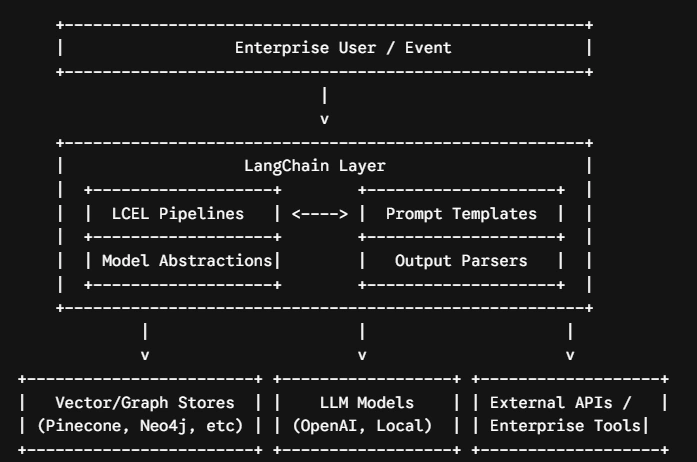
Key Components & Developer Benefits
Unified Model Abstraction: Interchange underlying LLM providers (e.g., swapping OpenAI for Anthropic or self-hosted open-source models via Ollama) through standard interfaces without refactoring core application logic.
LangChain Expression Language (LCEL): A declarative syntax engineered for production deployment. LCEL natively supports parallel execution, automatic retries, streaming responses, and async calls out of the box.
Advanced Retrieval-Augmented Generation (RAG): Built-in primitives for loading unstructured documents, optimizing chunking strategies, generating vector embeddings, and executing complex hybrid search algorithms.
LangGraph for Complex Workflows: An extension of the ecosystem built specifically for stateful, multi-actor agent loops. LangGraph allows developers to define explicit, cyclic graph structures with built-in checkpointing, fault tolerance, and human approval steps.
Observability via LangSmith: Seamless integration with monitoring tools to trace execution paths, inspect intermediate prompt-response cycles, measure token consumption, and evaluate model outputs against test sets.
3. Practical Steps for AI Developers
To leverage these technologies effectively in an enterprise context, engineers should focus on key implementation patterns:
Implement Hybrid Retrieval: Move beyond basic vector similarity searches by combining dense semantic embeddings with sparse keyword matching (BM25) and contextual reranking to improve context retrieval accuracy.
Shift to Graph-Based State Management: Utilize LangGraph to build complex agentic architectures that require loops, conditionals, and persistent multi-turn conversations rather than linear pipelines.
Establish Rigorous Tracing: Integrate tools like LangSmith early in the development lifecycle to debug agent reasoning failures, optimize token costs, and track latency bottlenecks across production workflows.
Summary
For software engineers entering the AI space, learning LangChain means moving beyond simple prompt engineering. By mastering memory architectures, state graph management, and observability tools, developers can build reliable, scalable AI systems capable of executing complex enterprise workflows without losing context.
Join the conversation! Your thoughts help the community grow.