
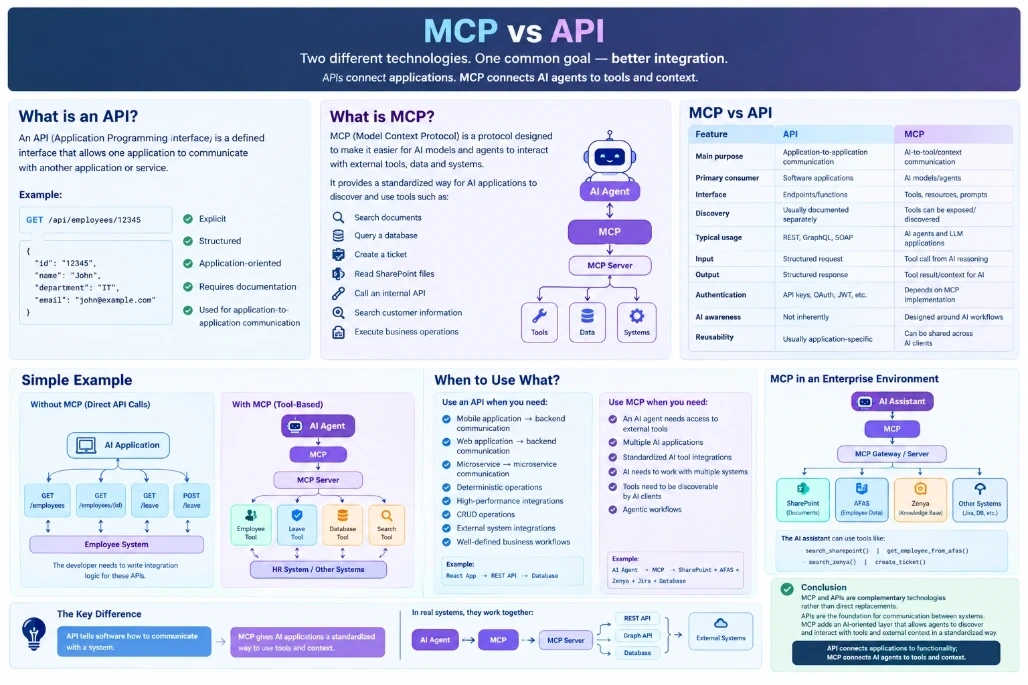
What is an API?
An API (Application Programming Interface) is a defined interface that allows one application to communicate with another application or service.
For example, suppose an employee application needs employee information from an HR system. The application might call:
GET /api/employees/12345
The API could return:
{
  "id": "12345",
  "name": "John",
  "department": "IT",
  "email": "[email protected]"
}
The application knows:
Which endpoint to call
Which parameters to send
What authentication is required
What response format to expect
APIs are therefore explicit, structured, and application-oriented.
What is MCP?
MCP (Model Context Protocol) is a protocol designed to make it easier for AI models and agents to interact with external tools, data, and systems.
Instead of an AI application having to implement every integration itself, an MCP server can expose capabilities such as:
Search documents
Query a database
Create a ticket
Read SharePoint files
Call an internal API
Search customer information
Execute business operations
An AI agent can discover these tools and use them based on the task it is trying to accomplish.
A simplified example:
AI Agent
   |
   | MCP
   ↓
MCP Server
   |
   ├── Search Documents
   ├── Query Database
   ├── Create Ticket
   └── Get Employee Information
The important difference is that MCP provides a standardized way for AI applications to discover and use tools, while an API generally exposes functionality directly to software clients.
MCP vs API
Feature | API | MCP |
|---|---|---|
Main purpose | Application-to-application communication | AI-to-tool/context communication |
Primary consumer | Software applications | AI models/agents |
Interface | Endpoints/functions | Tools, resources, prompts |
Discovery | Usually documented separately | Tools can be exposed/discovered |
Typical usage | REST, GraphQL, SOAP | AI agents and LLM applications |
Input | Structured request | Tool call generated from AI reasoning |
Output | Structured response | Tool result/context for AI |
Authentication | API keys, OAuth, JWT, etc. | Depends on MCP implementation |
AI awareness | Not inherently | Designed around AI workflows |
Reusability | Usually application-specific | Can be shared across AI clients |
Simple Example
Imagine you have an Employee Management System.
Without MCP
Your AI application may directly call several APIs:
AI Application
      |
      ├── GET /employees
      ├── GET /employees/{id}
      ├── GET /leave
      └── POST /leave
The developer needs to write integration logic for these APIs.
With MCP
You could create an MCP server:
                 AI Agent
                    |
                   MCP
                    |
              MCP Server
             /     |      \
            /      |       \
     Employee   Leave    Database
       Tool      Tool       Tool
The MCP server might expose:
get_employee()
get_leave_balance()
request_leave()
search_employee()
The AI can then decide which tool is relevant to the user's request.
For example:
"How many leaves does John have remaining?"
The agent could determine:
User Request
     ↓
AI Agent
     ↓
get_leave_balance()
     ↓
MCP Server
     ↓
HR System API
     ↓
Leave Balance
     ↓
AI Agent
     ↓
Response to User
MCP Does Not Replace APIs
This is one of the most important points.
MCP and APIs are not necessarily competitors.
In many architectures, MCP sits on top of existing APIs.
For example:
              AI Agent
                  |
                  | MCP
                  ↓
             MCP Server
                  |
                  | REST API
                  ↓
          Employee System
The MCP server can internally call an existing REST API.
So you don't necessarily need to replace your existing APIs.
Instead:
API = How systems communicate
MCP = How AI applications can discover and use tools/context
Why MCP Is Useful for AI Agents
Traditional APIs generally require developers to explicitly program the integration.
For example:
response = requests.get(
    "https://company.com/api/employees/123"
)
The developer decides:
Which API to call
Which endpoint
Which parameters
How to process the response
With an MCP-based architecture, the AI application can be given tools such as:
get_employee
search_employee
get_department
get_leave_balance
The agent can select the appropriate tool based on the user's request.
This becomes especially useful when an AI agent needs access to many different systems.
MCP in an Enterprise Environment
Consider a company with:
                 AI Assistant
                      |
                     MCP
                      |
              MCP Gateway/Server
                      |
       ┌──────────────┼──────────────┐
       ↓              ↓              ↓
    SharePoint       AFAS          Zenya
       |              |              |
    Documents      Employee       Knowledge
                    Data           Base
The AI assistant could potentially have tools like:
search_sharepoint()
get_employee_from_afas()
search_zenya()
create_ticket()
The underlying systems can continue using their existing APIs.
This makes MCP particularly interesting for enterprise AI agents and agentic automation.
MCP vs Direct API Integration
Direct API
User
 ↓
Application
 ↓
Developer-defined API call
 ↓
Backend
 ↓
Response
This is highly predictable and is often the right choice for normal application functionality.
MCP
User
 ↓
AI Agent
 ↓
Tool selection
 ↓
MCP
 ↓
External system
 ↓
Tool result
 ↓
AI Agent
 ↓
User
This is useful when the system needs to determine which tool to use based on natural-language instructions.
When Should You Use an API?
Use an API when you need:
Mobile application → backend communication
Web application → backend communication
Microservice → microservice communication
Deterministic operations
High-performance integrations
CRUD operations
External system integrations
Well-defined business workflows
For example:
React App → REST API → Database
An API is usually the natural choice here.
When Should You Use MCP?
MCP becomes useful when:
An AI agent needs access to external tools
You have multiple AI applications
You want standardized AI tool integrations
The AI needs to work with multiple systems
Tools need to be discoverable by AI clients
You are building agentic workflows
For example:
AI Agent
   ↓
MCP
   ↓
SharePoint + AFAS + Zenya + Jira + Database
The Key Difference
A simple way to remember it is:
API tells software how to communicate with a system.
MCP gives AI applications a standardized way to use tools and access context.
And in real systems, they can work together:
                 AI Agent
                    │
                    │ MCP
                    ↓
              MCP Server
                    │
          ┌─────────┼─────────┐
          ↓         ↓         ↓
       REST API   Graph API  Database
          ↓         ↓         ↓
       System A  System B  System C
Conclusion
MCP and APIs should generally be viewed as complementary technologies rather than direct replacements.
APIs remain the foundation for communication between software systems. MCP adds an AI-oriented layer that allows agents to discover and interact with tools and external context in a standardized way.
For traditional applications, APIs are usually sufficient. For systems where an AI agent needs to reason about tasks and interact with many tools, MCP can provide a more suitable integration layer.
In one sentence:
API connects applications to functionality; MCP connects AI agents to tools and context.
Join the conversation! Your thoughts help the community grow.