

When people talk about "Cloud Computing" and "Cloud Computing Service Providers" (e.g. Microsoft Azure – Cloud Computing Platform by Microsoft), the first thing they are asking and talking about is the security of Cloud. Various layers of security are provided by Clouds like Azure to the customers. Azure Platform offers customer defined features also.
DDOS Protection - Distributed Denial of Service Protection against DDOS Attacks.
Public IP Addresses and Ports are also safe because the endpoint uses NAT - Network Address Translation to route user request to the internal port and IP address
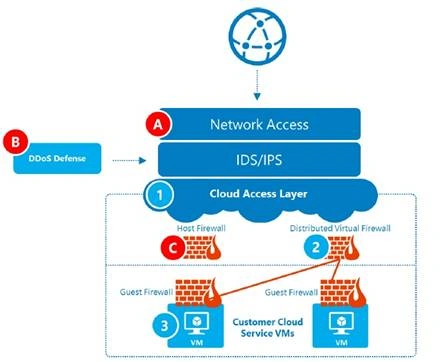
In Azure, Traffic Isolation is also there. Example - If we are creating Azure VNET in the same data center, they can't communicate to each other until you configure some hybrid Network Connectivity like Site to Site connectivity or VNET Peering between the two virtual networks you created in Azure VNET, because Azure Site to Site connectivity uses IPSec Protocol.
In Azure NSG
You can associate Network Security Rules with VNET / Subnet or NICs of your Virtual Networks. NSGs are collection of ACLs where you can create in-bound and out-bound rules to allow or deny. In one NSG, you can create 200 rules and in normal Azure subscription, you can create 100 NSGs to in-bound and out-bound your traffic. In Azure, user can define the User Defined Routes (UDR) to define his / her own traffic using Firewall etc. Using Routing Tables in Azure, you can force the subnet traffic to pass through the firewall, IDS or IPS devices. Your subnet has internet connectivity by default, but using NIC and NSG and Routing Table, you can route them via secure gateway to come into your subnet.
Along with that, Microsoft Azure offers Security Appliance Functionality like Firewall, Threat Detection and prevention, Auditing andLogging, Reverse Proxy and Forward Proxy, VPN Devices.
Join the conversation! Your thoughts help the community grow.