

Introduction
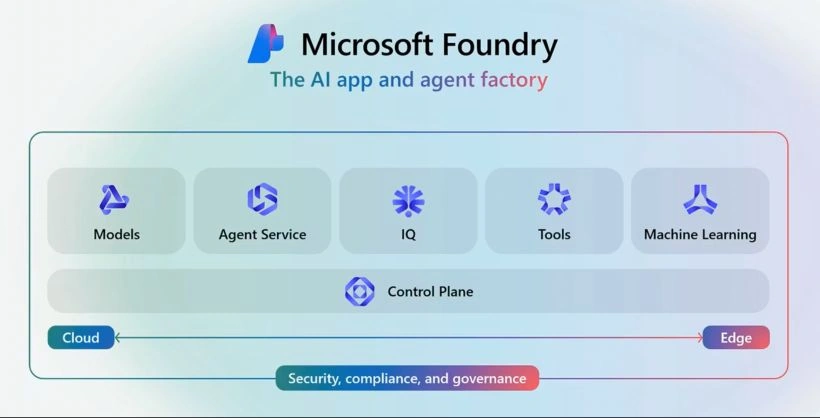
Unveiled at Microsoft Ignite 2025, Microsoft Foundry brings together models, tools, and expertise into a unified open platform, enabling organizations to deploy high-performance agent fleets and intelligent workflows across the enterprise. In this article, we will explore the core components of Microsoft Foundry, focusing on its four major capabilities: Models, Agents, IQ, and the Control Plane.
The journey from Azure AI Studio, through Azure AI Foundry, to Microsoft Foundry
Microsoft’s response to this transformation is Microsoft Foundry a platform that has evolved from Azure AI Studio to Azure AI Foundry, and ultimately into a fully integrated enterprise AI environment in 2025. This progression mirrors the platform’s own growth: it started as a hub for model experimentation, expanded into a space for building AI applications, and has now become a true AI factory a unified environment where ideas move seamlessly from experimentation to production without relying on multiple disconnected tools and systems.
The Four Foundational Pillars of the AI Factory
At the core of Foundry are four key capabilities Models, Agents, IQ, and the Control Plane. These aren’t isolated services; they function as four interconnected assembly lines within a single unified factory.
Foundry Models: The Unified Intelligent Model Catalog
The model catalog in Microsoft Foundry serves as a centralized repository where you can explore and choose the ideal language model for your generative AI scenario. It all begins with Foundry Models—a unified hub that gives organizations access to a wide range of models from providers such as OpenAI, Anthropic, Cohere, and NVIDIA, as well as Microsoft’s own Phi family.
Tools
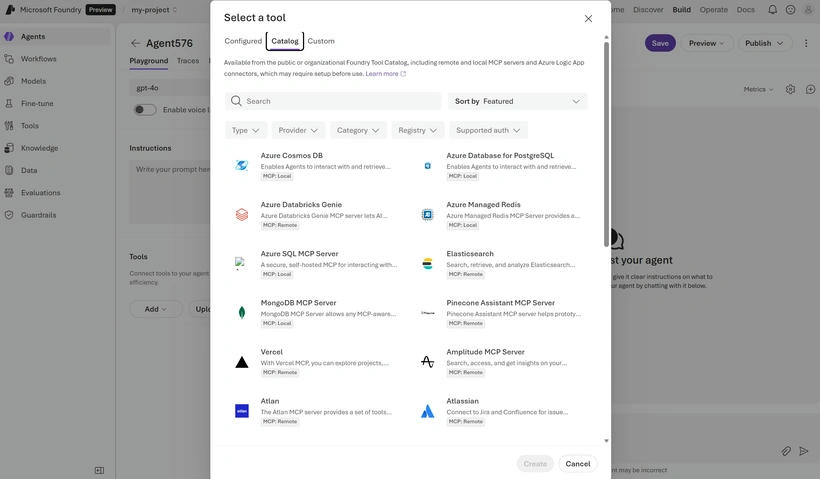
Microsoft has expanded MCP tooling to include dozens of integrations across Azure services—such as Cosmos DB, Databricks, and PostgreSQL—as well as popular third-party platforms like Stripe, Atlassian, and Supabase. They’ve also added support for Logic Apps connectors, giving AI agents access to nearly 1,400 additional services and platforms.
Foundry Agent Service
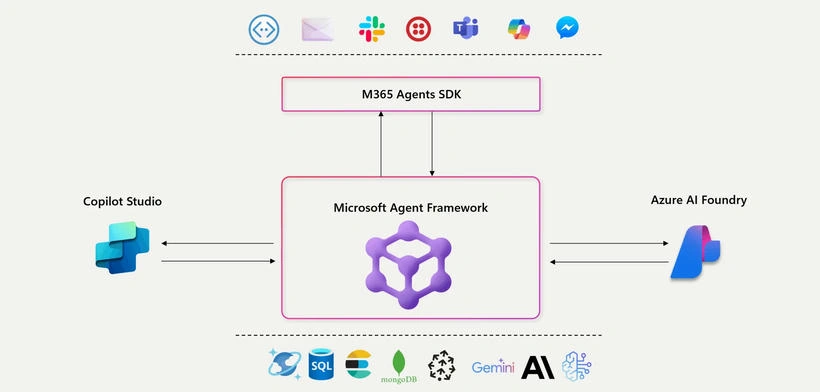
The Foundry Agent Service brings together the essential components of Foundry—models, tools, and frameworks—into a unified runtime. It handles conversations, coordinates tool calls, applies content safety, and connects with identity, networking, and observability systems to ensure agents are secure, scalable, and ready for production.
By removing infrastructure complexity and embedding trust and safety from the start, the Foundry Agent Service enables teams to transition from prototype to production with ease and confidence.
Microsoft Agent Framework
The Microsoft Agent Framework addresses a major challenge for developers: having to choose between the latest AI innovations and reliable, production-grade tooling. As an open-source initiative, Microsoft has released the Microsoft Agent Framework, enabling developers to build, orchestrate, and deploy agents using either Python or .NET. It merges the strengths of two powerful frameworks:
AutoGen: Delivers advanced multi-agent orchestration, enabling AI agents to collaborate in sophisticated ways—such as group discussions and debate-style reasoning.
Semantic Kernel: Provides the enterprise foundation with built-in security, type safety, and telemetry.
Foundry IQ: The Knowledge layer for Agents
Foundry IQ serves as the unified knowledge layer within Microsoft Foundry, delivering enterprise context to all agents through Azure AI Search. And there’s even better news it is now part of Microsoft Foundry’s new context engineering foundation.
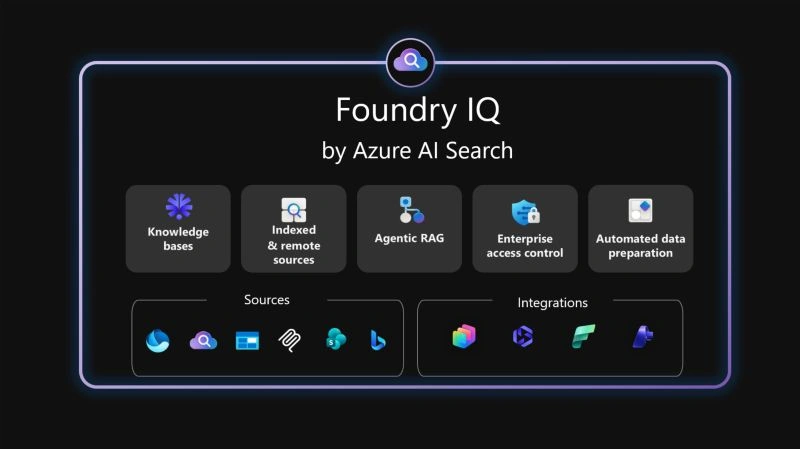
The updated Azure AI Search enhances its agentic retrieval capabilities with features such as unified search across all content from a single entry point, federated sources like web grounding to enrich private data, self-reflective search, adjustable latency–quality trade-offs, and high-quality answer generation. Developers can now configure and register a single knowledge base as a “super tool,” giving agents streamlined access to multiple knowledge sources. This dramatically reduces development complexity and cleanly separates the challenges of knowledge acquisition (the knowledge base) from knowledge utilization (the agent).
Foundry Control Plane
The Microsoft Foundry Control Plane is a unified management interface that delivers full visibility, governance, and control over all your agents, models, and tools across the Foundry ecosystem. It acts as the central hub for overseeing every stage of your AI operations—from development through production.
As organizations shift from individual copilots to autonomous multi-agent systems, unified oversight becomes essential. The Foundry Control Plane provides the visibility, governance, and operational control required to scale responsibly and confidently.
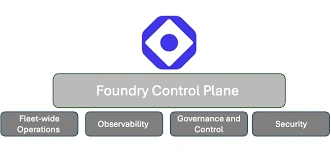
With the Foundry Control Plane, you can:
Access a consolidated view of all Foundry, Microsoft, and third-party agents in one place.
Monitor, analyze, and optimize agent performance, cost, quality, and compliance.
Enforce deterministic guardrails and policies to ensure safety, compliance, and consistent operations.
Visualize resource usage, identify anomalies, and fine-tune agent configurations to reduce costs without sacrificing reliability.
Key Features of Foundry Control Plane
The Foundry Control Plane brings together inventory, observability, compliance, and security into a single, role-aware interface. It seamlessly integrates with Microsoft security and governance tools such as Defender, Purview, and Microsoft Entra to provide scalable, trusted operations.
Summary
Microsoft Foundry revolutionizes enterprise AI by bringing together models, agents, knowledge, and management within a single, unified platform. Its four core pillars—Models, Agents, IQ, and the Control Plane—work in harmony to streamline development, strengthen governance, and speed the transition from experimentation to production. With Foundry, organizations can confidently scale intelligent workflows and agent fleets, establishing a new standard for enterprise AI innovation.
Thank you for reading! Stay tuned for the next article.
Happy learning and happy reading!
Join the conversation! Your thoughts help the community grow.