

Introduction
ASP.NET Core has evolved significantly over the years. With the introduction of Minimal APIs in .NET 6, developers gained a lightweight way to build APIs with less boilerplate code. At the same time, Controllers (MVC/Web API controllers) remain a powerful and structured approach for building enterprise-grade applications.
This raises an important question:
Should you use Minimal APIs or Controllers in modern .NET applications?
The answer depends on your project size, complexity, and long-term goals.
In this article, we will explore:
What Minimal APIs are
What Controllers are
Key differences
Performance considerations
When to use each approach
Best practices
What Are Minimal APIs?
Minimal APIs allow developers to define HTTP endpoints with minimal configuration and setup.
They remove the need for:
Controllers
Attributes
Extensive configuration
Everything can be defined directly in Program.cs.
Minimal APIs are designed for:
Simplicity
Lightweight services
Microservices
Small APIs
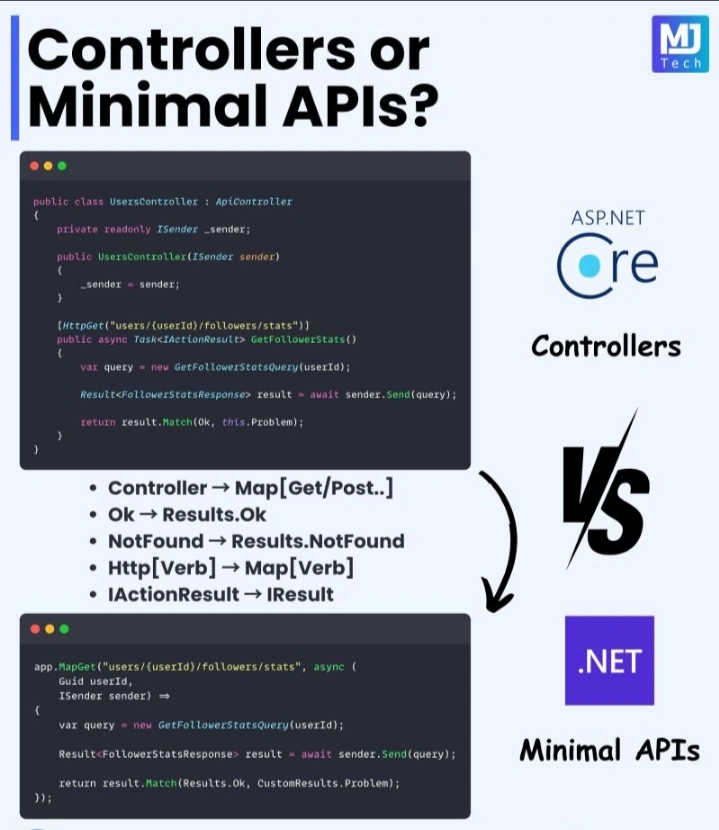
Example: Minimal API
var builder = WebApplication.CreateBuilder(args);
var app = builder.Build();

app.MapGet("/hello", () => "Hello World!");
app.Run();
Simple, clean, and minimal.
What Are Controllers?
Controllers are part of the traditional ASP.NET Core MVC architecture. They use classes and attributes to define endpoints and organize logic.
Controllers provide:
Clear separation of concerns
Structured routing
Filters
Model binding
Validation
Action results
Controllers are ideal for larger and more structured applications.
Example: Controller.
[ApiController]
[Route("api/[controller]")]
public class HelloController : ControllerBase

{
    [HttpGet]
    public IActionResult Get()
    {
        return Ok("Hello World!");
    }
}
More structured and scalable.
Key Differences Between Minimal APIs and Controllers
1. Boilerplate Code
Minimal APIs require less setup.
Controllers require attributes, base classes, and structure.
Minimal APIs win for simplicity.
2. Project Structure
Minimal APIs keep endpoints close to application startup.
Controllers organize endpoints into separate classes and folders.
Controllers are better for large projects.
3. Readability in Large Applications
Minimal APIs can become messy if many endpoints are defined in one place.
Controllers scale better because they organize logic into multiple classes.
4. Performance
Minimal APIs have slightly lower overhead because they avoid MVC pipeline complexity.
However, in real-world applications, the performance difference is usually small.
Performance should not be the only deciding factor.
5. Testing and Maintainability
Controllers provide better separation of concerns.
Minimal APIs can still be structured well, but require discipline.
For enterprise-level testing, Controllers are often easier to manage.
When to Use Minimal APIs
Minimal APIs are best when:
Building small services
Creating microservices
Rapid prototyping
Developing internal tools
Building lightweight APIs
They are simple, fast, and easy to write.
When to Use Controllers
Controllers are best when:
Building large enterprise applications
Needing advanced features like filters and model validation
Requiring structured architecture
Working in large teams
Maintaining long-term projects
Controllers provide better organization and scalability.
Real-World Recommendation
For small to medium APIs:
Minimal APIs are excellent.
For large-scale enterprise systems:
Controllers are safer and more maintainable.
Many teams even combine both approaches in the same application.
Modern Best Practices
In 2026, many developers use:
Minimal APIs for microservices
Controllers for monolithic enterprise systems
Vertical Slice Architecture with Minimal APIs
Clean Architecture with Controllers
The choice depends on complexity, not trend.
Conclusion
Minimal APIs and Controllers are both powerful tools in ASP.NET Core.
Minimal APIs offer simplicity, less boilerplate, and slightly better performance.
Controllers offer structure, maintainability, and enterprise-ready features.
There is no universal winner.
Choose Minimal APIs for simplicity and speed.
Choose Controllers for structure and scalability.
The best architecture is the one that fits your application’s needs — not the one that is trending.
Build smart. Choose wisely. 🚀
Join the conversation! Your thoughts help the community grow.