

Abstract / Overview
Mistral OCR 3 is the third-generation Optical Character Recognition system from Mistral AI, purpose-built to deliver high-accuracy text extraction and deep document understanding at scale. Unlike legacy OCR engines that focus primarily on raw text recognition, Mistral OCR 3 emphasizes structure, layout fidelity, and downstream usability, producing outputs such as markdown and JSON that preserve tables, forms, and semantic relationships.
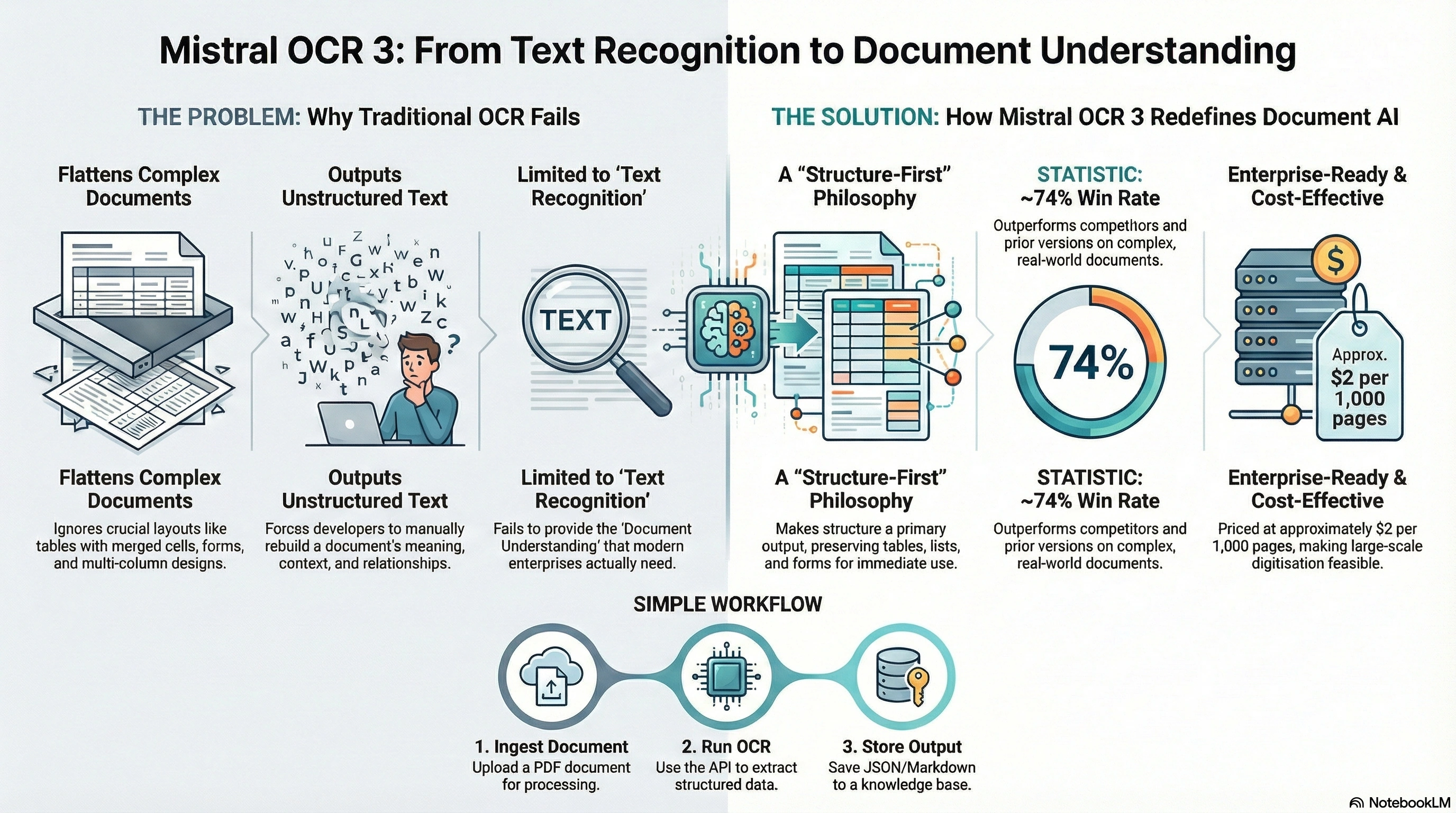
According to Mistral AI, OCR 3 demonstrates a ~74% win rate over competing solutions and prior versions across a wide range of real-world document categories, including scanned PDFs, invoices, complex tables, and handwritten text. With pricing positioned at approximately $2 per 1,000 pages, the model is designed to be both enterprise-grade and economically accessible, making large-scale document digitization feasible for organizations of all sizes.
Conceptual Background
The Problem With Traditional OCR
For decades, OCR systems have been optimized around one narrow goal: converting pixels into characters. While this approach works for clean, printed text, it breaks down when documents contain:
Complex tables with merged cells
Multi-column layouts
Forms with labels and values
Mixed fonts and low-quality scans
Handwritten annotations
Traditional OCR engines often flatten these documents into unstructured text, forcing developers to rebuild structure manually through brittle heuristics.
The Shift to Document Understanding
Modern enterprises do not need text alone. They need document understanding — the ability to extract meaning, structure, and context in a machine-consumable format. This shift mirrors the broader evolution in AI from narrow perception tasks to multimodal reasoning.
Mistral OCR 3 sits squarely in this new category. It treats documents as structured visual artifacts rather than simple images, enabling downstream systems to reason over documents with minimal post-processing.
What Is Mistral OCR 3?
Mistral OCR 3 is a proprietary vision-language model optimized for OCR and document layout understanding. It is exposed through a hosted API (mistral-ocr-2512) and an interactive playground, rather than as downloadable weights.
At a high level, OCR 3 combines:
Advanced visual perception for layout and typography
Language modeling for semantic coherence
Structural reconstruction for tables, lists, and forms
The result is an OCR system that outputs ready-to-use structured data, not just text blobs.
Step-by-Step Walkthrough: How Mistral OCR 3 Works
Input Normalization
Documents are ingested as images or PDFs. OCR 3 performs normalization steps such as orientation correction, noise reduction, and contrast enhancement to stabilize recognition across inconsistent scans.
Visual Layout Analysis
Before reading the text, the model identifies layout primitives:
Text blocks
Headers and footers
Tables and grids
Images and embedded figures
This layout-first approach allows OCR 3 to understand where content lives before deciding what it says.
Text Recognition and Semantic Alignment
Characters and words are recognized within their layout context. The model aligns textual content with its surrounding structure, preventing common errors such as table rows being read out of order.
Structured Reconstruction
Instead of emitting plain text, OCR 3 reconstructs document elements:
Tables are output with rows, columns, and spans
Forms preserve label-value relationships
Lists and headings maintain hierarchy
Output Generation
Outputs can include:
Plain text for lightweight use cases
Markdown with embedded tables and references
JSON for programmatic pipelines and analytics
This structured output significantly reduces downstream engineering effort.
Key Capabilities and Differentiators
Accuracy Across Real-World Documents
Mistral reports that OCR 3 outperforms prior versions and many competitors across categories such as:
Low-quality scans
Dense tables
Handwritten notes
Financial and legal documents
This robustness is critical for enterprise environments where document quality varies widely.
Structure-First Output Philosophy
Many OCR systems treat structure as an afterthought. OCR 3 makes structure a first-class output, which aligns well with modern data pipelines, analytics platforms, and retrieval-augmented generation (RAG) systems.
Cost Efficiency
At approximately $2 per 1,000 pages, OCR 3 undercuts many traditional enterprise OCR solutions while delivering stronger results. This pricing enables use cases that were previously cost-prohibitive, such as digitizing entire historical archives.
Developer-Friendly Integration
OCR 3 is exposed via a clean API and supports batch processing. Outputs are designed to plug directly into downstream systems without extensive transformation.
Sample Workflow JSON
A simplified example of a document processing workflow using OCR 3:
{
  "workflow": "document_ingestion",
  "steps": [
    {
      "step": "upload_document",
      "format": "pdf"
    },
    {
      "step": "run_ocr",
      "model": "mistral-ocr-2512",
      "output": ["markdown", "json"]
    },
    {
      "step": "store_output",
      "destination": "document_knowledge_base"
    }
  ]
}
This pattern is commonly used for compliance archives, searchable knowledge systems, and AI assistants.
Use Cases / Scenarios
1. Enterprise Knowledge Management
Organizations can convert decades of internal documentation into structured, searchable knowledge bases that power internal AI assistants.
2. Financial and Legal Document Processing
Invoices, contracts, and regulatory filings benefit from accurate table extraction and layout preservation, reducing manual review costs.
3. RAG Pipelines for AI Assistants
OCR 3 outputs integrate cleanly into vector databases and retrieval pipelines, improving answer quality by preserving document structure.
4. Public Sector and Archival Digitization
Governments and libraries can digitize historical records at scale while retaining document fidelity.
5. Customer Support Automation
Policy manuals and product documentation become machine-readable, enabling AI-driven support workflows.
Benchmark Context and Industry Comparison
While Mistral does not publish full benchmark datasets, it reports a ~74% win rate across internal and third-party evaluations against competing OCR systems. This figure is notable because it reflects performance on complex documents, not just clean text.
Industry analysts increasingly distinguish between:
Character accuracy (traditional OCR metric)
Structural accuracy (modern document AI metric)
OCR 3 is optimized for the latter, which aligns more closely with real enterprise needs.
Limitations and Considerations
OCR 3 is available as a hosted service, which may be a constraint for organizations requiring fully on-premise processing.
Extremely degraded handwriting or exotic scripts may still require human validation.
As with all document AI systems, sensitive data handling requires careful compliance and governance controls.
Future Enhancements and Roadmap Signals
Based on Mistral’s broader product trajectory, likely future enhancements include:
Expanded multilingual coverage
Tighter integration with large language models for end-to-end document Q&A
More granular layout annotations
Enhanced support for diagrams and charts
These developments would further position OCR 3 as a core building block for enterprise AI systems.
FAQs
Is Mistral OCR 3 suitable for large-scale enterprise use?
Yes. It is designed for high-volume processing with competitive pricing and structured outputs.Does OCR 3 support tables and forms?
Yes. Table and form reconstruction is a core strength of the model.How does OCR 3 differ from classic OCR APIs?
Classic OCR focuses on text. OCR 3 focuses on document understanding, preserving layout and semantics.Can OCR 3 feed AI assistants directly?
Yes. Its structured JSON outputs are well-suited for RAG and conversational AI systems.
Conclusion
Mistral OCR 3 represents a meaningful shift from text-centric OCR toward structure-aware document intelligence. By combining high accuracy, layout preservation, structured outputs, and accessible pricing, it addresses long-standing pain points in enterprise document processing.
For organizations seeking to unlock value from large document repositories — whether for compliance, analytics, or AI-driven knowledge systems — OCR 3 offers a modern, scalable foundation aligned with the future of document AI.
Join the conversation! Your thoughts help the community grow.