

Pre-requisite to Understand This
Before diving in, it helps to have basic knowledge of:
Client and server architecture
HTTP/HTTPS request–response flow
Microservices vs monolithic applications
Containers (Docker) and orchestration basics (Kubernetes)
Networking concepts (DNS, ports, IPs)
If we understand “a client sends a request and a backend processes it”, we are good to proceed.
Introduction
In modern cloud-native and microservices-based deployments, applications are no longer hosted on a single server. Instead, they run across multiple services, containers, and nodes that must be accessed reliably and securely. To manage incoming traffic and ensure scalability, availability, and security, architectures commonly use a combination of a Load Balancer, an Ingress Controller, and an API Gateway. Each of these components plays a distinct role at different layers of the system, and together they form a robust traffic management and API governance solution.
To manage traffic efficiently, securely, and reliably, we introduce three key components:
| Component | Primary Role |
|---|---|
| Load Balancer | Distributes traffic across multiple servers |
| Ingress Controller | Routes external traffic into Kubernetes services |
| API Gateway | Manages, secures, and governs APIs |
They work together, not as replacements for each other.
What problem we can solve?
Without these components, systems face serious challenges:
Problems Without Them
Single server overload or failure
No centralized authentication or rate limiting
Hardcoded service URLs
Poor scalability
Security risks (direct service exposure)
Problems Solved
High availability and fault tolerance
Controlled and secure API access
Clean routing and traffic management
Horizontal scalability
Observability and monitoring
How to Implement This?
Typical Deployment Flow (High Level)

Client sends request (browser/mobile app)
Load Balancer receives traffic and distributes it
Ingress Controller routes traffic inside Kubernetes
API Gateway applies policies (auth, rate limits, logging)
Microservices process the request
Response flows back to the client
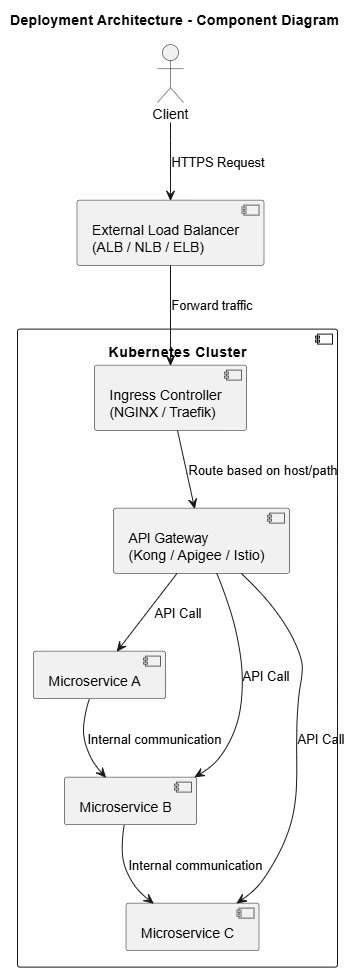
In a typical deployment, the client sends a request to the system, which first reaches an external Load Balancer. The Load Balancer distributes incoming traffic across multiple nodes and often handles SSL termination. The request is then forwarded to the Kubernetes Ingress Controller, which applies host- and path-based routing rules to determine which internal service should receive the request. The traffic is then passed to the API Gateway, which enforces cross-cutting concerns such as authentication, authorization, rate limiting, logging, and monitoring. Finally, the request is routed to the appropriate microservice, which processes the business logic and returns a response that flows back through the same path to the client.
Component Responsibilities
Load Balancer
Entry point for all traffic
Handles SSL termination
Distributes traffic across nodes
Examples: AWS ALB/NLB, Azure Load Balancer, GCP LB
Ingress Controller (Kubernetes)
Converts HTTP rules into Kubernetes routing
Routes traffic to correct service
Works inside the cluster
Examples: HAProxy
API Gateway
Controls API behavior
Authentication & authorization
Rate limiting & throttling
API versioning
Request/response transformation
Examples: Kong, Apigee, AWS API Gateway, Istio Gateway
Advantages
Scalability: Automatically scales services and traffic handling
High Availability: No single point of failure
Security: Centralized authentication and authorization. Hides internal services
Observability: Centralized logging, metrics, and tracing
Maintainability: Clean separation of concerns, easier updates and deployments
Summary
API Gateways, Load Balancers, and Ingress Controllers each serve a specific purpose in a deployment solution, operating at different layers of the architecture. The Load Balancer manages external traffic distribution, the Ingress Controller routes traffic within Kubernetes, and the API Gateway governs and secures API access. When combined, these components create a scalable, secure, and resilient deployment architecture that is well suited for modern microservices-based applications.
Join the conversation! Your thoughts help the community grow.