
Introduction
As platforms scale, multi-tenancy stops being just a feature and becomes an architectural mindset.
In a recent SaaS platform architecture, multi-tenancy was designed as a request-driven, Clean Architecture-based approach from day one—not as an afterthought.
Architecture Overview
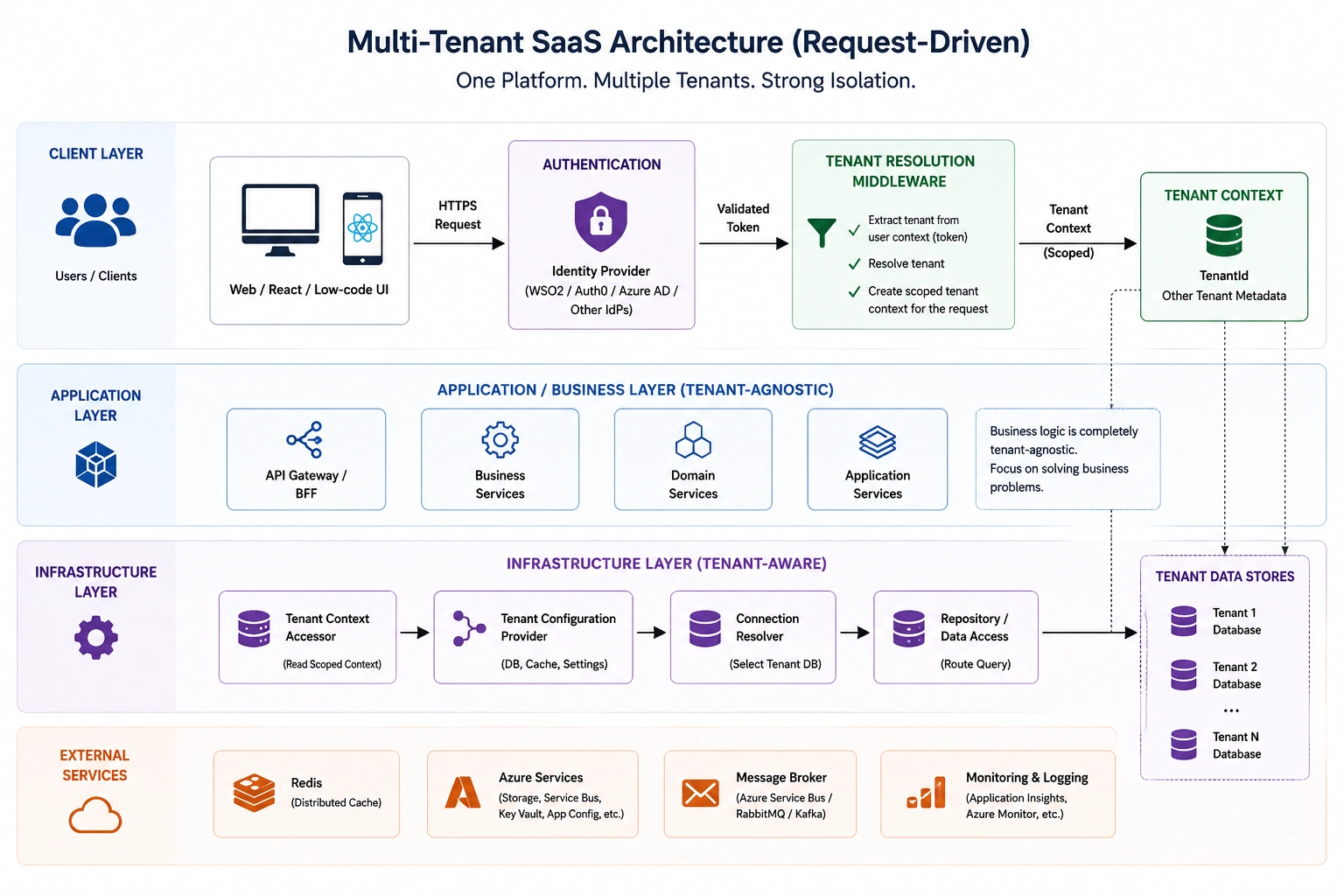
The architecture follows a clear separation of concerns:
Client Layer handles user interactions through React or low-code experiences.
Authentication Layer validates users through enterprise Identity Providers such as WSO2, Azure AD, or other OIDC-compliant providers.
Tenant Resolution Middleware extracts tenant information from the authenticated user context and creates a scoped tenant context for the lifetime of the request.
Application Layer remains completely tenant-agnostic, focusing only on business capabilities and domain logic.
Infrastructure Layer becomes tenant-aware, transparently resolving configurations, selecting the appropriate tenant database connection, and routing data access.
Core Design Principle
The key principle is simple:
Business logic never knows which tenant it is serving.
Tenant awareness is isolated within the infrastructure boundary, preserving the integrity of the domain and application layers while enabling seamless scalability.
Technology Stack
The solution is implemented using a modern cloud-native technology stack:
.NET 9 APIs and Microservices
SQL Server (database-per-tenant strategy)
React / Low-code UI
Azure Cloud Services
Redis Distributed Cache
Enterprise Identity Providers (WSO2, Azure AD, OIDC)
Benefits of This Architecture
This architecture delivers several practical advantages:
Strong tenant isolation
Clean separation of concerns
Simplified onboarding of new customers or business units
Easier horizontal scalability
Reduced code duplication across tenants
Improved maintainability and long-term evolution
Summary
A request-driven, Clean Architecture-based approach to multi-tenancy keeps tenant-specific concerns isolated within the infrastructure layer while allowing the application and domain layers to remain focused solely on business logic. By combining tenant resolution middleware, enterprise authentication, and a database-per-tenant strategy, this architecture supports strong isolation, simplified scalability, easier customer onboarding, and long-term maintainability for modern SaaS applications.
Join the conversation! Your thoughts help the community grow.