
Introduction
n8n has been widely used as an open-source workflow automation platform that helps teams connect applications and automate business processes using visual workflows. Over time, automation needs have evolved from simple task execution to more intelligent, adaptive, and scalable systems.
To meet these modern requirements, n8n introduced n8n 2.0, which brings significant improvements in user experience, performance, integrations, cloud readiness, and AI-powered automation.
This article explains the major differences between classic n8n (old version) and n8n 2.0 (new version) and how these changes impact real-world automation use cases.
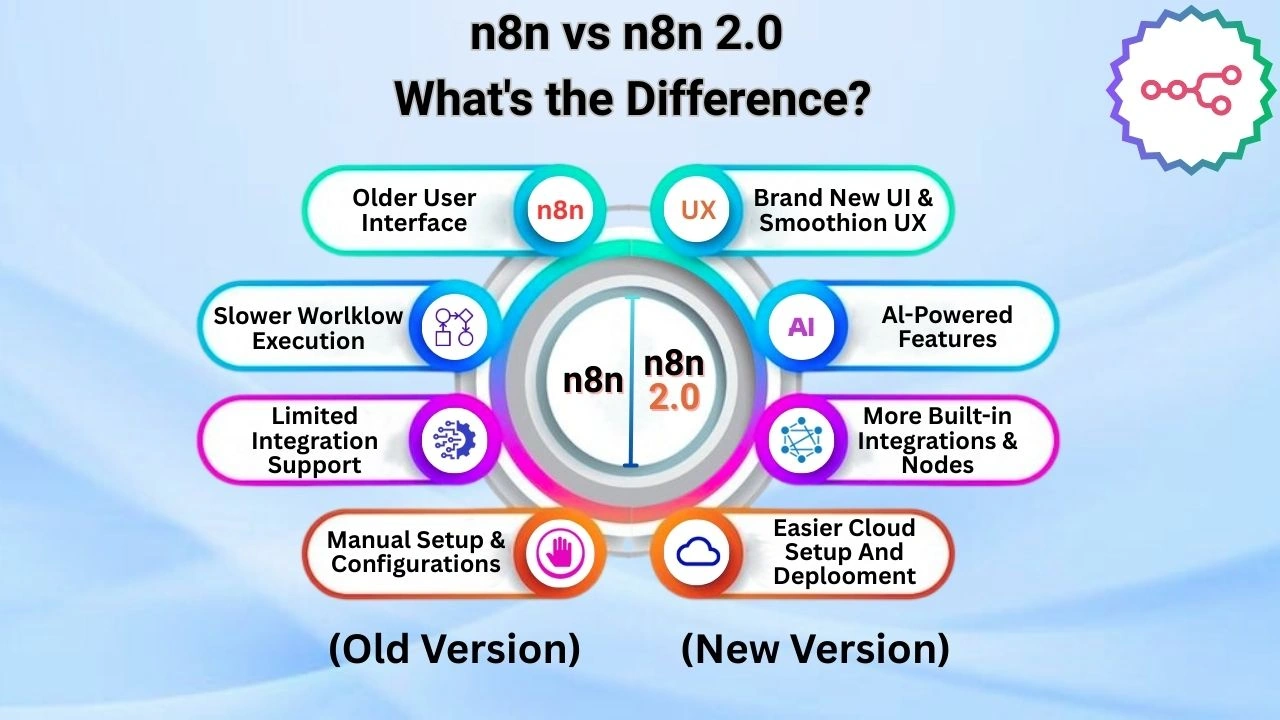
User Interface and Experience
Old n8n
The classic version of n8n provides a functional visual workflow builder, but managing large workflows can become complex. Navigation between nodes, debugging, and monitoring executions often requires multiple clicks and manual effort.
n8n 2.0
n8n 2.0 introduces a brand-new UI with smoother UX, better node organization, improved debugging views, and faster navigation. It is designed for both developers and business users, making it easier to design, test, and maintain workflows.
This significantly reduces development time and improves productivity.
Workflow Execution and Performance
Old n8n
In older versions, workflows mainly follow a linear execution model. While reliable, performance can degrade with heavy workloads, large datasets, or multiple API calls. Scaling often requires manual infrastructure tuning.
n8n 2.0
n8n 2.0 comes with an improved execution engine that supports better parallel processing, queue-based execution, and long-running workflows. This allows:
Faster execution times
Higher throughput
More stable enterprise-grade automation
This makes it suitable for both small teams and large organizations.
Integration Capabilities
Old n8n
Classic n8n offers many integrations, but in complex enterprise scenarios, users often rely heavily on HTTP nodes and custom scripting. Some integrations require additional configuration and maintenance.
n8n 2.0
n8n 2.0 provides more built-in integrations and smarter nodes, reducing the need for custom API handling. Many connectors are now optimized for common business systems such as CRMs, databases, cloud services, and messaging platforms.
This helps teams build solutions faster with fewer technical dependencies.
AI-Powered and Agentic Features
Old n8n
Traditional workflows are rule-based and deterministic. All decisions must be explicitly defined using IF, Switch, and routing logic. Handling unstructured inputs like emails, chats, or documents requires complex conditions.
n8n 2.0
n8n 2.0 introduces AI-powered features and agent-based workflows. Agents can:
Understand intent
Choose tools dynamically
Execute actions automatically
Maintain context and memory
This allows automation to move beyond static flows into intelligent decision-driven processes, such as customer support triage, document understanding, and automated operations.
Setup, Deployment, and Cloud Readiness
Old n8n
Setting up classic n8n, especially on self-hosted servers, often requires manual configuration of databases, queues, authentication, and scaling strategies.
n8n 2.0
n8n 2.0 focuses on easier cloud setup and deployment, with better support for managed environments, containerization, and cloud scaling. This reduces operational overhead and improves reliability in production environments.
It also aligns better with DevOps and CI/CD practices.
Real-World Business Impact
With n8n 2.0, organizations can:
Build faster and more reliable automations
Handle complex decision-making processes
Reduce dependency on manual approvals
Automate unstructured business workflows
Integrate AI into daily operations
This turns n8n into not just an integration tool, but a complete intelligent automation platform.
When to Use Classic Workflows vs Agentic Workflows
Even in n8n 2.0, classic workflows are still useful.
Use Classic Automation When:
Processes are predictable and rule-based
Data formats are structured
Compliance requires strict step-by-step execution
Use Agentic Automation When:
Inputs are dynamic or unstructured
Decisions depend on context
Human-like reasoning is required
Automation must adapt to changing conditions
The best solutions often combine both approaches in a hybrid model.
Conclusion
The evolution from classic n8n to n8n 2.0 represents a major shift in automation technology. While older versions focused on connecting systems and executing predefined logic, n8n 2.0 introduces intelligence, flexibility, and scalability into workflow automation.
With improved UI, faster execution, richer integrations, cloud-native deployment, and AI-powered agents, n8n 2.0 enables organizations to build automation that is not only efficient, but also smart and adaptive.
For teams looking to future-proof their automation strategy, n8n 2.0 is clearly the way forward.
Join the conversation! Your thoughts help the community grow.