

In today’s world, automation is no longer a “nice to have” — it’s a must for businesses of all sizes. From syncing data between apps to automating customer communications, integration platforms have become the backbone of digital operations.
But when it comes to choosing the right tool, you’ll often find yourself asking:
Should I go with a traditional integration platform (like Zapier, Integromat/Make, or Workato)?
Or should I use an open-source solution like n8n?
Let’s break this down by comparing n8n vs traditional integration platforms — their pros, cons, and where each fits best.
What is n8n?
n8n is an open-source workflow automation tool that lets you connect APIs, databases, and services together. Unlike most traditional platforms, n8n gives you:
Full flexibility with JavaScript functions and expressions.
Self-hosting options, meaning your data stays with you.
Unlimited workflows and executions (no per-task pricing).
Think of n8n as a developer-friendly automation platform with low-code/no-code capabilities.
What are Traditional Integration Platforms?
Platforms like Zapier, Make (Integromat), Workato, and Tray.io are well-known automation tools that:
Offer plug-and-play connectors for thousands of apps.
Focus on ease of use for non-technical users.
Charge based on usage limits (number of tasks/runs).
These platforms shine for business users who want to quickly automate without worrying about hosting or coding.
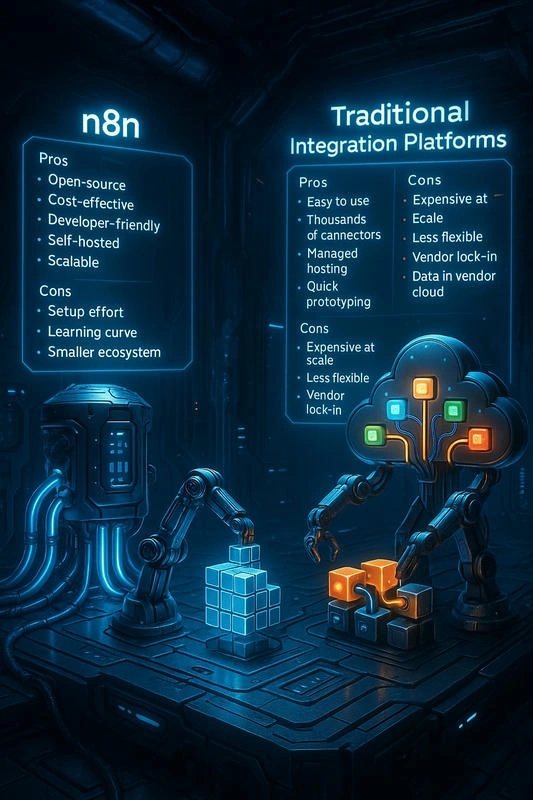
n8n vs Traditional Platforms: Pros & Cons
Pros of n8n
Open Source & Self-Hosted: Full control over where and how your workflows run.
Cost-Effective: No per-task limits; ideal for high-volume automations.
Developer Friendly: Add logic with JavaScript, build custom nodes, or connect to any API.
Scalability: Perfect for growing businesses that want unlimited automations.
Data Privacy: Keep sensitive data in your own infrastructure.
Cons of n8n
Setup Effort: Requires hosting (Docker, cloud, or server).
Learning Curve: More technical than drag-and-drop-only tools.
Smaller Community: Fewer pre-built integrations compared to Zapier.
Pros of Traditional Platforms
Ease of Use – Designed for non-technical users.
Large App Ecosystem – Thousands of pre-built connectors.
Managed Hosting – No need to worry about infrastructure.
Great for Prototyping – Build workflows in minutes without setup.
Cons of Traditional Platforms
Expensive at Scale – Per-task pricing can skyrocket with heavy usage.
Limited Flexibility – Harder to handle complex logic or custom APIs.
Data Location – Runs on their cloud, not yours (privacy concerns).
Vendor Lock-In – Migrating workflows can be painful.
When to Choose n8n
You need scalable automations without per-task costs.
Your business handles sensitive data (healthcare, finance, internal systems).
You have a developer team or a technical background.
You want to customize workflows beyond plug-and-play connectors.
When to Choose Traditional Platforms
You’re a small team or startup that wants to move fast.
You don’t want to worry about hosting or infrastructure.
Your workflows are simple (e.g., send a Slack alert when a form is filled).
You prefer ready-made connectors and don’t need deep customization.
Conclusion
Both n8n and traditional integration platforms have their place.
If you want ease of use and speed, go for Zapier/Make.
If you want flexibility, cost efficiency, and data ownership, go for n8n.
At the end of the day, the choice depends on your business needs, technical expertise, and budget. For many teams, starting with traditional tools makes sense — but as complexity and costs grow, n8n becomes the natural long-term solution .
Join the conversation! Your thoughts help the community grow.