Introduction
In the rapidly evolving world of cross-platform development, developers face the
challenge of selecting the best framework for their projects. Two prominent frameworks
that have gained significant traction are .NET MAUI (Multi-platform App UI) by Microsoft
and Flutter by Google. This document provides an in-depth comparison of both
frameworks to help developers and stakeholders make informed decisions.
Overview of .NET MAUI
.NET MAUI is Microsoft’s cross-platform framework that enables developers to build
applications for iOS, Android, Windows, and macOS using a single codebase. Built as
an evolution of Xamarin.Forms, .NET MAUI enhances the development experience by
providing a unified approach for building applications across multiple platforms using
C# and XAML.
Key Features of .NET MAUI:
• Single project structure for multiple platforms.
• Access to native APIs for all supported platforms.
• Built on top of .NET, providing robust tooling and integration with Visual Studio.
• Support for platform-specific customizations using handlers.
• Leverages Xamarin’s existing ecosystem for extended platform support.
Overview of Flutter
Flutter, developed by Google, is an open-source UI toolkit that allows developers to
build natively compiled applications for mobile, web, and desktop using a single
codebase. Flutter is powered by the Dart programming language and has gained
popularity due to its fast-rendering engine and expressive UI components.
Key Features of Flutter:
• Hot reload feature for instant UI updates during development.
• Rich set of customizable widgets.
• High-performance rendering with Skia graphics engine.
• Strong community support and extensive plugins for third-party integration.
• Works well for both mobile (Android/iOS) and desktop (Web, Windows, macOS,
Linux).
.NET MAUI Architecture
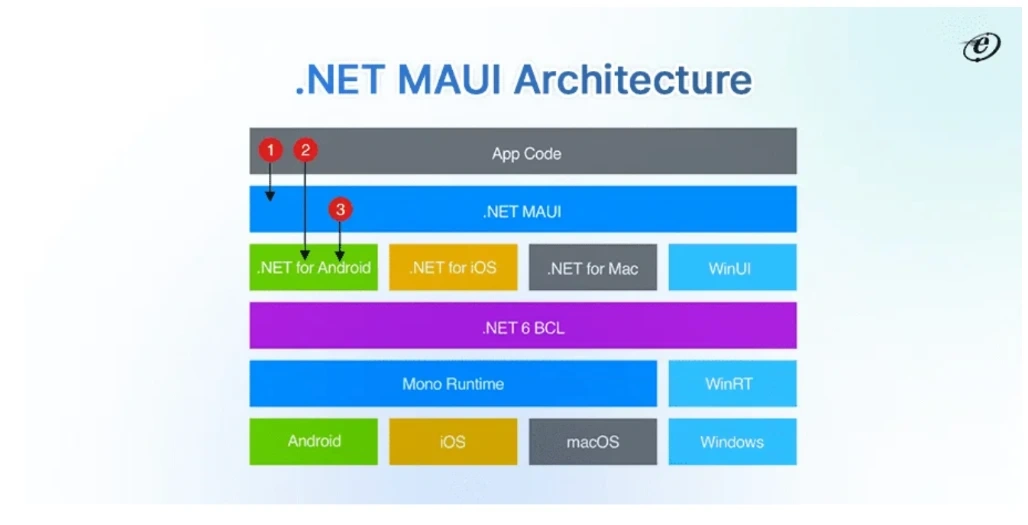
Flutter Architecture
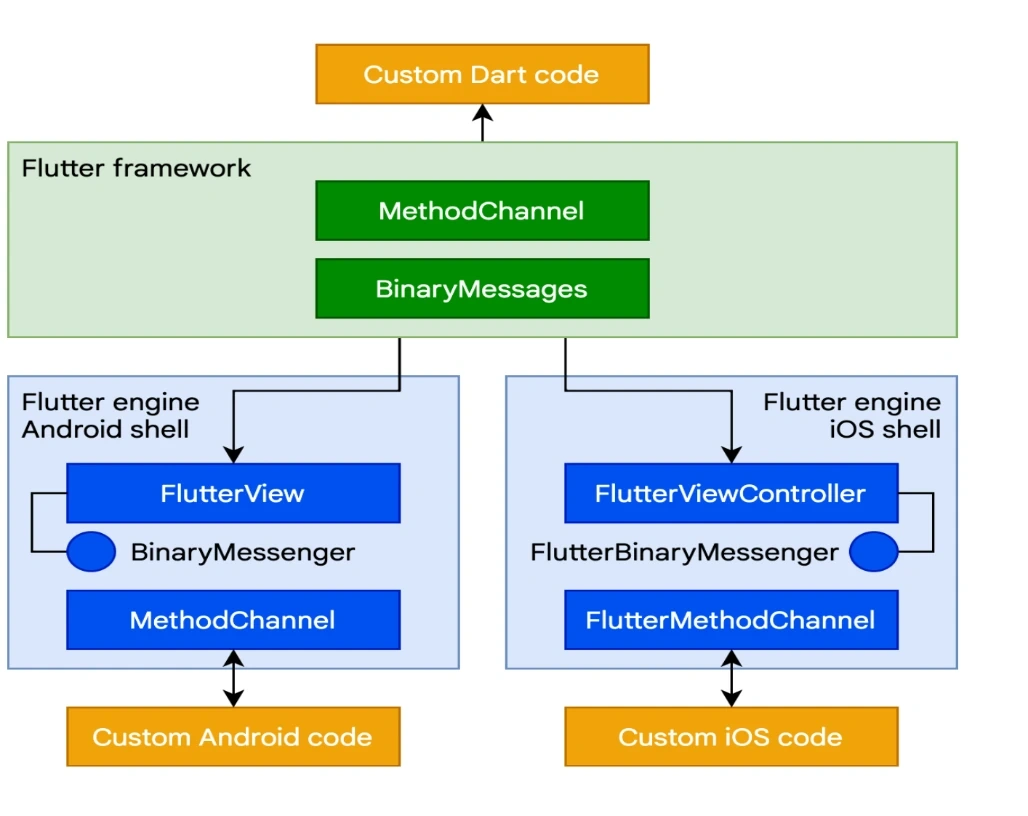
Comparison
Aspect | .NET MAUI | Flutter |
ProgrammingLanguage | C# and XAML | Dart |
Performance | Near-native performance withplatform optimizations | High-performance rendering withSkia engine |
UI Components | Native controls for each platform | Customizable widgets forconsistent UI across platforms |
Hot Reload | Supports Hot Reload for quick UIupdates | Hot Reload with near-instantupdates to the UI |
Tooling & IDESupport | Excellent support in VisualStudio | Best support in Android Studioand Visual Studio Code |
PlatformSupport | iOS, Android, Windows, macOS | iOS, Android, Web, Windows,macOS, Linux |
Learning Curve | Easier for developers withC#/.NET experience | Requires learning Dart, butsimpler for those familiar withFlutter’s declarative UI approach |
Customizability | Easy customization usingplatform handlers | Highly customizable via widgetsand layout control |
Deployment | Supports CI/CD pipelinesthrough App Center and AzureDevOps | Supports CI/CD pipelines withCodemagic and other tools |
Key Benefits of .NET MAUI
1. Unified Codebase: Simplifies development by o\ering a single project structure
for all platforms.
2. Seamless Integration with .NET: Leverages the .NET ecosystem for robust
development, including access to libraries, APIs, and tooling.
3. Native Performance: Ensures high performance by using native components
and optimizing for each platform.
4. Enterprise-Ready: Supported by Microsoft, making it a reliable choice for
enterprise-level applications.
Key Benefits of Flutter
1. Faster Development: Hot reload and a wide array of pre-designed widgets
speed up the development process.
2. Beautiful UIs: Flutter o\ers extensive options for creating visually appealing and
highly customizable user interfaces.
3. Cross-Platform Reach: Besides mobile, Flutter allows developers to target web
and desktop platforms from a single codebase.4. Strong Community Support: The active Flutter community provides numerous
plugins and resources for developers.
Conclusion
Both .NET MAUI and Flutter provide robust solutions for cross-platform development,
each with unique strengths. .NET MAUI is ideal for developers and enterprises already
invested in the Microsoft ecosystem, o\ering smooth integration with .NET technologies
and a unified project structure. On the other hand, Flutter excels in delivering fast,
beautiful UIs across multiple platforms with minimal performance trade-o\s, making it
a great choice for projects that demand highly customized UIs and web support.
The decision between .NET MAUI and Flutter should be based on your team’s existing
skill set, project requirements, and long-term goals.
.NET MAUIFluttercross-platform developmentmobile app developmentC#DartXAMLapp frameworks


Join the conversation! Your thoughts help the community grow.