

Abstract: We practically show examples of 15 different .NET8/9 build modes, including Framework-Dependent and Framework-Independent, how to bundle an app into a single file, how to trim app bundles from unused libraries, and how to build an Ahead-of-time (AOT) precompiled app.
1. .NET8/9 toolset supports different build/publish/deployment modes
I was experimenting with different project properties/flags, and I developed several proof-of-concept build projects showcasing different build/publish/deployment modes available in .NET8/9, using Microsoft tools.
1.2 Articles in this series
For technical reasons, I will organize this text into several articles.
- .NET8/9 – Testing different Build/Deployment modes – Part1
- .NET8/9 – Testing different Build/Deployment modes – Part2
- .NET8/9 – Testing different Build/Deployment modes – Part3
- .NET8/9 – Testing different Build/Deployment modes – Part4
- .NET8/9 – Testing different Build/Deployment modes – Part5
- .NET8/9 – Testing different Build/Deployment modes – Part6
2. Some Tricks
Here are some useful topics.
2.1 Embedding.PDB files
Embedding .pdb files into your assemblies is possible and will give you the line number of the exception.
/*
Without PDB files there are no line numbers in the Exception log
*/

public static string? ExceptionTest()
{
    string? result = null;
    try
    {
        throw new Exception("Exception_from_ClassLibraryA.ClassA");
    }
    catch (Exception ex)
    {
        result = ex.ToString();
    }
    return result;
}

/*
====Exception Log without PDB files=============
System.Exception: Exception_from_ClassLibraryA.ClassA
   at ClassLibraryA.ClassA.ExceptionTest()

====Exception Log with PDB files===============
System.Exception: Exception_from_ClassLibraryA.ClassA
   at ClassLibraryA.ClassA.ExceptionTest() in C:\tmpNetBundle\BundleExample01\ClassLibrary1\ClassA.cs:line 18

==This is from AOT compiled project (build 19), with .pdb files==============
System.Exception: Exception_from_ClassLibraryA.ClassA
   at ClassLibraryA.ClassA.ExceptionTest() + 0x31
*/
2.2 Some APIs change behavior in different build/deployment modes.
Some APIs aren't compatible with single-file deployment (see [4]). Here, I test assembly location one, which is of interest to me, and show its substitute.
/*
Some assembly location API behave differently in SingleFile bundled build
-API System.Reflection.Assembly.GetExecutingAssembly() will generally work
-but System.Reflection.Assembly.GetExecutingAssembly().Location no longer works
*/

static string? TestAssemblyLocationAPI()
{
    string? result = String.Empty;

    string ? locationAssembly =
            System.Reflection.Assembly.GetExecutingAssembly().Location;
    //result += "\n";
    result +=$"locationAssembly:{locationAssembly}";

    string? BaseDirectory = System.AppContext.BaseDirectory;
    result += "\n";
    result += $"BaseDirectory:{BaseDirectory}";

    string? ProcessPath = System.Environment.ProcessPath;
    result += "\n";
    result += $"ProcessPath:{ProcessPath}";
    result += "\n";

    return result;
}

/*
===Execution in regular build==================
locationAssembly:C:\tmpNetBundle\BundleExample01\ConsoleApp1\bin\Debug\net8.0-windows\win-x64\ConsoleApp1.dll
BaseDirectory:C:\tmpNetBundle\BundleExample01\ConsoleApp1\bin\Debug\net8.0-windows\win-x64\
ProcessPath:C:\tmpNetBundle\BundleExample01\ConsoleApp1\bin\Debug\net8.0-windows\win-x64\ConsoleApp1.exe

===Execution in SingleFile bundled build==================
locationAssembly:
BaseDirectory:C:\tmpNetBundle\BundleExample01\ConsoleApp1\Framework_SingleFile_Win-X64\
ProcessPath:C:\tmpNetBundle\BundleExample01\ConsoleApp1\Framework_SingleFile_Win-X64\ConsoleApp1.exe

*/
3. Sample Test App
I created a sample Test App for this prototyping.
It consists of
- a library ClassLibraryA that has EF8 Database access in it.
- Executable ConsoleApp1 that invokes some, but not all, API exposed in the library so I can test “trimming”. The process of statistical lexical analysis should discover that the main app is not really using database access and that all linked .dll-s related to EF8/SQL are not needed.
- Because many properties/flags are set on the project level, I need to create several clones of ConsoleApp1 to test all the variations in project properties/flags.
- I was using PostBuild Event to run “dotnet publish” scripts. (Advice: be sure to add enough spaces after each command, before ==, after ==, etc.)
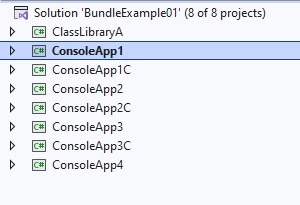
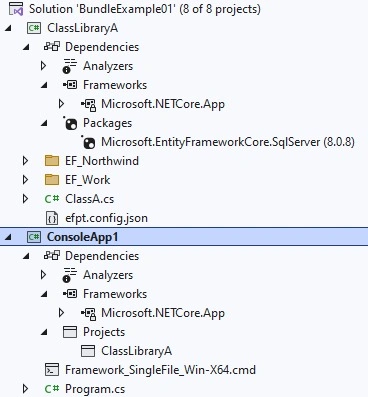
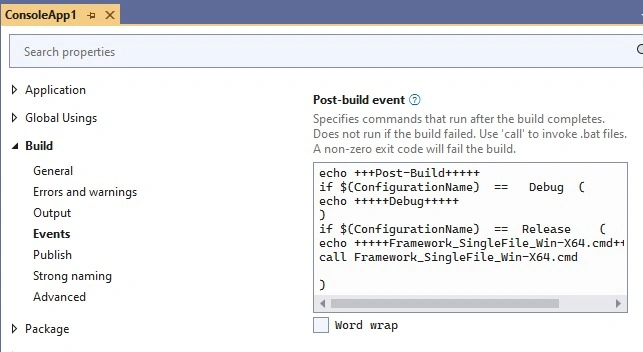
// ClassLibraryA, ClassA.cs =========================================
using ClassLibraryA.EF_Work;

namespace ClassLibraryA
{
    public static class ClassA
    {
        public static string? BasicCall()
        {
            string? result = "Hello from ClassLibraryA.ClassA";
            return result;
        }

        public static string? ExceptionTest()
        {
            string? result = null;
            try
            {
                throw new Exception("Exception_from_ClassLibraryA.ClassA");
            }
            catch (Exception ex)
            {
                result = ex.ToString();
            }
            return result;
        }

        public static string? BasicDbTest()
        {
            string? result = EF_Test1.BasicDbTest();
            return result;
        }
    }
}

// ConsoleApp1, Program.cs ===============================================
namespace ConsoleApp1
{
    internal class Program
    {
        static void Main(string[] args)
        {
            Console.WriteLine("Hello, World from ConsoleApp1\n");

            Console.WriteLine(TestAssemblyLocationAPI());

            Console.WriteLine(ClassLibraryA.ClassA.BasicCall());
            Console.WriteLine(ClassLibraryA.ClassA.ExceptionTest());

            // deliberately commented to test Trim mode
            // Console.WriteLine(ClassLibraryA.ClassA.BasicDbTest());

            Console.ReadLine();
        }

        static string? TestAssemblyLocationAPI()
        {
            string? result = string.Empty;

            string? locationAssembly =
                System.Reflection.Assembly.GetExecutingAssembly().Location;
            result += $"locationAssembly: {locationAssembly}";

            string? BaseDirectory = System.AppContext.BaseDirectory;
            result += "\n";
            result += $"BaseDirectory: {BaseDirectory}";

            string? ProcessPath = System.Environment.ProcessPath;
            result += "\n";
            result += $"ProcessPath: {ProcessPath}";
            result += "\n";

            return result;
        }
    }
}
Join the conversation! Your thoughts help the community grow.