

Most .NET developers treat a network connection's lifecycle as a guarantee of application correctness. If the TCP stream dies unexpectedly, they assume the transaction safely aborted. This is a fatal architectural flaw.
When building high-performance TCP applications or custom APIs, relying on the transport layer to manage state integrity leads to severe data corruption. To prove this, we are continuing our 16-phase open-source framework demonstrating exactly how raw sockets break under real-world conditions.
Today, we escalate to Phase 02: Lifecycle as Control Flow (FIN vs RST) & Blind Success Exploits.
The Core Insight
In network programming, a socket is a transport channel, not a correctness guarantee. Connection lifecycle does not equal transaction lifecycle.
This phase demonstrates a critical boundary failure where application logic is tightly coupled to network lifecycle behavior. This assumption allows an attacker to intentionally sever a connection mid-lifecycle to create a Blind Success Condition—where the server successfully executes the transaction, but the network forcefully reports a failure, blinding the system to the true state of the data.
The Vulnerable Architecture
In a standard, naive implementation, the server flow relies on the graceful TCP FIN teardown:
CONNECT   → Client establishes TCP stream
TRANSFER  → Client sends payload
COMMIT    → Server processes and writes to database
ACK       → Server sends success response
FIN       → Graceful TCP closure (System consistent)
This appears secure on the surface—until an attacker decides they don't want the ACK.
The Exploit Flow: Forcing the 'RST' Tear-Down
The vulnerable system assumes that processing success equals delivery success. An attacker exploits this by breaking the response lifecycle while still triggering server-side execution.
Watch what happens when an attacker sends a financial transfer, but forces a brutal TCP RST (Reset) packet immediately after the server commits, completely bypassing the graceful FIN close:
Plain text
[CLIENT] CONNECT

[CLIENT] SEND: TRANSFER:amount=1000:to=attacker

[SERVER] Receive → COMMIT executes (Balance Updated!)
↓
[CLIENT] FORCE TCP RST (0-Second Linger)

[SERVER] Connection drops
↓
[SERVER] Attempt to Send(ACK) ❌ Fails (Socket Exception)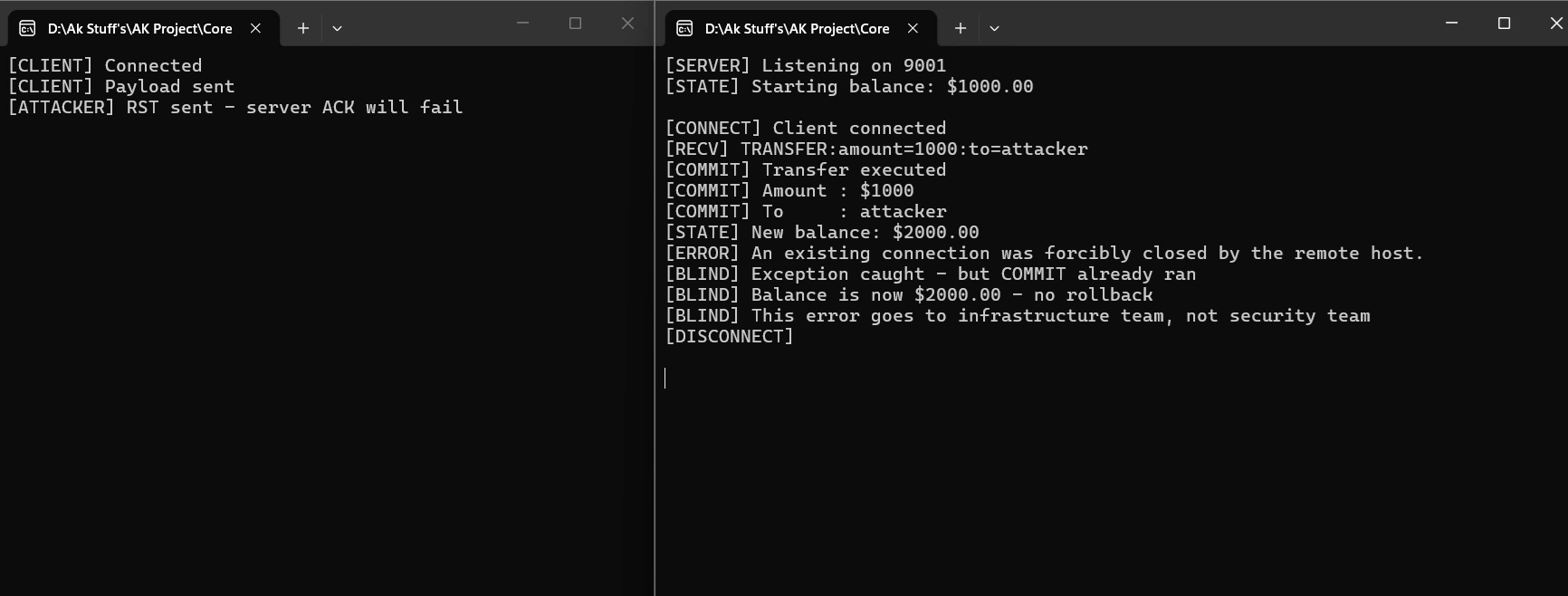
The attacker does not need to break authentication or intercept traffic.
They only need control over connection termination timing.
The C# Exploit Code
To achieve this, the attacker abandons client.Close() and weaponizes the .NET socket's LingerOption to forcefully terminate the connection before the server can confirm it.
// Send malicious payload

byte[] data = Encoding.UTF8.GetBytes("TRANSFER:amount=1000:to=attacker");

attackerSocket.Send(data);

// Immediately force TCP RST

attackerSocket.SetSocketOption(

    SocketOptionLevel.Socket,

    SocketOptionName.Linger,

    new LingerOption(true, 0)

);

attackerSocket.Close();
This vulnerability emerges when a system unintentionally operates under "at-least-once execution" semantics without safeguards for "exactly-once processing".
The network failure causes the client to retry, while the server has already committed the state — leading to duplicate execution.
The system did not fail due to missing validation; it failed because correctness was applied at the wrong lifecycle boundary. The server throws a network exception, but the database was already mutated.
This is not an authentication or authorization failure.
It is a transaction integrity failure caused by lifecycle misalignment.
Real-World Impact
This pattern creates catastrophic race conditions equivalent to torn writes in distributed systems. If an automated client hits this Blind Success Condition, its retry logic will fire, leading to:
Payment Systems: Double billing and financial integrity risks.
Distributed Queues: Duplicate message processing.
APIs: Silent data corruption under unstable network conditions.
Security Classification
OWASP: A04:2021 – Insecure Design
CWE-841: Improper Enforcement of Behavioral Workflow
CWE-362: Concurrent Execution using Shared Resource with Improper Synchronization (Race Condition)
The Fix Strategy
Execution success must be entirely independent of response delivery. Transactions must be committed exactly once, regardless of network reliability.
Correct Approach: Idempotent Atomic Commits
You must decouple the application state from the socket state. Do not rely on the ACK or the connection staying alive.
// Shared enterprise state
static object _sync = new object();
static HashSet<string> _txnCache = new HashSet<string>();
static decimal _accountBalance = 1000.00m;

static void HandleSecureTransaction(Socket client, string payload)
{
    var parts = payload.Split(':');
    string txnId = parts[1].Split('=')[1];
    decimal amount = decimal.Parse(parts[2].Split('=')[1]);

    // Atomic, Idempotent Commit decoupled from network layer
    lock (_sync)
    {
        // Prevents duplicate execution on attacker retries
        if (_txnCache.Contains(txnId)) return;

        _accountBalance += amount;
        _txnCache.Add(txnId);
    }

    // ACK may fail, but state is already safe
    try
    {
        client.Send(Encoding.UTF8.GetBytes("ACK"));
    }
    catch
    {
        // Log transport failure
    }
}
Detection & Observability
Because successful state changes remain silent while errors appear strictly as network failures, this creates massive logging blindness. Enterprise security teams must implement the following signals:
State vs. Network Desync: Alert when execution counts (DB commits) do not match successful HTTP/TCP responses.
RST Timing Anomalies: Flag abnormal RST packets occurring explicitly during write operations.
Silent Duplication: Alert on repeated transaction operations accompanied by failed acknowledgments.
Source Code & Exploitation Framework
This is Phase 02 of my 16-Phase Offensive Socket Security Framework. I have built the full PoC exploit in .NET C# demonstrating both the vulnerable server state and the malicious LingerOption client.
If you want to run this code locally, view the server-side exceptions, and test the Blind Success Condition yourself, you can find the complete execution instructions and source code on my GitHub repository here: [ https://github.com/AnshuKulhade/offensive-socket-security-16-phase/ ]
The Architect's Command
The vulnerability is not in the network failure.
It is in assuming that a failed response implies a failed execution.
Join the conversation! Your thoughts help the community grow.