

Introduction
One of the first questions that confused me while learning Microsoft Fabric was this:
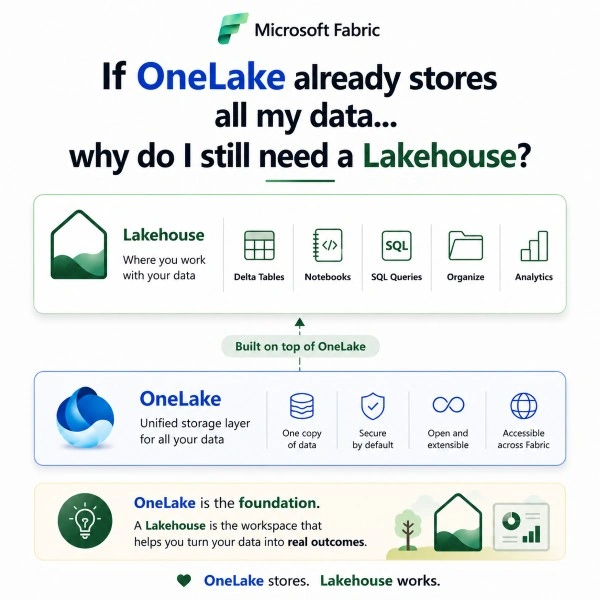
If OneLake already stores all my data, why do I still need a Lakehouse?
At first, I assumed OneLake and Lakehouse were simply two names for the same thing.
After all, both seemed related to storing data.
But as I spent more time working with Fabric, I realized they solve different problems.
Understanding this relationship was one of the biggest turning points in my Microsoft Fabric journey.
In this article, I'll explain the difference in the simplest way possible.
Why This Confuses So Many People
If you've recently started learning Microsoft Fabric, you've probably seen something like this:
Create a Workspace → Create a Lakehouse → Upload Data → Work with the Data
And then you hear:
"The data is stored in OneLake."
This naturally raises a question:
If the data is stored in OneLake anyway, why am I creating a Lakehouse?
The answer becomes much easier once you understand that OneLake and Lakehouse are not competing services.
They work together.
Think of It Like Land and a House
The analogy that finally made everything click for me was this.
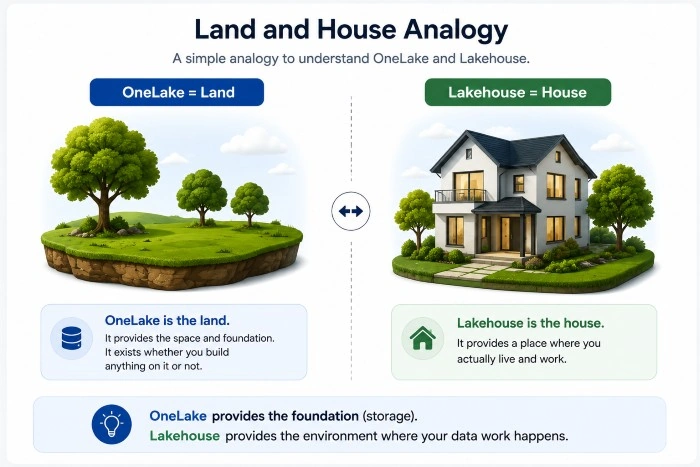
Imagine you're buying a piece of land.
The land provides the space and foundation where you can build something.
Now imagine building a house on that land.
The house gives you a place where you can actually live and work.
Microsoft Fabric works in a similar way.
OneLake is the land.
A Lakehouse is the house built on that land.
One provides the foundation.
The other provides the environment where your data work happens.
What Exactly Is OneLake?
OneLake is the unified data lake storage foundation for Microsoft Fabric.
It provides a common storage layer across Fabric instead of requiring organizations to manage completely separate data lakes for different Fabric workloads.
OneLake can be used by Fabric experiences such as:
Lakehouses
Warehouses
Data engineering workloads
Analytics workloads
Power BI experiences working with Fabric data
Think of OneLake as the storage foundation of Microsoft Fabric.
Its primary responsibility is providing a unified place to store and access organizational data.
What Exactly Is a Lakehouse?
A Lakehouse is a Fabric item that combines data lake storage capabilities with analytical capabilities and uses OneLake as its underlying storage.
This is where data engineers can actually work with their data.
Inside a Lakehouse, you can:
Organize files and folders
Create and work with Delta tables
Run Spark notebooks
Transform data
Query data using SQL
Build Bronze, Silver and Gold layers
Prepare data for analytics
Notice something?
None of these activities replace OneLake.
They use OneLake underneath.
The Relationship Between OneLake and Lakehouse
This is the simplest way I think about it today:
| OneLake | Lakehouse |
|---|---|
| Unified storage foundation | Data engineering and analytics experience |
| Provides underlying storage | Provides tools to work with data |
| Shared across Fabric | Created as a Fabric item |
| Stores and organizes data | Organizes, transforms and analyzes data |
| Platform-level concept | Workload/item |
Once I understood this relationship, I stopped thinking of them as two different storage systems.
Instead, I started seeing them as two different layers of the same architecture.
A Common Misconception
One misconception I had was:
"Creating a Lakehouse means creating completely separate storage."
That's not how I look at it anymore.
Creating a Lakehouse creates a Fabric item that uses OneLake as its underlying storage.
The Lakehouse gives us the structure and capabilities needed to work with the data.
The underlying storage is provided by OneLake.
This distinction becomes especially useful when working with Delta tables, Spark notebooks, medallion architecture and Power BI in Fabric.
A Simple Real-World Example
Let's take an e-commerce company.
Suppose the company receives data from:
Customers
Orders
Payments
Support tickets
Website activity
The data can be stored in OneLake.
A Lakehouse then provides the environment where a data engineer can ingest, transform and organize that data.
For example:
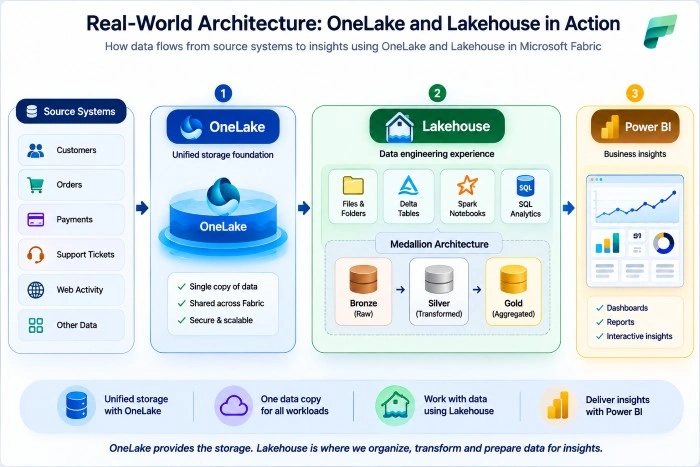
Within the Lakehouse, the data can be processed using Spark and SQL, organized using the medallion architecture, and prepared for downstream analytics.
The important point is that OneLake provides the storage foundation, while the Lakehouse provides the environment for working with the data.
OneLake vs Lakehouse: The Simple Answer
If someone asks me:
What's the difference between OneLake and a Lakehouse?
I'd answer:
OneLake is the unified storage foundation of Microsoft Fabric, while a Lakehouse is a Fabric data and analytics experience that uses OneLake underneath.
Conclusion
OneLake and Lakehouse can look very similar when you're new to Microsoft Fabric.
That was certainly my experience.
The biggest mindset shift for me was realizing that OneLake isn't something you replace with a Lakehouse.
Instead, the Lakehouse is a Fabric experience that uses OneLake as its underlying storage foundation.
Once that clicked, many other Microsoft Fabric concepts became much easier to understand.
Join the conversation! Your thoughts help the community grow.