
Introduction
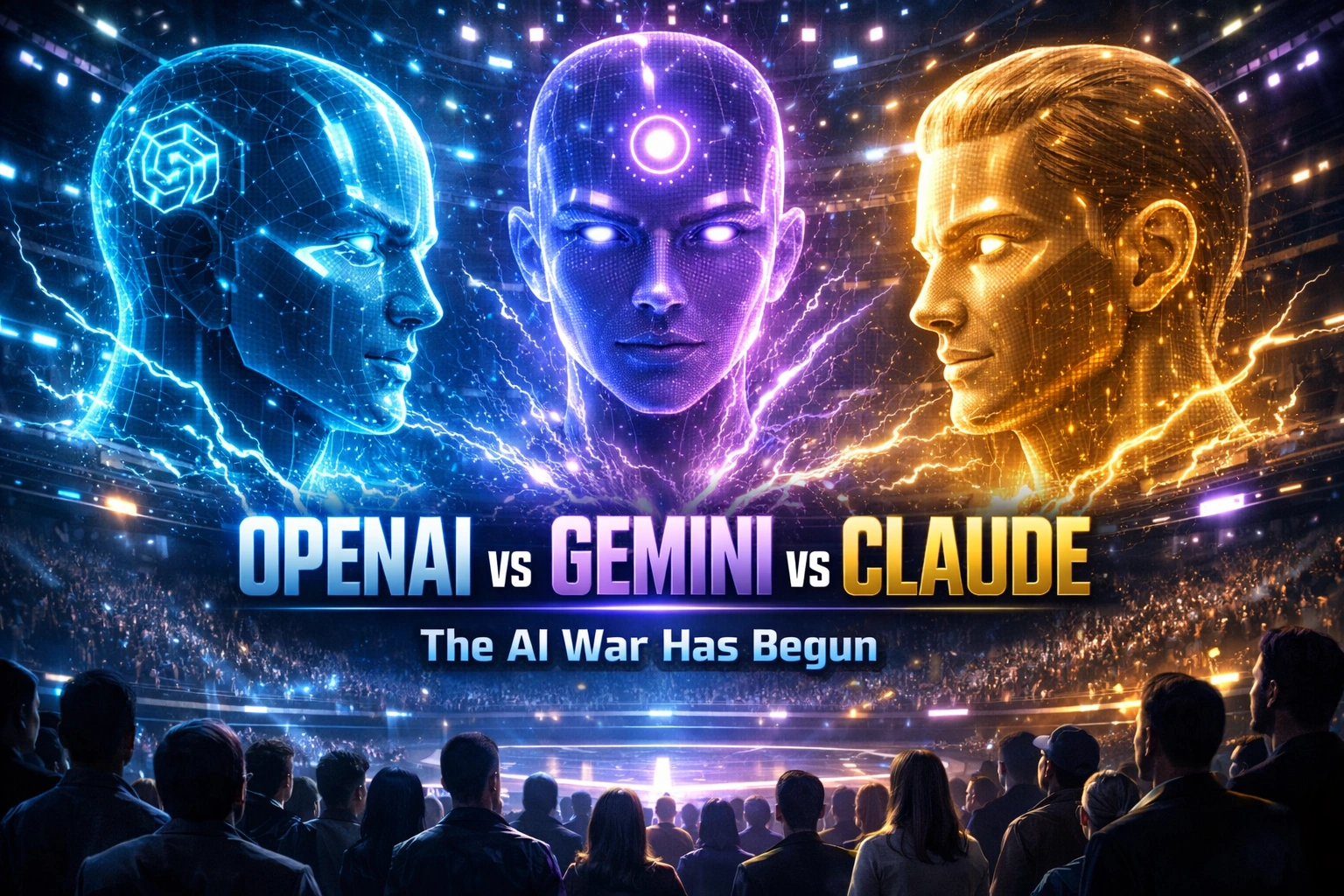
Artificial Intelligence has entered a new phase. AI is no longer just a productivity tool. It has become a competitive battlefield where tech giants are racing to define the future of software development, knowledge work, and digital creativity.
At the center of this race are three major players:
OpenAI (ChatGPT)
Google Gemini
Anthropic Claude
This is not just product competition.
This is the AI War — and developers are directly impacted by its outcome.
Why This AI War Matters
Every major shift in technology reshapes how software is built.
Cloud changed infrastructure.
Mobile changed application design.
AI is now changing how developers think, code, test, and deploy software.
The AI model that becomes dominant will influence:
Developer tools and coding assistants
Software architecture workflows
Debugging and testing automation
Documentation and knowledge systems
Future application experiences
Understanding the strengths of each AI model is becoming a practical career skill.
OpenAI – The All-Rounder Leader
OpenAI’s ChatGPT introduced AI to the mainstream world.
Today, it is the most widely used AI assistant globally.
Strengths:
Excellent general-purpose reasoning
Strong coding assistance
Large developer ecosystem
Massive plugin and API integration
High-quality conversational flow
Limitations:
Occasional hallucinations
Context handling can degrade in long tasks
Position:
OpenAI currently leads in overall adoption and versatility, making ChatGPT the default AI tool for most developers.
Google Gemini – The Real-Time Knowledge Engine
Gemini represents Google’s deep integration of AI with its massive data ecosystem.
Strengths:
Real-time search-powered responses
Strong multimodal understanding (text, image, audio, video)
Excellent for research and factual retrieval
Native integration with Google services
Limitations:
Reasoning consistency still evolving
Developer ecosystem smaller than OpenAI
Position:
Gemini excels where live data, search, and real-world information accuracy matter most.
Claude – The Deep Understanding Specialist
Claude, built by Anthropic, focuses on safety, long-context understanding, and structured reasoning.
Strengths:
Handles long documents efficiently
Excellent summarization and analysis
Strong contextual memory
Preferred for research, legal, and technical reading tasks
Limitations:
Lower public visibility
Smaller integration ecosystem
Position:
Claude is currently the best choice for deep reading, large-context tasks, and analytical workflows.
Who Is Winning the AI War?
Each model leads in different domains:
ChatGPT → Best general-purpose AI
Gemini → Best real-time knowledge AI
Claude → Best deep-context AI
The final winner will be decided by:
Developer adoption
API ecosystem growth
Enterprise integration
Cost-performance balance
This war is still in its early stages.
Why Developers Must Pay Attention
Modern developers already use AI for:
Writing boilerplate code
Debugging errors
Generating documentation
Designing system architecture
Learning new frameworks
The future developer profile is evolving into: Coder + AI Power User
Developers who understand how to:
Choose the right AI model
Write strong prompts
Integrate AI APIs
Automate workflows
will have a clear career advantage.
India and the Global AI Shift
India’s tech ecosystem is rapidly adopting AI-powered development tools.
Global enterprises are integrating AI into daily engineering workflows.
This means:
AI literacy is becoming job-critical
Prompt engineering is now a core skill
AI tool proficiency is expected in modern roles
Remote global opportunities are increasing
Developers who adapt early will lead this transition.
Final Thoughts
The AI War between OpenAI, Gemini, and Claude is not just about chatbots.
It is about:
How software will be built
How knowledge will be accessed
How productivity will scale
How future applications will feel
For developers in India and worldwide, staying informed and adaptive in this AI race is no longer optional.
It is the new professional baseline.
Join the conversation! Your thoughts help the community grow.