

Introduction
In the dynamic realm of digital security and identity management, OpenID Connect and OAuth 2.0 stand as fundamental pillars, revolutionizing how applications handle authentication, authorization, and secure access to resources.
In identity management, it has a couple of main entities. OAuth 2.0 is for industry-standard authorization framework that grants third-party applications limited access to a user's resources without exposing credentials, and OpenID Connect serves as an identity layer built on top of the OAuth 2.0 protocol. It introduces a standardized method for verifying user identities, allowing users to authenticate across different sites or applications without the need to create new credentials for each portal.
Together, these protocols have transformed the way modern applications handle user-secure and user-centric digital experiences.
Cognizance of OpenID Connect
Open ID Connect (OIDC) = Identity + Authentication + OAuth 2.0.
OpenID Connect (OIDC) is an identity layer built upon the foundation of OAuth 2.0, serving as a standardized authentication framework in the digital space. While OAuth 2.0 primarily deals with authorization, OpenID Connect extends its capabilities to provide secure and standardized user authentication, aiming to confirm user identities across various applications and services.
OIDC defines its set of protocols that are used to authenticate users and verify their identities. The core protocols and mechanisms utilized by OIDC include.
- OAuth 2.0
- OIDC is an extension of OAuth 2.0, inheriting and leveraging OAuth 2.0's underlying frameworks for managing authorization.
- Authorization Endpoint
- Similar to OAuth 2.0, OIDC has an authorization endpoint where clients initiate the authentication process by requesting access to user resources.
- Token Endpoint
- The token endpoint in OIDC is used to exchange authorization codes for tokens, including ID tokens and access tokens, after successful authentication.
- ID Token
- OIDC introduces the concept of the ID token, a JSON Web Token (JWT) containing user identity information. This token is used to verify the user's identity.
- Discovery Endpoint (OpenID Provider Configuration)
- The Discovery Endpoint provides metadata and configuration details for the OpenID Connect Provider, enabling clients to dynamically discover OIDC capabilities, endpoints, and supported features.
- UserInfo Endpoint
- This endpoint allows clients to request additional user information beyond what's included in the ID token, providing more details about the authenticated user.
- Standard Claims
- OIDC defines a set of standard claims that can be included in the ID token, containing user attributes such as name, email, and other profile information.
- Scopes
- OIDC utilizes scopes as defined in OAuth 2.0, allowing clients to request specific permissions for accessing user information or other resources.
- Session Management
- OIDC includes protocols for managing user sessions, ensuring secure session handling during authentication
Key Aspects of OpenID Connect
- Authentication Protocol Extension
- OpenID Connect extends OAuth 2.0, adding a standardized authentication layer on top of the existing authorization framework. This extension empowers applications with the ability to verify and authenticate user identities securely.
- Standardized Identity Verification
- It introduces a set of standard methods and practices for confirming user identities, allowing users to authenticate themselves across multiple platforms without the need to create separate credentials for each service.
- ID Tokens for Identity Confirmation
- OpenID Connect utilizes ID tokens to confirm a user's identity. These tokens contain specific information about the user and are issued by the identity provider, allowing relying parties to confirm the user's identity securely.
- Separation of Authentication and Authorization
- Similar to OAuth 2.0, OpenID Connect maintains a separation between authentication and authorization. It focuses solely on the authentication aspect, providing a standardized method for confirming user identities while leaving the authorization to OAuth 2.0.
- Enhanced User Experience
- By providing standardized methods for identity verification, OpenID Connect facilitates a seamless and user-friendly experience, enabling users to authenticate themselves across different platforms more conveniently.
- User Consent and Control
- OpenID Connect, like OAuth 2.0, incorporates user consent mechanisms, ensuring that users explicitly grant permission for their identities to be confirmed by third-party applications.
Purpose of OpenID Connect in Providing Authentication
- Enhancing OAuth 2.0 with Identity Verification
- OpenID Connect fills the need for user authentication in the OAuth 2.0 framework. While OAuth 2.0 primarily handles authorization by providing limited access to resources, OpenID Connect extends this to offer robust identity confirmation.
- Standardized Authentication Layer
- OpenID Connect introduces standardized methods for confirming user identities. It defines a set of practices and protocols for securely verifying user identities across different applications and services.
- ID Tokens for Identity Confirmation
- The utilization of ID tokens is a core aspect of OpenID Connect. These tokens contain information about the user and are issued by the OpenID Connect provider, allowing relying parties to confirm the user's identity without requiring the user's credentials.
- User-Centric Approach
- OpenID Connect is user-centric, emphasizing the user's control and consent in the authentication process. It empowers users by allowing them to manage and grant permission for their identities to be confirmed by third-party applications or services.
- Single Sign-On (SSO) Capability
- OpenID Connect supports Single Sign-On functionality, enabling users to authenticate themselves once and access multiple services without the need for separate logins, enhancing user convenience.
- Separation of Identity Confirmation and Resource Access
- OpenID Connect focuses on confirming the user's identity while leaving the authorization and access control to OAuth 2.0, maintaining the separation between the two crucial aspects of secure digital interactions.
Introduction to OAuth 2.0
OAuth 2.0 is an industry-standard authorization framework widely utilized in modern application development to facilitate secure and controlled access to resources. It provides a structured protocol for secure authorization without the need for sharing user credentials, making it an essential tool in managing and granting access rights within digital ecosystems.
- Key features of OAuth 2.0 as an authorization framework
- Third-Party Access:
- OAuth 2.0 allows third-party applications or services to gain limited access to a user's resources on another service without sharing the user's credentials directly. This is achieved by using access tokens to grant specific permissions to access resources.
- Authorization Grants and Tokens:
- It operates based on the concept of authorization grants, where an authorization server issues access tokens that authorize specific actions or data access within defined scopes.
- Secure Communication:
- OAuth 2.0 ensures secure communication between applications through the exchange of tokens, allowing seamless access while keeping sensitive information like user credentials confidential.
- User Consent and Revocable Access:
- It incorporates user consent, ensuring that users grant permission for the access requested by third-party applications. Furthermore, access granted through OAuth 2.0 can be easily revoked, giving users control over their data.
- Scalability and Interoperability:
- Its standardized framework and widespread adoption contribute to its scalability and interoperability across different platforms and services, making it a versatile choice for secure authorization in various applications.
- Authorization Server and Resource Server:
- In the OAuth 2.0 architecture, the Authorization Server is responsible for issuing access tokens upon successful authentication, while the Resource Server hosts the protected resources that can be accessed using the provided access tokens.
- Third-Party Access:
- Role of OAuth 2.0 in Secure Resource Access
- Limited Access Grants:
- Instead of sharing passwords or credentials, OAuth 2.0 grants limited access to resources. It allows third-party applications or services to access only the specific data or functionality required, eliminating the need for sharing complete user login information.
- Access Tokens for Authorization:
- OAuth 2.0 employs access tokens as a means of authorization. These tokens are granted to applications by the authorization server after the user consents to share their resources. Tokens act as temporary access permissions, enabling the application to perform specific actions on behalf of the user.
- User Authentication Separation:
- It separates user authentication from the authorization process. The user's credentials are stored securely with the service provider, while the authorization process uses tokens to grant access without exposing sensitive login information.
- User Consent and Control:
- OAuth 2.0 ensures that the user explicitly grants consent for the third-party application to access their resources. Additionally, users have the ability to revoke access at any time, maintaining control over their data.
- Improved Security Measures:
- By eliminating the direct sharing of passwords, OAuth 2.0 enhances security by reducing the risk of exposure or misuse of user credentials. This framework facilitates secure interactions between various applications and services without compromising user privacy.
- Limited Access Grants:
OpenID Connect: The Authentication Layer Architecture
OpenID Connect serves as an authentication layer, building upon OAuth 2.0's foundation, to provide standardized and secure user authentication capabilities in the digital space. It focuses specifically on user identity verification, making it an essential component in confirming user identities securely across various applications and services.
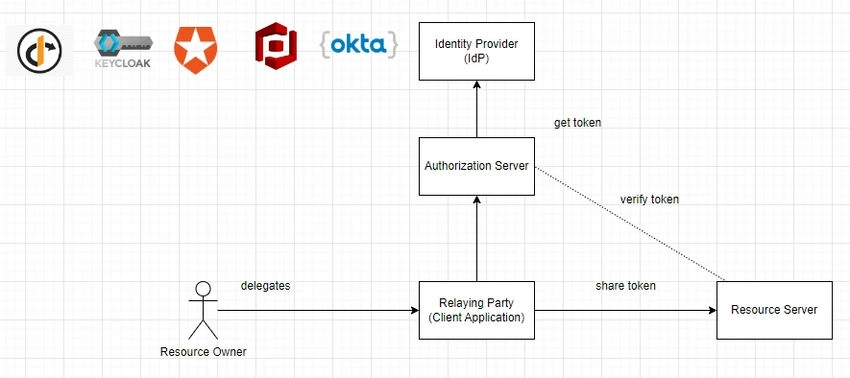
OpenID Connect & OAuth 2.0 Authentication and Authorization Interaction flow
- Authentication Flow
- The Resource owner (end-user) interacts with the Relying Party.
- The relying Party initiates the authentication process and redirects the user to the Auth server
- Identity Provider authenticates the user and generates an ID token.
- The ID token is provided back to the Relying Party for user identity confirmation.
- Authorization Flow
- OAuth 2.0 is responsible for resource authorization, providing access tokens to the Relying Party.
- OpenID Connect acts as an authentication layer on top of OAuth 2.0, focusing on user authentication and identity verification through ID tokens.
Key Components of OAuth 2.0 and OpenID Connect
In the case of Identity Providers (IdPs) like OpenID Connect, different types of tokens are utilized to facilitate authentication and authorization processes. Here are the common token types used by Identity Providers:
- Access Token
- Access tokens are used to access protected resources on behalf of the user.
- This token contains permissions, scopes, and other access-related information.
- Refresh Token
- Refresh tokens are used to obtain new access tokens after they expire without the need for the user to re-authenticate.
- This token does have the necessary information for the IdP to issue a new access token without user interaction
- Id Token
- The ID token is issued by the Identity Provider (IdP) after successful user authentication and is presented by the client application (Relying Party) to confirm the user's identity.
- It contains user-specific details like user ID, name, email, and other relevant metadata about the authentication event.
- Bearer Token
- Typically, the bearer token is presented by the client application (Relying Party) to the resource server as proof of authorization to access protected resources.
- It doesn't contain user-specific information or claims; instead, it represents the authorization to access resources.
The primary difference lies in their purpose and usage. Bearer tokens are used for authorization to access resources, while ID tokens are specifically used for authentication and confirming the user's identity. Bearer tokens do not contain user-specific information, whereas ID tokens are specifically designed to carry user identity-related claims.
Scope and Claims in OpenID Connect and OAuth 2.0 Relationship
In the context of OpenID Connect (OIDC) and OAuth 2.0, "scope" and "claims" are crucial concepts, each serving distinct roles within the identity and access management process:
- Claims in OpenID Connect
- Claims are pieces of information about the user contained within the ID token issued by the OpenID Connect provider.
- These claims represent user attributes or properties, such as name, email, or other user-specific information.
- Claims provide details about the user's identity and any associated metadata.
- This token contains permissions, scopes, and other access-related information.
- Typically, claims help the client application understand who the user is and retrieve necessary user-related information for authentication and user identity verification.
- Scope in OAuth 2.0
- It defines the specific permissions or access levels that a client application requests from the resource owner (user), which indicates the types of access the client is requesting.
- Scopes are defined by the OAuth 2.0 service provider and may include various levels of access, such as read, write, or other specific actions.
- In the real-time scenario, during the authorization process, the client includes a scope parameter in the authorization request, indicating the specific access permissions it requires. The authorization server grants access tokens with the associated scopes that were approved by the user. This is the place where the user will get a denied message in the case of a user requesting an unauthorized scope.
Implementation of OAuth 2.0 and OpenID Connect
Implementing OAuth 2.0 and OpenID Connect involves integrating these protocols into applications and systems to enable secure and standardized authentication and authorization functionalities. Here's an overview of how you might approach the implementation of these protocols.
- Select an Authorization Server (OAuth 2.0)
- Choose or set up an OAuth 2.0-compliant authorization server. There are various options, including open-source solutions like Keycloak, Okta, Auth0, Identity Server, and AWS Cognito, or even building your own server with libraries like Spring Security OAuth or OAuth2 Server for Node.js.
- Define Scopes (OAuth 2.0)
- Determine the scopes needed for your application to define the specific permissions or access levels required. This is part of the authorization.
- Integrate OAuth 2.0 Flow
- Implement the OAuth 2.0 flow in your application, takeaway based on your use case, Please find the different types of Auth flow
- Authorization Code Flow ( best and most secured approach)
- Implicit Flow (depreciated / not secured)
- Resource owner credential (depreciated from modern OAuth2)
- Client Credentials Flow
- let's look at this detail in another article, let me add a link in the future.
- Implement the OAuth 2.0 flow in your application, takeaway based on your use case, Please find the different types of Auth flow
- Select an OpenID Connect Provider
- Choose an OpenID Connect-compliant provider. Many OAuth 2.0 providers also support OpenID Connect.
- Configure OpenID Connect for User Authentication
- Set up OpenID Connect within your application to handle user authentication and identity verification. Here we need to tailor our application.
- Requesting ID Tokens and Access Tokens
- Request ID tokens from the OpenID Connect provider to verify user identities, and access tokens from the OAuth 2.0 provider to access protected resources.
- Token Verification and Usage
- Validate and use the tokens received within your application. Verify the ID tokens to confirm the user's identity and access tokens to access protected resources. Here we need to tailor our application.
- Handle Token Expiry and Refresh
- Implement token management, including handling token expiration and refreshing access tokens using refresh tokens where applicable.
- Secure Token Storage
- Ensure secure storage and handling of tokens within your application to prevent unauthorized access or exposure. Here we need to tailor our application.
- Testing and Validation
- Thoroughly test the implemented OAuth 2.0 and OpenID Connect functionalities to ensure they work as intended, and validate the authentication and authorization processes.
Benefits and Advantages
- User-centric and consistent Authentication practices
- Standard Claims
- Token Security
- Scope-based Access Control
- OAuth 2.0 separates the roles of resource owners, clients, and authorization servers, preventing clients from directly handling user credentials
- Single Sign-On (SSO) experience
- Limited Data Exposure
- Transparent Practices
Trends and Innovations
- Passwordless Authentication using Biometrics
- Contextual and Adaptive Authentication
- Decentralized Identity using Blockchain-Based Identity and Self-Sovereign Identity
- Continuous Authentication Using Zero Trust Model
- Enhanced User Experience using SSO and Consolidated Identity Access regardless of device, location, etc.,
- Forecast and Prevention of Potential Security Threats Using AI.
Conclusion
The roles of OAuth 2.0 in authorization and OpenID Connect in authentication play pivotal roles in the digital realm, collectively providing a comprehensive framework for secure access control and user identity verification. OAuth 2.0 primarily focuses on authorization, enabling controlled access to resources without sharing user credentials. It does so by issuing access tokens and managing user consent, offering granular access through scopes while separating user credentials from client applications.
On the other hand, OpenID Connect extends OAuth 2.0, specifically addressing authentication by providing a standardized layer for user identity verification. Through the issuance of ID tokens, OpenID Connect confirms the user's identity to client applications, employing standardized authentication practices and user-centric controls for explicit user consent.
Together, these protocols collaborate to maintain a fine balance between security, user privacy, and convenience in the digital realm. OAuth 2.0 handles authorization needs, ensuring controlled resource access, while OpenID Connect complements it by focusing on user authentication, establishing a secure and standardized framework that separates the critical aspects of authorization and authentication.
Their collaborative functionality not only ensures a user-centric approach to secure access control and identity verification but also offers a structured and standardized approach, maintaining a separation between these critical aspects, thus contributing significantly to secure and trustworthy digital interactions.
I hope you enjoyed this article. Let's catch up on another article.
Join the conversation! Your thoughts help the community grow.