

Table of Contents
Introduction
The Real-Time Crisis: A Container Ship Stuck in the Suez Canal
What Happens When an Orchestrator Function Fails?
Fan-out/Fan-in vs. Chaining: Choosing the Right Pattern
Code Example: Resilient Cargo Rerouting Workflow
Enterprise Resilience Principles
Conclusion
Introduction
In the world of serverless orchestration, failure isn’t an exception—it’s a certainty. Networks drop, APIs throttle, and container ships get stuck in canals. As a senior cloud architect, your job isn’t to prevent every failure, but to design workflows that recover gracefully.
Azure Durable Functions provide powerful patterns like chaining and fan-out/fan-in, but they behave very differently under failure. Understanding these behaviors is critical when orchestrating mission-critical logistics, healthcare, or financial operations.
Let’s explore this through one of the most disruptive supply chain events of the decade.
The Real-Time Crisis: A Container Ship Stuck in the Suez Canal
Your company manages global freight for a Fortune 500 retailer. A mega-container ship runs aground, blocking the Suez Canal. Instantly, 200+ shipments are stranded. Your system must:
Assess impact per shipment
Contact 15+ alternate carriers in parallel
Rebook cargo based on cost, ETA, and carbon footprint
Notify stakeholders and update ERP systems
This demands parallel evaluation (fan-out/fan-in)—but what if one carrier API fails? What if the orchestrator crashes mid-execution?
Let’s break it down.
What Happens When an Orchestrator Function Fails?
Unlike regular Azure Functions, orchestrator functions are not idempotent by default—but they are replay-resilient.
Here’s what actually happens on failure:
Transient errors (e.g., timeout, network glitch):
The Durable Task Framework automatically replays the orchestrator from its last checkpoint. Completed activity results are replayed from history, not re-executed.Unrecoverable errors (e.g., bug, invalid state):
The orchestration moves to a failed state. You can inspect the error via the Durable Functions HTTP API or Application Insights.Platform interruptions (scale-in, host restart):
No data loss. The framework restores the state from Azure Storage and resumes replay.
Critically: only activity functions are retried—not the orchestrator itself. The orchestrator is replayed, not restarted. This ensures exactly-once semantics for side effects.
Because orchestrators are replayed, they must be deterministic. Never call
random(),datetime.now(), or external APIs directly inside them.
Fan-out/Fan-in vs. Chaining: Choosing the Right Pattern
These two patterns solve different problems—and fail differently.
Chaining
Sequential execution: A → B → C
Used when each step depends on the previous result
Failure impact: One failed step halts the entire chain
Example: Validate → Approve → Notify
Fan-out/Fan-in
Parallel execution: Start 10 tasks → Wait for all → Aggregate
Used for independent, concurrent work
Failure impact: One failed task can be handled individually (e.g., retry or skip)
Example: Query 10 carriers → Pick best offer
In our Suez crisis, fan-out/fan-in is essential—we can’t wait for slow or failing carriers to block rerouting.
But how do we handle partial failures?
Code Example: Resilient Cargo Rerouting Workflow
import azure.functions as func
import azure.durable_functions as df
from typing import List, Dict

def RerouteCargoOrchestrator(context: df.DurableOrchestrationContext):
    shipment = context.get_input()  # e.g., {"id": "SHP-789", "origin": "SG", "dest": "NL"}

    # Step 1: Get list of alternate carriers (from config or DB)
    carriers = yield context.call_activity("GetAlternateCarriers", shipment["route"])

    # Step 2: Fan-out — query all carriers in parallel
    tasks = [
        context.call_activity_with_retry(
            "GetFreightQuote",
            retry_options=df.RetryOptions(first_retry_interval_in_milliseconds=5000, max_number_of_attempts=3),
            input={"shipment": shipment, "carrier": carrier}
        )
        for carrier in carriers
    ]

    # Step 3: Fan-in — wait for all (with error tolerance)
    quotes: List[Dict] = []
    for task in tasks:
        try:
            quote = yield task
            if quote and quote.get("available"):
                quotes.append(quote)
        except Exception as e:
            # Log and continue — don’t let one carrier kill the workflow
            yield context.call_activity("LogCarrierFailure", {"carrier": task.carrier, "error": str(e)})

    if not quotes:
        raise Exception("No valid freight options available")

    # Step 4: Select best quote (pure logic — safe for replay)
    best_quote = min(quotes, key=lambda q: q["cost"] + q["co2_penalty"])

    # Step 5: Book and notify
    booking = yield context.call_activity("BookShipment", best_quote)
    yield context.call_activity("NotifyStakeholders", booking)

    return {"status": "rerouted", "booking_id": booking["id"]}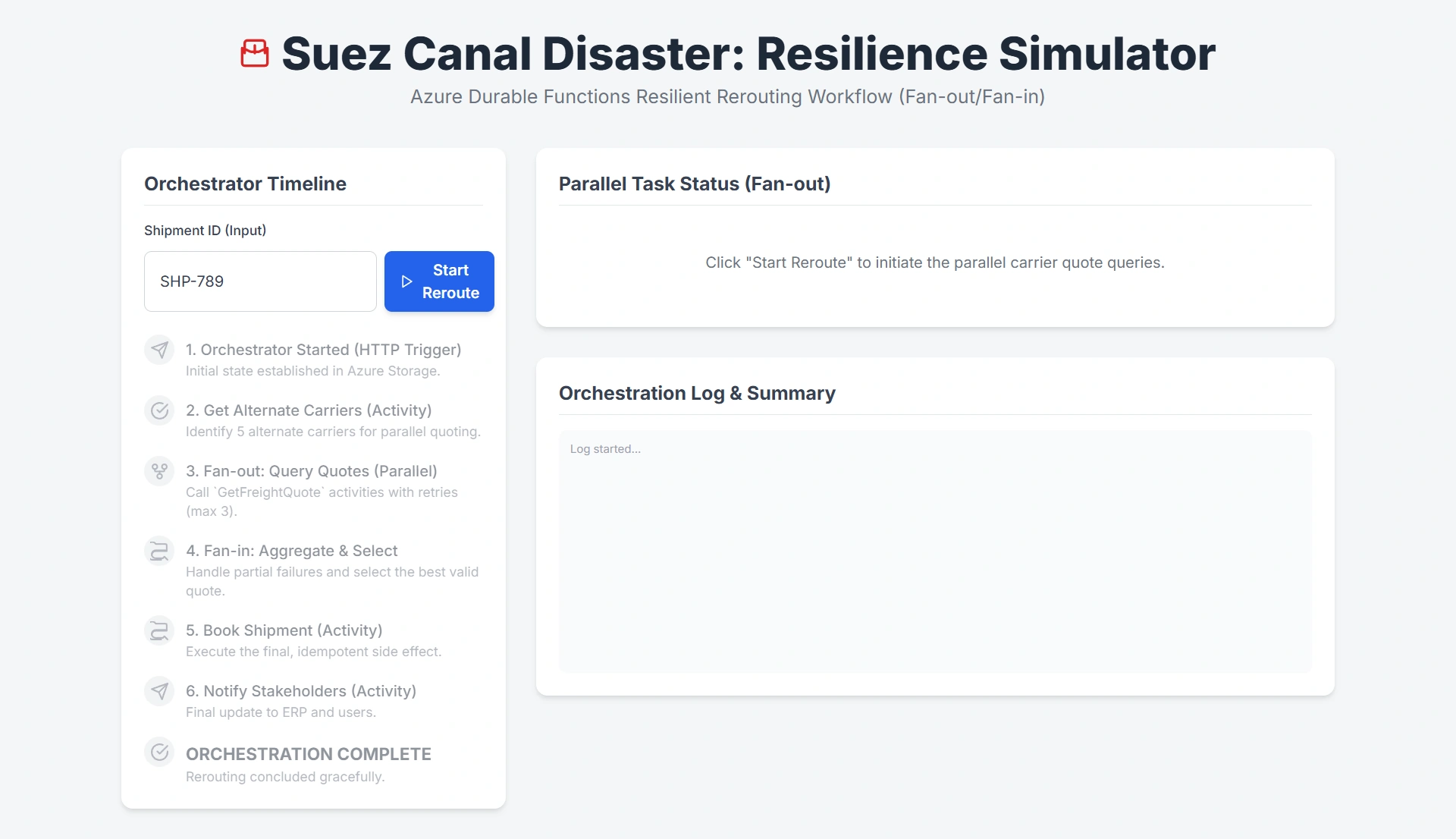
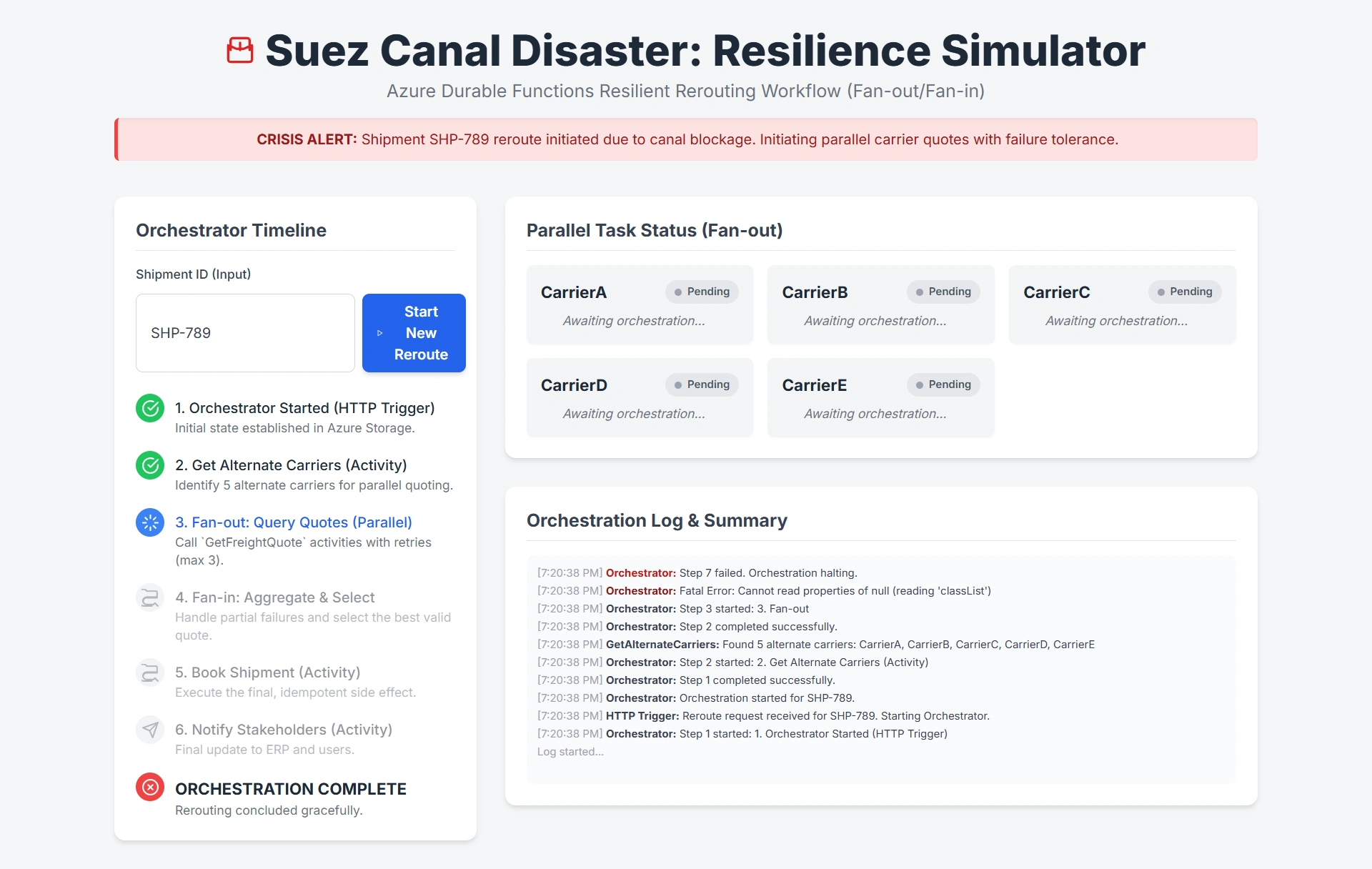
This design:
Uses retry policies at the activity level
Catches individual failures during fan-in
Keeps orchestrator deterministic and replay-safe
Enterprise Resilience Principles
Assume partial failure: In fan-out, expect some tasks to fail. Design for degradation.
Use retry policies wisely: Don’t retry forever—set max attempts and exponential backoff.
Log failures contextually: Include
instanceIdand business context for traceability.Monitor orchestration health: Alert on high failure rates or long-running instances.
Test failure scenarios: Simulate carrier outages in staging using chaos engineering.
Conclusion
When a container ship blocks a global trade artery, your orchestration must keep moving. Azure Durable Functions give you the tools—replay-based resilience, structured error handling, and pattern flexibility—but only if you wield them wisely. Chaining ensures order; fan-out/fan-in ensures speed and robustness. And when failure strikes—as it always does—your workflow doesn’t collapse. It adapts, recovers, and delivers. In the cloud, resilience isn’t optional. It’s architecture.
Join the conversation! Your thoughts help the community grow.