

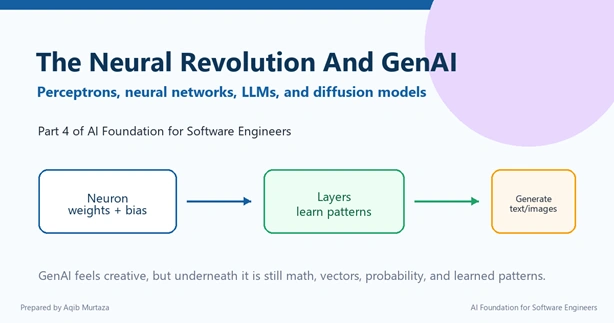
Part 4 explains how neural networks made modern generative AI possible.
Introduction
In Part 3, we explored the shift from hand-written rules to machine learning systems that learn patterns from data. That shift changed how software engineers think about logic, data, and predictions.
Now we move into the neural revolution: the set of ideas that made modern AI systems dramatically more powerful. This is where perceptrons become neural networks, neural networks become deep learning systems, and deep learning systems become the foundation of generative AI.
The goal of this article is not to turn you into a research scientist. The goal is to give software engineers a clean mental model so terms like neural network, LLM, token, hallucination, and diffusion model make practical sense.
Perceptron: The Digital Neuron
A perceptron is one of the simplest building blocks of neural networks. You can think of it as a digital neuron that receives inputs, applies weights, adds a bias, and produces an output through an activation function.
A biological neuron receives signals through dendrites, processes them in the cell body, and sends output through the axon. A perceptron is not a real brain cell, but it borrows the rough idea in mathematical form.
z = (x1*w1) + (x2*w2) + ... + b
output = activation(z)
Here, x represents input values, w represents weights, and b represents bias. The activation function decides how the signal should be transformed into an output.
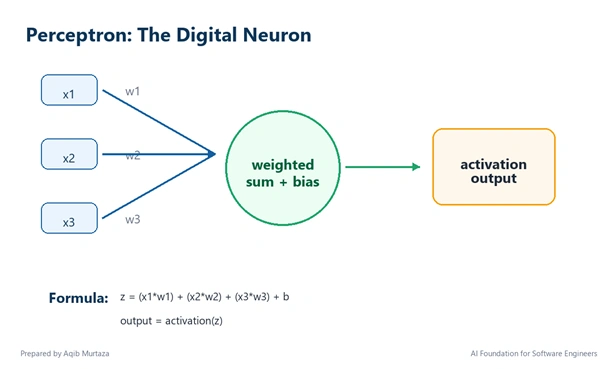
A perceptron combines inputs, weights, and bias before producing an activated output.
For example, in a house-price model, location may be more important than the number of bathrooms. The model can learn a larger weight for location and a smaller weight for bathrooms. Training is the process that adjusts these weights into useful values.
From One Neuron to Neural Networks
One perceptron is simple. The real power appears when many perceptrons are connected together in layers. This structure is called a neural network.
A typical neural network has an input layer, one or more hidden layers, and an output layer. The input layer receives data. Hidden layers transform that data into increasingly useful representations. The output layer produces the final prediction or generated token.
Deep learning means using neural networks with multiple hidden layers. The word deep is not just marketing. It refers to a stack of layers where each layer can learn a different level of representation.
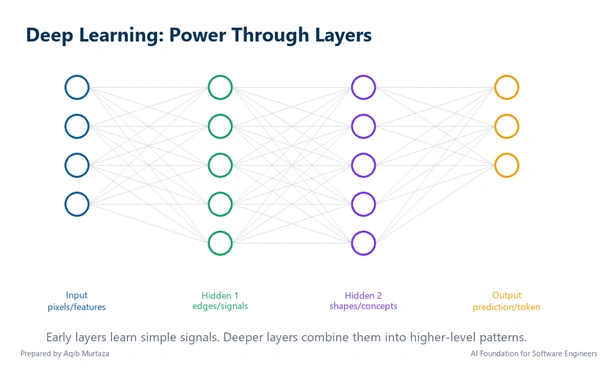
Deep learning uses multiple layers to transform raw inputs into higher-level patterns.
Why Layers Matter
Layers matter because complex concepts can be built from simpler signals. In image recognition, early layers may detect edges and lines. Middle layers may detect shapes such as eyes, ears, wheels, or corners. Deeper layers may detect full objects such as faces, cars, dogs, or buildings.
This is why neural networks became powerful for messy real-world data. Instead of manually writing rules for every pattern, the network can learn useful representations from examples.
For software engineers, this is a crucial idea: neural networks are not just making a final prediction. They are also learning internal representations that help them solve the task.
Generative AI: Machines That Create
Traditional AI systems are often discriminative. They classify, rank, detect, or predict. For example, a model may answer: is this image a cat or a dog? Is this email spam or not spam? What is the predicted house price?
Generative AI goes further. It creates new content using patterns learned from data. It can generate text, images, code, music, video, designs, and structured outputs.
A useful comparison is this: a discriminative model may look at a painting and say, 'This looks like a Picasso painting.' A generative model may take a prompt and create a new robot image in a Picasso-inspired style.
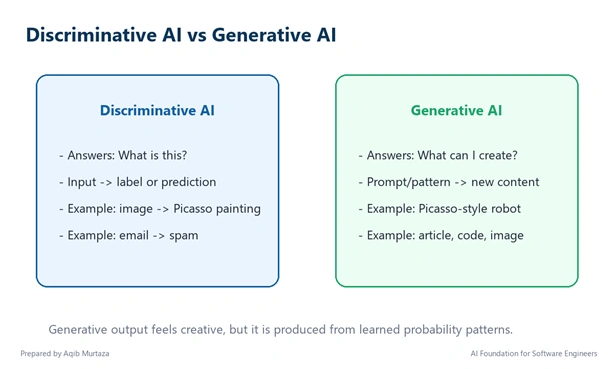
Discriminative AI predicts labels. Generative AI creates new content from learned patterns.
The creative output can feel magical, but the engine underneath is still mathematical: vectors, probabilities, learned patterns, and optimization.
Large Language Models
A large language model, or LLM, is a neural network trained on huge amounts of text and other language-like data. It learns statistical patterns in language and uses those patterns to generate text.
An LLM does not write because it has a soul, emotions, or human understanding. It writes by predicting likely next tokens based on context.
A token can be a word, part of a word, punctuation, or another small unit of text. The model reads the current context and estimates which token should come next.
Prompt: "The cat sat on the ..."
mat -> high probability
floor -> medium probability
moon -> very low probability
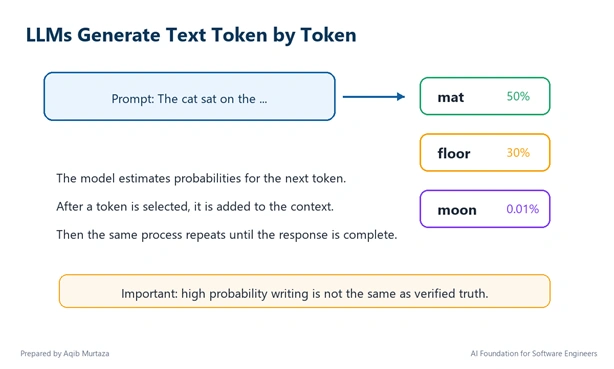
LLMs generate responses by repeatedly predicting the next token from the current context.
After the model selects a token, that token becomes part of the context. Then the model predicts the next token, and the process repeats until the response is complete.
Why LLMs Matter for Developers
LLMs matter because language is the natural interface for human intent. Developers, users, analysts, managers, and customers already express problems through language.
This makes LLMs useful for many software workflows: chatbots, code assistants, document search, customer support, data extraction, summarization, report generation, and agentic task automation.
The important shift is that software can now accept flexible natural language input and produce useful language output. That does not remove the need for engineering. It increases the need for evaluation, grounding, guardrails, observability, and clear product design.
Hallucination: Fluent Does Not Mean True
One of the biggest risks with LLMs is hallucination. A hallucination happens when the model produces an answer that sounds confident but is factually wrong or unsupported.
This happens because the model is optimized to generate plausible next tokens, not guaranteed truth. Good writing style is not the same as verified knowledge.
For low-risk brainstorming, this may be acceptable. For legal, medical, financial, security, or production engineering decisions, it is not enough.
Practical mitigation includes retrieval from trusted sources, citations, validation rules, human review, tests, and clear boundaries around what the system is allowed to answer.
Diffusion Models: Generating Images With Math
Text generation is not the only form of generative AI. Image generation often uses a different family of models called diffusion models.
A diffusion model treats image generation as a denoising problem. During training, noise is gradually added to clean images until they become random fuzz. The model learns how to reverse that process.
During generation, the model starts with random noise and repeatedly removes noise while being guided by a prompt. Step by step, the noise is shaped into an image that matches the requested concept.
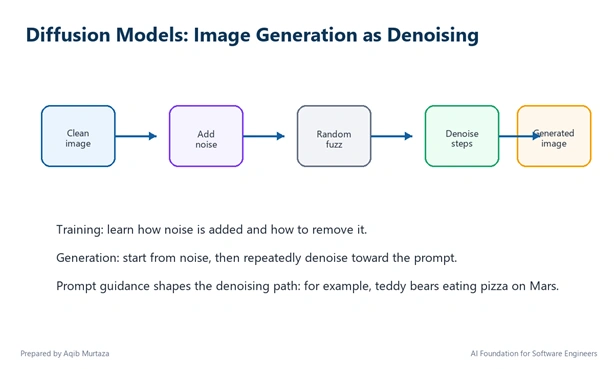
Diffusion models generate images by learning to reverse the noise process.
For example, if the prompt says 'teddy bears eating pizza on Mars', the denoising process is guided toward visual patterns related to teddy bears, pizza, Mars, lighting, composition, and style.
What GenAI Is Really Learning
Generative AI is learning probability distributions. In simple words, it learns what realistic data looks like and how new samples can be created that resemble the training distribution.
For text, that means learning language patterns, grammar, facts, styles, code structures, and relationships between concepts. For images, that means learning visual patterns such as edges, textures, object shapes, lighting, and composition.
This is why GenAI can feel creative. It is not copying one exact example every time. It is sampling from learned patterns and combining them in new ways.
A Developer-Friendly Mental Model
If you are a software engineer, keep this simple mental model:
Perceptron = small mathematical decision unit.
Neural network = many units connected in layers.
Deep learning = many layers learning richer representations.
Generative AI = models that create new content from learned patterns.
LLM = generative model for language using next-token prediction.
Diffusion model = generative model for images using denoising.
This model will help you understand modern AI systems without getting lost in hype. You do not need to memorize every research detail, but you should know what kind of system you are using and where it can fail.
Conclusion
The neural revolution made modern AI possible by scaling simple mathematical units into deep networks that learn powerful representations.
Generative AI builds on this foundation. LLMs generate text token by token. Diffusion models generate images by reversing noise. Both systems can produce impressive results, but both still require engineering discipline.
For software engineers, the right mindset is balanced: appreciate the power, understand the math-shaped foundation, and design systems that verify, constrain, monitor, and improve AI behavior.
In the next part of this series, we will focus on evaluating and deploying AI: metrics beyond accuracy, overfitting, bias, validation, monitoring, and practical production concerns.
Join the conversation! Your thoughts help the community grow.