

Introduction
With every new C# release, the language continues to reduce boilerplate while improving clarity and maintainability. C# 14, designed to work seamlessly with the .NET 10 framework, introduces an important evolution in object construction: Partial Constructors.
This feature builds on partial classes and primary constructors, enabling large and modular applications to share constructor logic across files without sacrificing readability or correctness. For enterprise systems, source generators, and layered architectures, this is a genuine game changer.
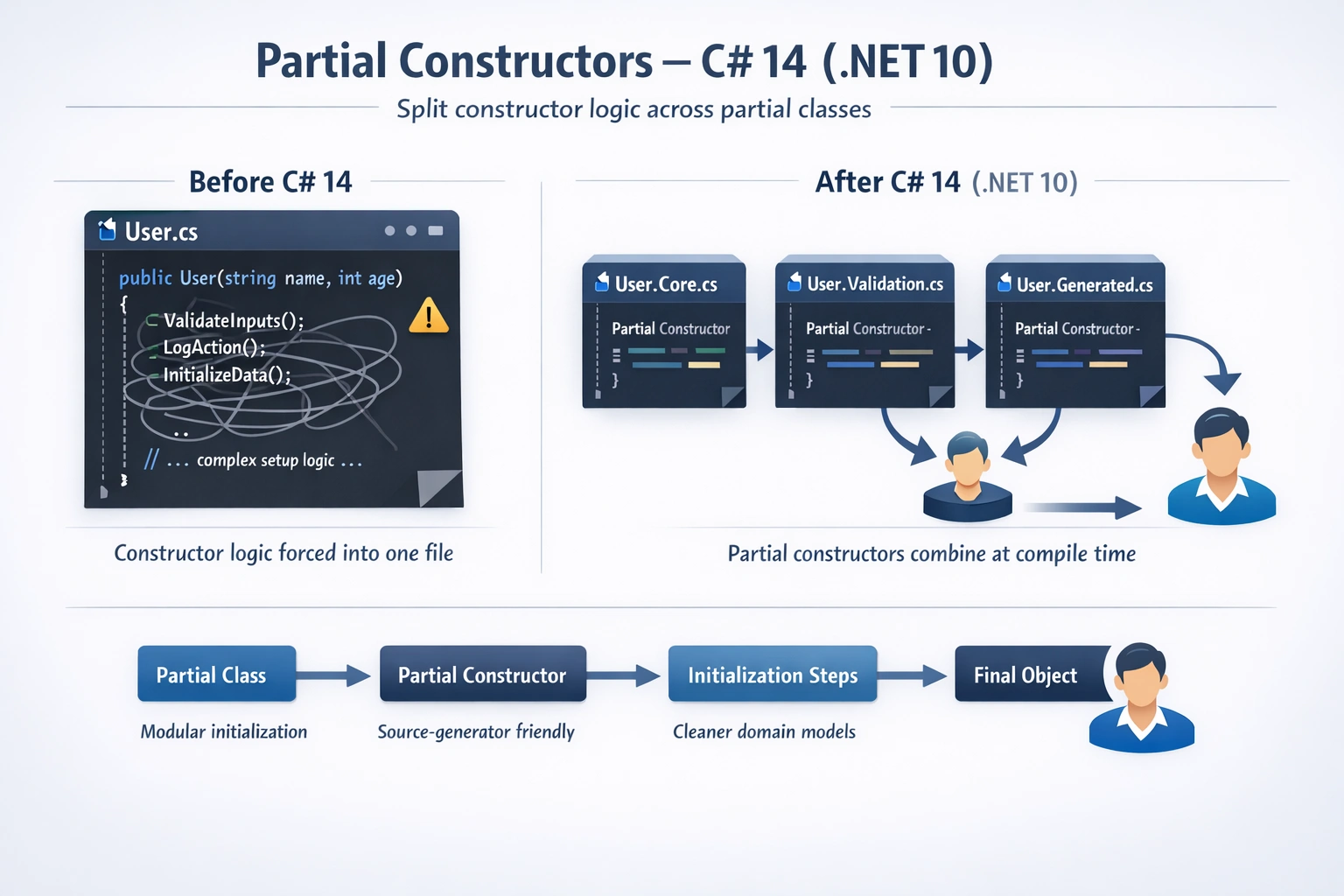
What Is a Partial Constructor?
A partial constructor allows the implementation of a constructor to be split across multiple partial class declarations, enabling different parts of a class to contribute to the object's initialization logic.
In short:
The constructor signature is defined once
Its initialization logic can be extended in other partial files
The compiler combines them into a single constructor at build time
Why Partial Constructors Were Needed
Before C# 14, developers faced several limitations:
Constructor logic had to live in one file
Partial classes could not share constructor initialization cleanly
Source generators had no safe way to inject constructor logic
Large domain models ended up with bloated constructors
Partial constructors solve these issues by allowing modular initialization.
Partial Constructors vs Traditional Constructors
| Feature | Traditional Constructor | Partial Constructor |
|---|---|---|
| Works with partial classes | ❌ | ✅ |
| Split logic across files | ❌ | ✅ |
| Source-generator friendly | ❌ | ✅ |
| Cleaner separation of concerns | ❌ | ✅ |
| Compatible with primary constructors | ❌ | ✅ |
Basic Example: Partial Constructor in Action
File 1: Core Model Definition
public partial class User
{
    public string Name { get; }
    public string Email { get; }

    public partial User(string name, string email);
}
File 2: Validation Logic
public partial class User
{
    partial void Initialize(string name, string email)
    {
        if (string.IsNullOrWhiteSpace(name))
            throw new ArgumentException("Name is required.");

        if (!email.Contains("@"))
            throw new ArgumentException("Invalid email.");
    }
}
File 3: Constructor Implementation
public partial class User
{
    public partial User(string name, string email)
    {
        Initialize(name, email);
        Name = name;
        Email = email;
    }
}
✔ The compiler merges all partial pieces into a single constructor
✔ Initialization logic is cleanly separated
✔ Each concern lives in its own file
Partial Constructors with Primary Constructors (C# 14)
C# 14 extends this concept to primary constructors, making them even more powerful.
public partial class Product(string name, decimal price)
{
    public string Name { get; } = name;
    public decimal Price { get; } = price;
}
Adding Partial Initialization Logic
public partial class Product
{
    partial void OnConstructed()
    {
        if (Price <= 0)
            throw new ArgumentOutOfRangeException(nameof(Price));
    }
}
The runtime behavior is the same as if all logic lived in one constructor, but the code is modular and extensible.
Why This Is a Game Changer in .NET 10
1. Better Source Generator Support
Source generators can safely add:
Logging
Validation
Dependency checks
…without rewriting your constructor.
2. Cleaner Domain Models
Each layer owns its own initialization:
Domain validation
Infrastructure setup
Diagnostics hooks
3. Improved Maintainability
Smaller files
Clear responsibility boundaries
Fewer merge conflicts
4. Future-Proof Design
Partial constructors align with:
AOT compilation
Modular monoliths
Large-scale cloud services
Real-World Use Cases
Enterprise applications
DDD (Domain-Driven Design)
Code generation frameworks
SDK and library development
Microservice model validation
Key Rules to Remember
The class must be marked
partialThe constructor signature must match exactly
All partial parts are combined at compile time
Execution order follows the compiler's constructor composition rules
Partial constructors do not change runtime performance
Join the conversation! Your thoughts help the community grow.