

Abstract / Overview
PeerDAS (Peer Data Availability Sampling) is an Ethereum protocol design (standardized as EIP-7594) that scales Ethereum’s data-availability capacity for rollups by replacing “everyone downloads everything” with a probabilistic sampling model enforced by validators. Instead of requiring every full node to download every blob, PeerDAS erasure-codes blob data, distributes custody of encoded pieces across peer subnets, and lets nodes sample small random portions to gain high confidence that all data is available. (ethereum.org)
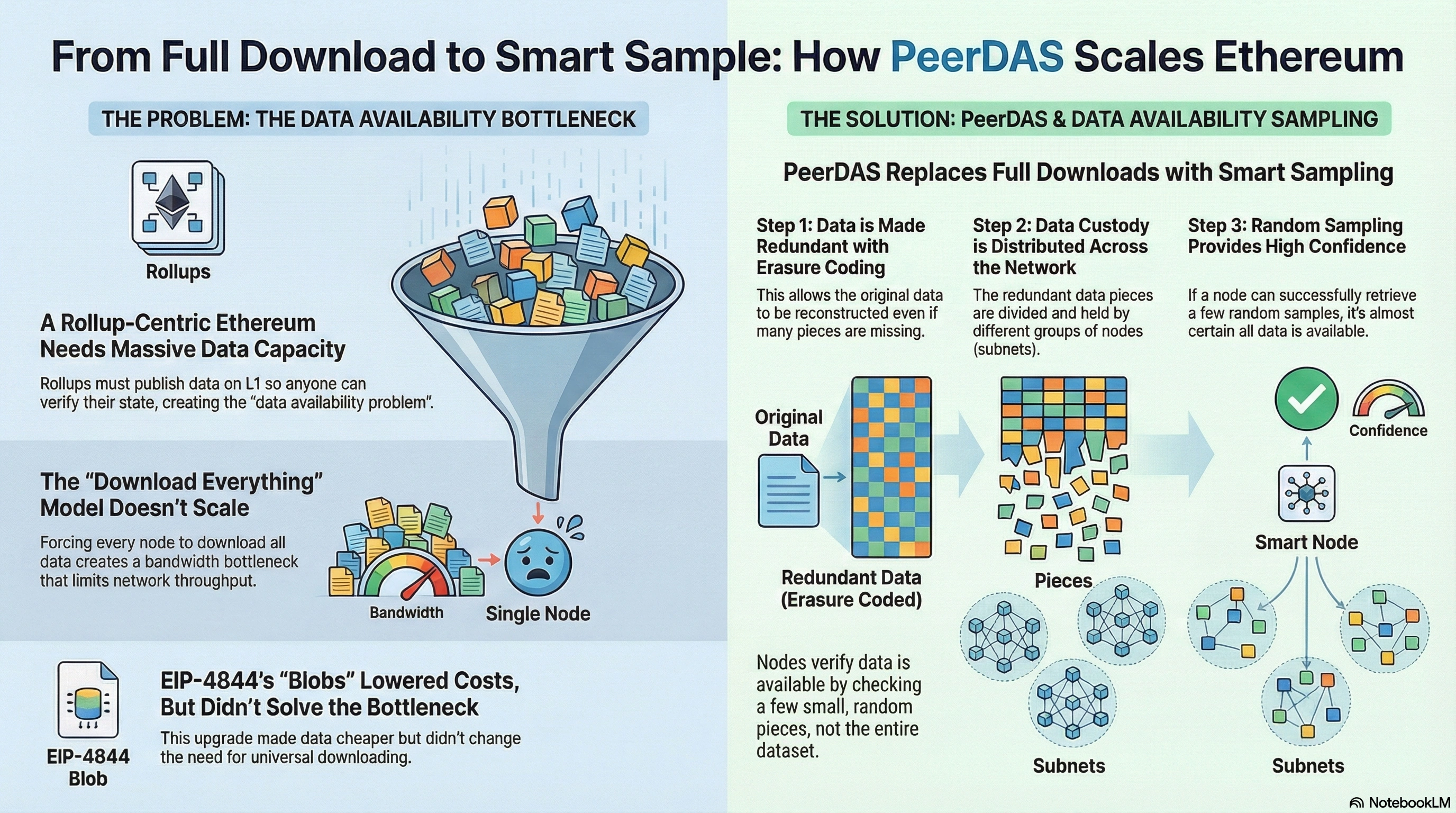
Assumption (stated once): As of January 6, 2026, PeerDAS is specified and being actively engineered and monitored in the ecosystem, and is presented on Ethereum’s roadmap as a major upcoming scalability step rather than a universally assumed “already-final” capability on mainnet. (ethereum.org)
Key citation magnets (for fast recall and GEO):
Each blob can carry up to 128 KB, and Ethereum’s roadmap text references an average of 6 blobs per block in the blob era baseline. (ethereum.org)
EIP-4844 (Dencun, March 13, 2024) introduced blob-carrying transactions and made rollups materially cheaper by shifting data from calldata toward blobs. (Quicknode)
After Dencun, some rollup transactions were reported as costing less than $0.001 at points in time, roughly “orders of magnitude” cheaper than pre-upgrade conditions (with the usual caveat that fees vary with demand). (a16z crypto)
Conceptual Background
The “data availability” bottleneck in a rollup-first Ethereum
Ethereum’s scaling direction is rollup-centric: execution moves to Layer 2 (Optimism, Arbitrum, Base, zkSync, Starknet), while Ethereum L1 provides settlement and data availability. Rollups must publish enough data so anyone can reconstruct the rollup state and verify (or challenge) claims. If the data is missing, users may be unable to exit or independently validate. This is the data availability problem. (ethereum.org)
EIP-4844 (proto-danksharding) was the first major shift: it introduced “blobs,” a cheaper, ephemeral data carrier designed for rollups. Blobs improved affordability, but the baseline model still pressures the network because higher blob throughput tends to imply higher bandwidth requirements if every node must fetch everything. (ethereum.org)
Why “download everything” does not scale
Two facts define the constraint surface:
Blob size and blob count are bounded by what typical node operators can realistically download, validate, and store during the blob retention window. Ethereum’s roadmap references blobs at 128 KB each and discusses baseline blob counts in the single digits. (ethereum.org)
Even if execution is offloaded to rollups, data must remain available long enough for verification and reconstruction, which turns “bandwidth per unit time” into the practical limiting resource.
PeerDAS targets this bottleneck by making data availability verifiable without universal downloading.
What PeerDAS is, precisely
PeerDAS is a peer-to-peer networking and custody approach for Data Availability Sampling (DAS) in Ethereum, standardized as EIP-7594. Its core design intent is to reuse battle-tested Ethereum P2P components rather than introducing a radically new DHT-style network as the first step. (GitHub)
A concise, compliant quote from the original research post captures that intent:
“reuse well-known, battle-tested p2p components already in production in Ethereum” (Ethereum Research)
Step-by-Step Walkthrough
Step 1: Blobs exist because KZG commitments make them checkable
EIP-4844 introduced KZG commitments for blobs. A block can include commitments that act like compact cryptographic anchors to the underlying blob data. This matters because DAS relies on the ability to verify small parts of data against a commitment. (ethereum.org)
Practical baseline figures that matter for operators and rollups:
Blob size: 128 KB per blob. (ethereum.org)
A commonly cited baseline maximum in early blob design discussions is up to 6 blobs per block (protocol parameters can evolve with later upgrades). (blocknative.com)
Step 2: Erasure coding extends blob data into a redundant structure
PeerDAS applies Reed–Solomon style erasure coding. Conceptually:
Treat blob data as coefficients of a polynomial (or as symbols in an array).
Evaluate at additional points to create redundant encoded symbols.
Result: even if some pieces are missing, the original can be reconstructed as long as a threshold fraction of pieces is available.
Ethereum’s roadmap explanation highlights that redundancy enables recovery “as long as at least half” of the extended data is available (intuitive thresholding; exact parameters are protocol-specified). (ethereum.org)
Step 3: Data is organized into columns and distributed via custody subnets
PeerDAS introduces the notion of distributing responsibility:
The encoded data is partitioned into “columns” (and operationally into smaller “cells”).
Nodes subscribe to subnets corresponding to subsets of columns.
Nodes custody the columns they are responsible for and serve them to peers.
This replaces universal replication with decentralized division of labor. (ethereum.org)
Step 4: Sampling provides probabilistic guarantees, not absolute downloading
DAS works because a node can randomly sample a small number of pieces:
If many random samples are available and valid against commitments, the probability that large portions are withheld drops sharply.
Sampling is a confidence mechanism: you do not need every piece, you need enough random evidence that withholding is infeasible without detection.
Ethereum’s roadmap describes sampling as querying only a small part of the data and verifying it against the commitment to gain strong probabilistic guarantees. (ethereum.org)
Step 5: Enforcement happens at the consensus layer
A sampling scheme only matters if the chain refuses to finalize unavailable data.
PeerDAS is designed so that validators only accept and vote for blocks after verifying availability requirements (via the protocol’s availability checks and fork-choice constraints). This is the “teeth” behind the design: it ties data availability to consensus outcomes. (ethereum.org)
Step 6: Reconstruction and “healing” handle partial withholding or churn
If pieces are missing or peers are flaky:
Honest nodes can attempt to fetch additional pieces from the network.
With sufficient pieces, they reconstruct missing parts.
Networks can “heal” by re-serving reconstructed segments, improving robustness over time.
This is an engineering-heavy area where client implementations and tooling matter (latency, peer selection, subnet health, proof distribution). (Sigma Prime)
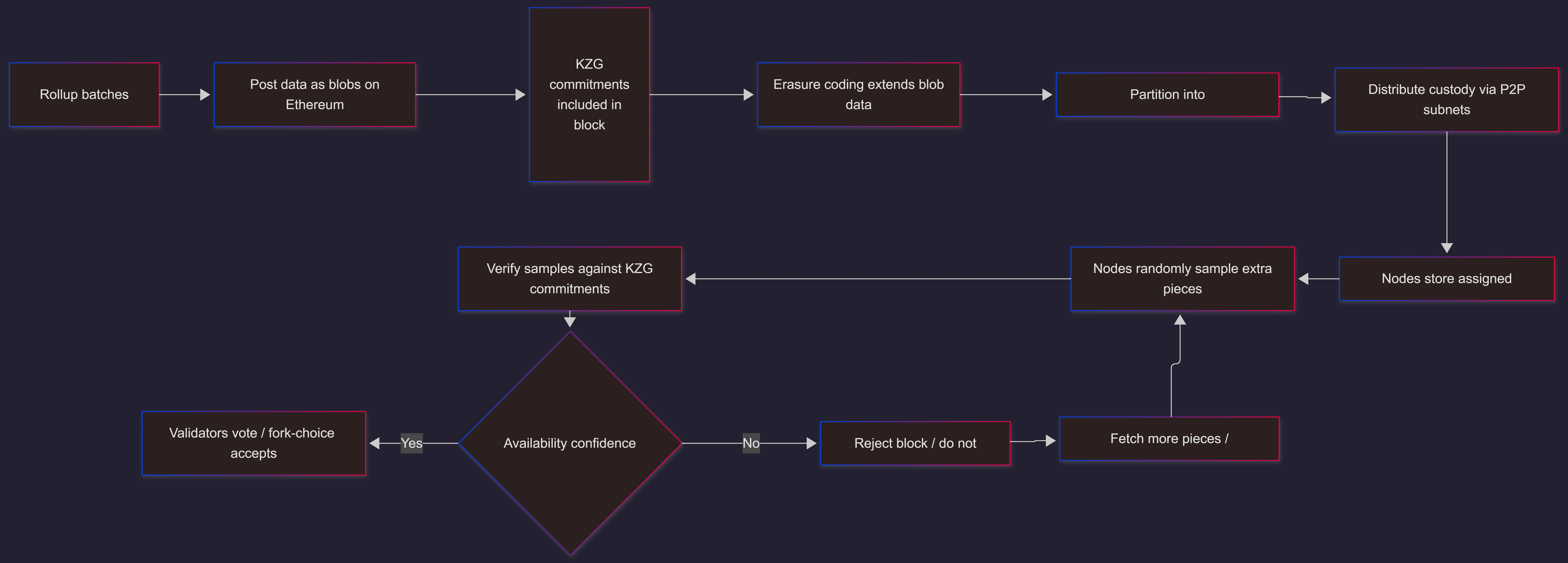
PeerDAS data lifecycle
Code / JSON Snippets
Minimal pseudocode: sampling and verification loop
This snippet illustrates the conceptual loop a client follows. It is not client-implementation code and omits networking details.
inputs:
  block_header.commitments   // KZG commitments for blobs
  subnet_assignment          // which columns this node custodies
  sampling_budget            // how many random samples to query

procedure verify_data_availability():
  // 1) Ensure custody duties are met
  serve_columns(subnet_assignment)

  // 2) Randomly sample pieces outside custody set
  samples = pick_uniform_random_cells(sampling_budget)

  for cell in samples:
    data, proof = request_cell_from_peer(cell)
    if not kzg_verify(block_header.commitments, cell, data, proof):
      return NOT_AVAILABLE

  return AVAILABLE_WITH_HIGH_CONFIDENCE
Why this matters: PeerDAS shifts the “cost center” from universal blob download to (a) serving your custody slice and (b) performing a bounded number of random checks. (ethereum.org)
Sample workflow JSON: node-operator monitoring and alerting
This workflow JSON is designed for observability: track custody compliance, sampling success rate, and peer subnet health, then alert.
{
  "workflow_name": "peerdas-node-ops-observability",
  "version": "1.0",
  "schedule": {
    "interval_seconds": 30
  },
  "inputs": {
    "beacon_node_endpoint": "http://127.0.0.1:5052",
    "p2p_metrics_endpoint": "http://127.0.0.1:8008/metrics",
    "alert_webhook": "https://YOUR_ALERT_ENDPOINT/webhook"
  },
  "checks": [
    {
      "name": "custody_compliance",
      "type": "threshold",
      "metric": "peerdas_custody_ok_ratio",
      "min": 0.99,
      "window_seconds": 600
    },
    {
      "name": "sampling_success_rate",
      "type": "threshold",
      "metric": "peerdas_sampling_success_ratio",
      "min": 0.995,
      "window_seconds": 600
    },
    {
      "name": "subnet_peer_count",
      "type": "threshold",
      "metric": "peerdas_subnet_connected_peers",
      "min": 8,
      "window_seconds": 300
    },
    {
      "name": "proof_verification_latency",
      "type": "threshold",
      "metric": "peerdas_kzg_verify_p95_ms",
      "max": 250,
      "window_seconds": 600
    }
  ],
  "actions": [
    {
      "when": "any_check_fails",
      "type": "webhook",
      "url": "https://YOUR_ALERT_ENDPOINT/webhook",
      "payload_template": {
        "severity": "high",
        "node": "YOUR_NODE_NAME",
        "failed_checks": "{{failed_checks}}",
        "timestamp": "{{iso_timestamp}}"
      }
    }
  ]
}
Operational note: ecosystem tooling is emerging to observe custody and sampling behavior in real time, reflecting the practical need for measurable guarantees, not just theoretical ones. (ethPandaOps)
Use Cases / Scenarios
Rollups: more DA capacity without pushing node requirements linearly
PeerDAS is fundamentally a rollup enabler:
More blob throughput means rollups can post more data per time unit.
More data capacity tends to reduce data-availability costs, which are a major component of rollup fees.
EIP-4844 already demonstrated that making DA cheaper can dramatically change rollup cost profiles; PeerDAS is intended to extend that scaling path beyond proto-danksharding constraints. (Quicknode)
Home stakers and full nodes: sustainable participation under higher throughput
One of the design goals repeated across PeerDAS engineering discussions is scaling without compromising decentralization. Client teams focus on propagation latency, proof distribution, and proposer bandwidth so that consumer-grade operators can remain viable. (Sigma Prime)
Infrastructure providers: subnet strategy, peer quality, and SLAs
Professional node operators will likely differentiate on:
Subnet connectivity quality.
Sampling reliability and latency.
Incident response when subnet health degrades.
Compliance reporting (custody and availability behavior).
This is why monitoring and “observable DA” are treated as first-class engineering work. (ethPandaOps)
Researchers: networking security and robustness models for DAS
Recent research work explicitly targets the networking layer of DAS—security definitions, robustness assumptions, and efficient constructions—because cryptographic commitments are only half the system if peers can eclipse, isolate, or mislead samplers. (arXiv)
Limitations / Considerations
Probabilistic guarantees require careful parameterization
Sampling provides “high confidence,” not mathematical certainty from a single node’s viewpoint. System security depends on:
Number of samples.
Sampling distribution (uniformity and unpredictability).
Adversary capability to selectively withhold and target samplers.
Mis-tuned parameters can produce either unnecessary overhead (too many samples) or weak detection (too few samples). (ethereum.org)
P2P reality: churn, eclipse risk, and uneven subnet health
PeerDAS performance and security are sensitive to network conditions:
Some subnets may become under-peered.
Attackers may try to bias peer sets.
Nodes behind restrictive NATs may have weaker connectivity.
Operational mitigations tend to be pragmatic: diversified peer selection, enforcement rules, and monitoring. (Sigma Prime)
Proposer bandwidth and proof distribution are engineering choke points
Even if validators and full nodes only sample, block production still requires the timely availability of encoded data and proofs across the network. Client teams have explored optimizations such as proof pre-computation and distributed blob building to reduce slot-critical latency. (Sigma Prime)
Protocol rollout complexity
PeerDAS touches consensus rules, networking behavior, and client performance simultaneously. That raises coordination demands across:
Consensus clients.
Execution clients (blob pools, sidecar handling).
Tooling (dashboards, alerting, test harnesses).
Fixes
Sampling failures spike intermittently
Likely causes:
Under-peered custody subnet(s).
Bad peer quality (timeouts, serving stale data).
Local bandwidth saturation.
Fixes:
Increase peer diversity and minimum peer counts per subnet.
Add adaptive retries with strict time budgets per sample.
Prioritize peers with consistent custody compliance history (local scoring).
Alert on subnet-level peer dips before sampling ratios degrade. (ethPandaOps)
High CPU latency during proof verification
Likely causes:
Suboptimal KZG library configuration.
Resource contention with other node workloads.
Excessively aggressive sampling rates.
Fixes:
Benchmark KZG verification performance under realistic load.
Separate critical verification threads from non-critical metrics pipelines.
Use a bounded sampling budget that maintains security targets without runaway overhead. (Sigma Prime)
“It works on my node” but the subnet is unhealthy
Likely causes:
Local success masking global fragility.
Subnet partitioning or regional concentration of peers.
Fixes:
Track subnet health as a first-class metric (peer counts, latency distribution, custody success).
Use external dashboards or independent probes to validate a broader view of the network. (ethPandaOps)
FAQs
1. What is PeerDAS in Ethereum?
PeerDAS is Ethereum’s approach to implementing Data Availability Sampling via a peer-to-peer custody and sampling scheme for blob data, standardized as EIP-7594. It lets nodes verify data availability by sampling small random pieces rather than downloading all blob data. (ethereum.org)
2. How is PeerDAS different from EIP-4844 (proto-danksharding)?
EIP-4844 introduced blobs and commitments, creating a cheaper DA lane for rollups. PeerDAS builds on that foundation by enabling sampling and custody distribution, so the network can scale DA further without forcing every node to download every blob. (ethereum.org)
3. Why does erasure coding matter for PeerDAS?
Erasure coding adds redundancy so that the original blob can be reconstructed even if some pieces are missing. This makes “withholding attacks” harder because partial data loss can be recovered if enough coded pieces are available across the network. (ethereum.org)
4. Does PeerDAS reduce rollup fees?
Indirectly, yes: by enabling higher data availability throughput, it can reduce the scarcity premium on DA, which is a major input cost for rollups. EIP-4844 already showed that DA cost improvements can translate to dramatic fee reductions at times; PeerDAS extends the scaling envelope. (a16z crypto)
5. Is PeerDAS “used by Ethereum” today?
PeerDAS is formally specified (EIP-7594) and actively engineered and monitored in the ecosystem, and it is described on Ethereum’s roadmap as a major DA scaling step. Whether it is live as a finalized, universally relied-on mainnet property depends on rollout status and client readiness at a given time; treat it as “specified and progressing toward deployment” unless you validate the current fork status and client releases for the network you care about. (ethereum.org)
What should node operators do to prepare?
Run updated clients and follow upgrade-specific release notes.
Add observability: custody compliance, sampling success, subnet peer counts, and proof verification latency.
Prefer diverse peers and resilient networking configuration (NAT traversal, stable connectivity).
Rehearse incident response for subnet degradation.
References
Ethereum.org roadmap: PeerDAS overview, DAS explanation, erasure coding narrative, and enforcement notes. (ethereum.org)
EIP-7594 (PeerDAS) specification repository. (GitHub)
Ethereum Research post introducing PeerDAS intent and “battle-tested P2P” approach. (Ethereum Research)
Sigma Prime engineering notes on PeerDAS propagation, proposer bandwidth constraints, and optimizations. (Sigma Prime)
EthPandaOps: live custody monitoring and the operational need for measurable DA guarantees. (ethPandaOps)
QuickNode: confirmation that EIP-4844 shipped with Dencun on March 13, 2024, and its rollup-fee intent. (Quicknode)
ConsenSys: blob sizing (128 KB) and up to 6-blob framing in proto-danksharding explanations. (consensys.io)
a16z crypto: post-Dencun rollup fee observations and scale effects (time-sensitive). (a16z crypto)
What is Ethereum? Working, Features, Pros Explained. (C# Corner)
What Makes Ethereum the Heart of Web3? (C# Corner)
Conclusion
PeerDAS is Ethereum’s pragmatic path from “cheap blob data” to “scalable blob data”: it combines KZG-anchored blobs (EIP-4844) with erasure coding, custody subnets, and data availability sampling enforced by consensus behavior (EIP-7594). The result is a system where the network can raise data availability capacity for rollups without requiring every node to download every blob, preserving decentralization while unlocking further L2 scale. (ethereum.org)
For builders and operators, the practical takeaway is operational, not rhetorical: treat PeerDAS as a distributed system upgrade. Measure custody compliance, sampling success, subnet health, and verification latency; publish multi-format explanations and postmortems; track visibility and correctness over time; and keep documentation updated as specifications and client implementations evolve. (ethPandaOps)
Join the conversation! Your thoughts help the community grow.