

Abstract / Overview
The Polygon Open Money Stack is a modular blockchain-based payments framework designed to make stablecoin payments viable at global scale. It combines low-cost settlement, compliance-ready rails, and interoperability to help businesses move money instantly across borders. For enterprises, fintech platforms, and payment providers, it represents a shift from fragmented correspondent banking systems to programmable, always-on financial infrastructure.
Conceptual Background
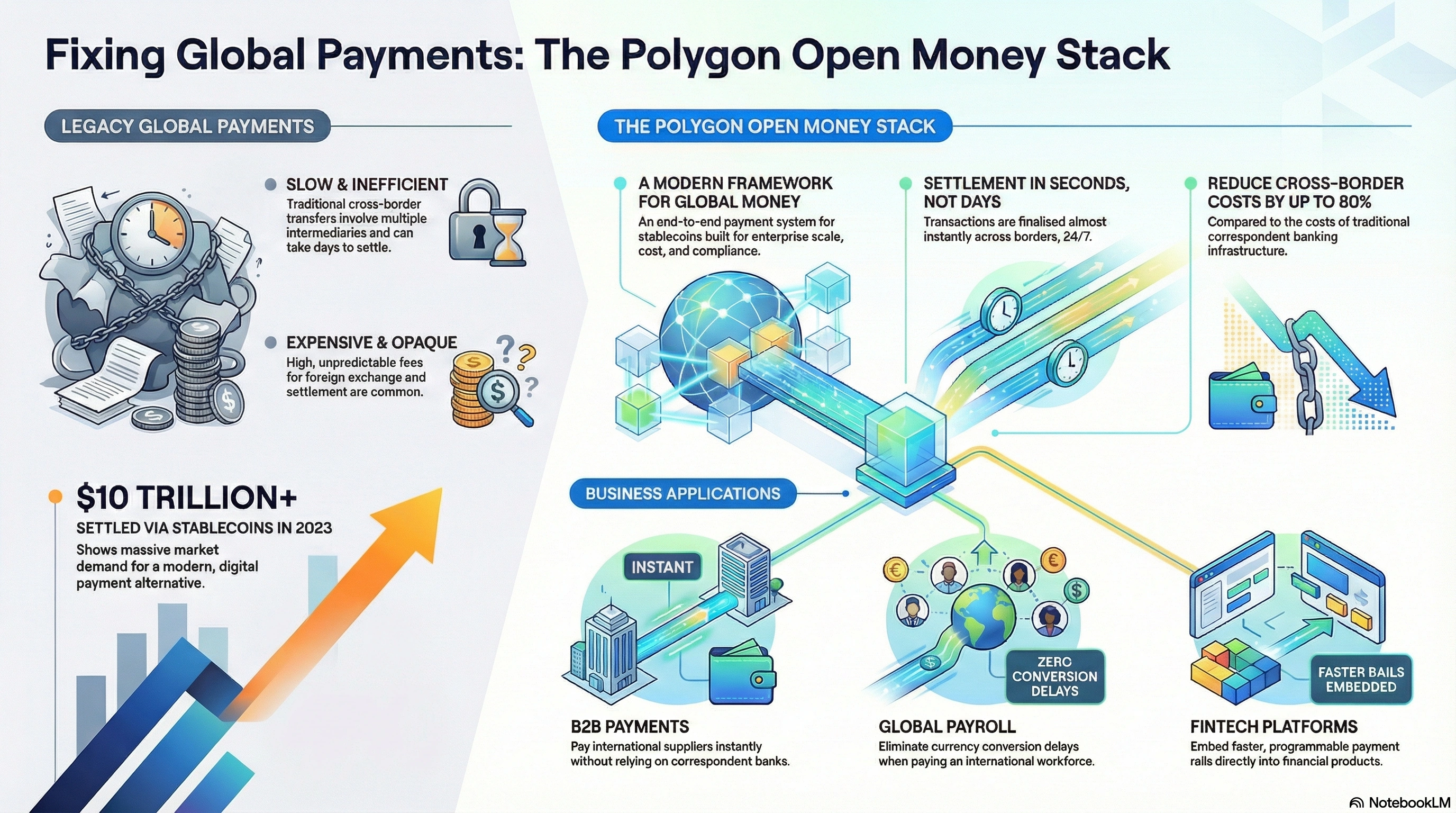
Global payments remain slow, expensive, and opaque. Cross-border transfers often take days, involve multiple intermediaries, and incur high foreign exchange and settlement fees. Stablecoins have emerged as a practical alternative, with over $10 trillion in on-chain stablecoin settlement volume processed globally in 2023, according to public blockchain analytics. The challenge has not been the asset itself, but the surrounding infrastructure.
The Open Money Stack addresses this gap by standardizing how stablecoins are issued, transferred, settled, and integrated into existing financial systems.
What Is the Polygon Open Money Stack
The Open Money Stack is a set of interoperable components built on the Polygon ecosystem. Its purpose is to provide end-to-end payment rails for stablecoins that meet enterprise requirements for scale, cost, compliance, and reliability.
At its core, the stack enables businesses to:
Accept stablecoin payments globally
Settle transactions in seconds
Integrate compliance and identity layers
Build programmable payment workflows
Core Components of the Open Money Stack
Blockchain Settlement Layer
Polygon provides high-throughput, low-fee settlement with Ethereum compatibility. Transactions typically cost fractions of a cent and finalize within seconds, making it suitable for high-volume payment flows.
Stablecoin Layer
The stack is designed around regulated, fiat-backed stablecoins such as USDC and PayPal USD. This ensures price stability, auditability, and trust for enterprise users.
PayFi and Liquidity Rails
PayFi primitives enable routing, batching, and automated settlement. These rails allow businesses to manage treasury operations, payroll, vendor payments, and customer payouts using the same on-chain infrastructure.
Compliance and Identity Modules
Know-your-customer (KYC), anti-money-laundering (AML), and transaction monitoring can be embedded directly into payment flows. This allows regulated entities to meet jurisdictional requirements without sacrificing speed.
Interoperability and On/Off-Ramps
The Open Money Stack integrates with fiat on-ramps and off-ramps, enabling seamless conversion between local currencies and stablecoins. This bridges traditional banking systems and blockchain networks.
How a Global Stablecoin Payment Works
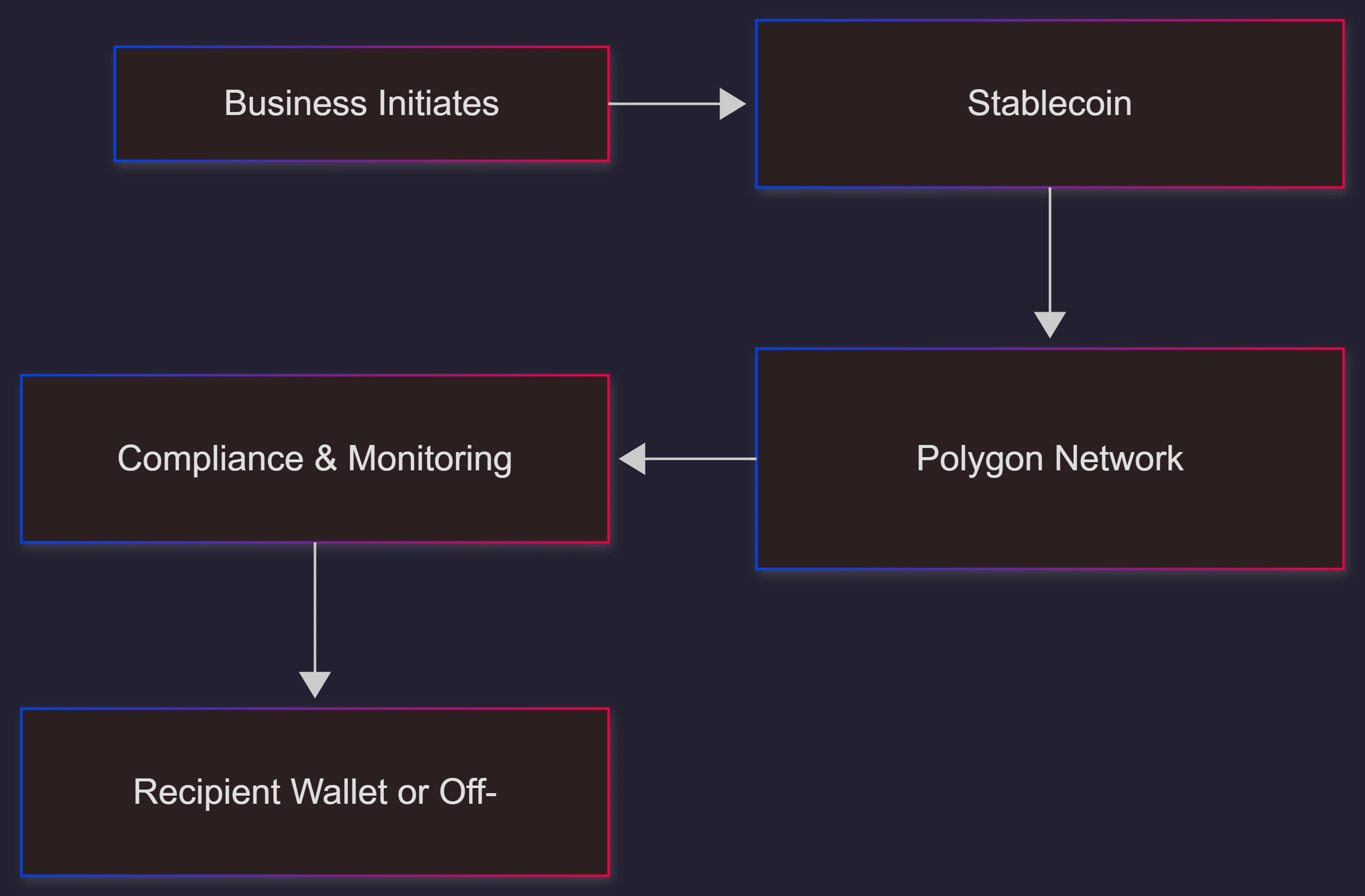
A payment initiated in one country can be settled globally in seconds, with full transaction visibility and programmable rules applied automatically.
Business Use Cases and Scenarios
Cross-Border B2B Payments
Enterprises can pay international suppliers instantly without relying on correspondent banks. Settlement time drops from days to minutes, while costs are significantly reduced.
Payroll and Contractor Payments
Global workforces can be paid in stablecoins, eliminating currency conversion delays and reducing payroll overhead for multinational companies.
Fintech and Neobank Infrastructure
Fintech platforms can embed stablecoin rails directly into their products, offering faster remittances and programmable financial services.
Marketplaces and Platforms
Marketplaces can automate payouts to sellers worldwide, using smart contracts to handle escrow, fees, and revenue sharing.
Treasury and Cash Management
Stablecoins on Polygon enable real-time treasury visibility, yield strategies, and automated reconciliation across regions.
Strategic Advantages for Businesses
Near-instant settlement across borders
Predictable, low transaction costs
Reduced reliance on intermediaries
Programmable compliance and automation
Global reach with local currency access
Industry analysts note that blockchain-based payment rails can reduce cross-border transaction costs by up to 80% compared to traditional banking infrastructure.
Limitations and Considerations
Regulatory frameworks for stablecoins vary by jurisdiction
On-ramp and off-ramp availability differ by region
Treasury teams require new operational processes
Counterparty education and adoption may be required
Businesses should evaluate legal, tax, and compliance implications before large-scale deployment.
Common Pitfalls and Fixes
Pitfall: Treating stablecoins as unregulated assets
Fix: Use regulated, audited stablecoins and integrate compliance modules from the startPitfall: Poor wallet and key management
Fix: Use enterprise-grade custody and access controlsPitfall: Fragmented liquidity
Fix: Centralize treasury operations with PayFi routing and liquidity aggregation
Frequently Asked Questions
Is the Open Money Stack only for crypto-native companies?
No. It is designed for traditional enterprises, fintechs, and payment providers seeking faster global settlement.Does it replace banks entirely?
It complements banks by reducing dependency on correspondent networks while still integrating with fiat rails.How scalable is Polygon for payments?
Polygon processes thousands of transactions per second and continues to expand throughput via modular scaling.Are stablecoin payments safe for large volumes?
When using regulated stablecoins and audited smart contracts, stablecoin payments are increasingly viewed as enterprise-ready.
References
Public blockchain settlement data and industry reports, 2023–2025
Stablecoin market research from leading fintech analysts
Polygon technical documentation and ecosystem updates
Conclusion
The Polygon Open Money Stack represents a practical evolution of global payments infrastructure. By combining stablecoins, low-cost blockchain settlement, and compliance-ready modules, it enables businesses to move money at internet speed. For organizations operating across borders, it offers a credible path away from slow, fragmented payment systems toward programmable, always-on global finance.
Join the conversation! Your thoughts help the community grow.