

New York / Jan 13, 2026 — Polygon Labs, the prominent blockchain infrastructure company powering one of the most active Layer-2 ecosystems tied to Ethereum, announced definitive agreements to acquire two key U.S. crypto firms - Coinme and Sequence — in deals valued at more than $250 million. This marks a pivotal moment in Polygon’s strategy to build a fully regulated U.S. payments platform centered on stablecoins and licensed financial infrastructure.
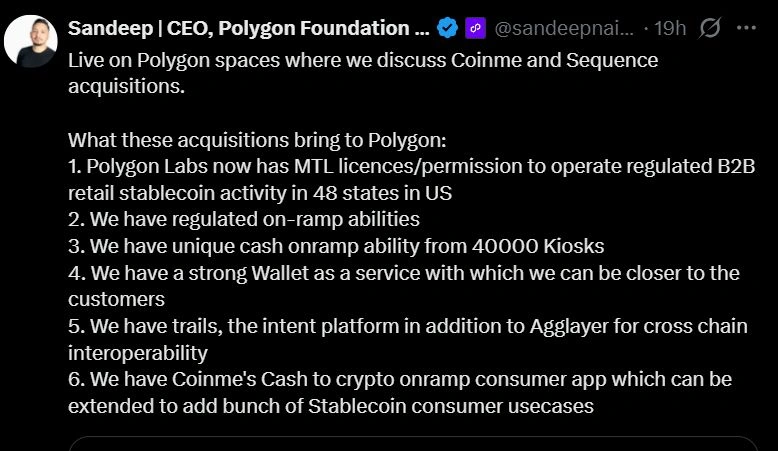
In a Twitter AMA, Sandeep, CEO, Polygon Foundation discussed about these acquisitions and impact it will make on Polygon ecosystem including Polygon Labs having MTL license, on-ramp abilities and more.
Why This Matters
Until now, much of the crypto industry’s stablecoin stack has operated in a regulatory grey area, with separate pieces handling fiat on- and off-ramps, wallet infrastructure, and cross-chain payments. Polygon’s acquisition push consolidates three crucial components — licensed money transmitter coverage, retail cash access, and developer-friendly wallet tooling — to create what leaders call the Polygon Open Money Stack.
Polygon’s CEO Marc Boiron emphasized that stablecoins are increasingly becoming the preferred settlement layer for digital payments, but infrastructure needs to catch up. With these acquisitions, Polygon gains regulated access to U.S. payment rails, wallet infrastructure, and cross-chain operational capabilities, forming the backbone of an onchain settlement-ready payments network.
The Acquisitions at a Glance
Coinme
• One of the earliest licensed digital currency exchanges in the U.S., founded in 2014.
• Holds money-transmitter licenses in 48 states, a foundational compliance asset for regulated payments.
• Operates a physical network with more than 50,000 cash-to-crypto touchpoints, including Coinstar kiosks.
• Offers fiat-to-crypto on- and off-ramps and white-label crypto-as-a-service tools for enterprises.
• Backed by major investors like Circle Ventures, Pantera Capital, and Digital Currency Group.
Sequence
• Developer-centric wallet infrastructure provider with smart wallets and a one-click intents engine that simplifies crypto transactions across blockchains without manual bridging or gas management.
• Trusted by a wide range of blockchain projects for wallet and payment integration.
• Adds a composable, cross-chain layer to Polygon’s payments stack, enabling simplified onboarding for developers and enterprises.
What the Combined Strategy Enables
Regulated U.S. Reach
With Coinme’s nationwide licensing and retail footprint, Polygon can interact with U.S. dollars within regulated financial frameworks — a critical advantage for institutional adoption and compliance-minded enterprises.
Seamless On- and Off-Ramps
The combined stack bridges real-world fiat into blockchain payments, offering both digital rails and physical access points. This opens the door to B2B and eventual consumer-facing rails with transparent pricing and compliance safeguards.
Enterprise-Grade Payment Infrastructure
Sequence’s tools allow developers and businesses to integrate crypto payments with minimal friction. Smart wallet infrastructure and cross-chain orchestration reduce complexity — a key selling point against legacy rails and manual integrations.
Network Effects for Polygon Chain
As these payments flows grow, so does onchain activity. Increased throughput can drive protocol usage, boost network fees, and create demand for validators and stakers on Polygon’s ecosystem.
Regulatory and Competitive Context
The U.S. stablecoin landscape has been evolving rapidly. In 2025 the Genius Act (signed into law) introduced clarity around regulated stablecoin issuance and usage, spurring institutional interest in compliant payments products. Polygon’s acquisition strategy arrives in that context, positioning it as one of the first major blockchain ecosystems to secure licensed payments infrastructure at scale in the U.S.
The move also signals intensified competition with traditional payments giants and fintechs. Polygon’s leadership states they are not immediately targeting head-to-head competition with incumbents like Visa or Mastercard but see strategic partnerships and integration as a near-term path, particularly for enterprise B2B payment solutions.
What’s Next for Polygon
With these acquisitions now announced, Polygon’s focus turns to integration and rollout of the Open Money Stack. The company anticipates launching regulated stablecoin payment infrastructure in 2026, initially targeting business payments and developer adoption before expanding into broader consumer use cases.
Polygon’s success with this stack could redefine how mainstream commerce leverages blockchain rails, stabilize transaction settlement costs, and enable new use cases in cross-border commerce and programmable money.
In a decisive move that signals the next phase of blockchain adoption in the United States, Polygon Labs has announced the acquisition of Coinme and Sequence in a combined deal valued at approximately $250 million. The strategic acquisition positions Polygon to build one of the first large scale fully regulated stablecoin payments platforms in the U.S. market.
This is not a speculative Web3 play. This is a clear infrastructure bet on regulated digital payments and real world financial rails.
Why Polygon Is Making This Move Now
Stablecoins have quietly become the backbone of crypto based payments settlement and cross border transfers. Yet most of the infrastructure still operates in fragmented layers with regulatory uncertainty. Polygon is stepping in to consolidate these layers into a compliant payments stack that enterprises and developers can actually trust and deploy at scale.
By acquiring Coinme and Sequence, Polygon gains three critical advantages
Licensed access to U.S. fiat rails
Retail and digital on ramp and off ramp coverage
Developer friendly wallet and payment orchestration infrastructure
Together these pieces form what Polygon refers to as its Open Money Stack.
What Coinme Brings to Polygon
Coinme is one of the earliest and most established crypto exchanges in the United States. Founded in 2014, Coinme operates with money transmitter licenses in nearly every U.S. state and maintains a nationwide physical and digital presence.
Key strengths Coinme adds to Polygon
Regulatory coverage across the U.S. financial system
More than 50,000 retail access points including Coinstar kiosks
Fiat to crypto and crypto to fiat infrastructure
Enterprise grade compliance and reporting systems
This gives Polygon something most blockchain networks lack. A compliant gateway between U.S. dollars and onchain settlement.
What Sequence Adds to the Payments Stack
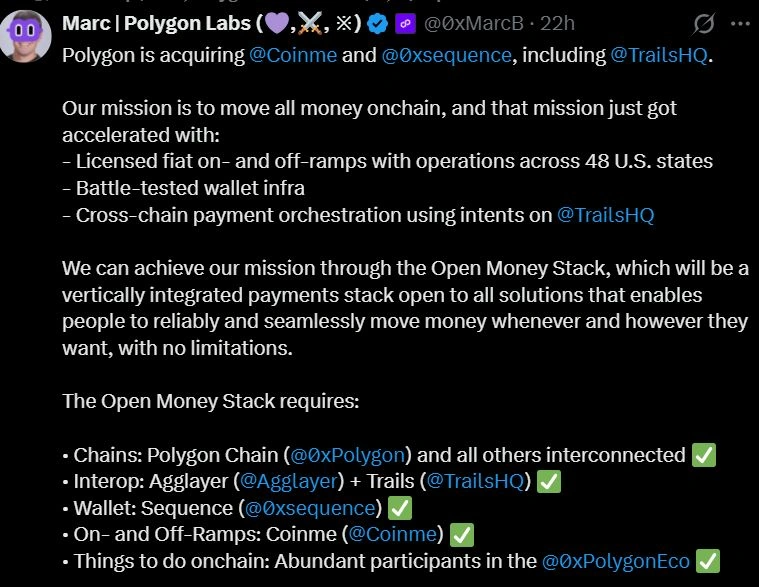
CEO of Polygon Labs, Marc posted how Polygon's mission is to move all money on chain and working on a Money Stack for businesses and developers.
Sequence is known for building smart wallet infrastructure designed to remove friction from Web3 applications. Its wallet technology abstracts gas fees simplifies cross chain interactions and enables seamless user experiences without exposing blockchain complexity.
With Sequence integrated into Polygon’s ecosystem
Developers can embed wallets and payments directly into apps
Users can transact across chains without manual bridging
Businesses can offer crypto payments without deep blockchain knowledge
This is a major step toward making stablecoin payments feel like traditional digital payments while retaining programmability.
The Bigger Picture for Developers and Enterprises
Polygon’s strategy goes far beyond crypto natives. This move is designed to attract
Enterprises exploring stablecoin based settlements
Fintech platforms seeking blockchain rails
Developers building payment enabled Web3 and Web2.5 apps
Institutions that require regulatory clarity before adopting crypto
With regulated on ramps combined with smart wallet abstraction, Polygon is positioning itself as a serious alternative payments infrastructure rather than just a scaling solution for Ethereum.
Regulatory Timing Matters
The acquisition comes at a moment when U.S. regulators are providing clearer guidance around stablecoins and digital asset payments. That clarity is driving institutional demand for compliant blockchain solutions.
Polygon’s leadership has made it clear that this platform is designed to work within existing financial regulations rather than around them. That distinction is critical and may ultimately determine which blockchain ecosystems see mainstream adoption.
What This Means for the Polygon Ecosystem
Increased transaction volume from payments use cases
Higher onchain activity across Polygon networks
Stronger developer incentives to build payment focused applications
Greater institutional confidence in Polygon as infrastructure
This is how blockchains transition from experimental technology to financial plumbing.
Final Take
Polygon’s $250 million acquisition of Coinme and Sequence is one of the most important infrastructure moves in crypto so far this year. It signals a shift from scaling narratives to real world utility with regulation at the core.
If successful, Polygon will not just be a Layer 2 network. It will be a regulated payments platform powering the next generation of digital commerce in the United States.
Frequently Asked Questions About Polygon
What is Polygon used for
Polygon is a blockchain infrastructure platform used to build scalable decentralized applications, enable fast transactions, and support use cases such as DeFi, NFTs, gaming, and now regulated payments.
Why did Polygon acquire Coinme
Polygon acquired Coinme to gain licensed U.S. fiat on ramp and off ramp infrastructure, allowing it to operate regulated stablecoin payments within the U.S. financial system.
What role does Sequence play in Polygon
Sequence provides smart wallet and payment orchestration technology that simplifies blockchain interactions for users and developers, making crypto payments easier to integrate and use.
Is Polygon becoming a payments company
Polygon is evolving into a blockchain payments infrastructure provider while still supporting its broader ecosystem of scaling solutions and developer tools.
How does this impact developers building on Polygon
Developers gain access to compliant payment rails, easier wallet integration, and enterprise ready infrastructure, enabling them to build payment enabled applications with less friction and regulatory risk.
Join the conversation! Your thoughts help the community grow.