

In continuation of my previous article on PopUps with Interactivity, here we will see how to implement an IConfirmation request. To make this article short, I'll implement an IConfirmation request on top of the previous example.
Step 1
Let's open our viewModel and add a property for the InteractionRequest of type IConfirmation as:
- public InteractionRequest<IConfirmation> ConfirmationRequest { get; set; }
Step 2
Now for every getter/setter we should have a corresponding command, that will help us in invoking this request:
- public ICommand ConfirmationCommand { get; set; }
Step 3
Just like NotificationRequest, we need to create instances of these objects in the constructor as:
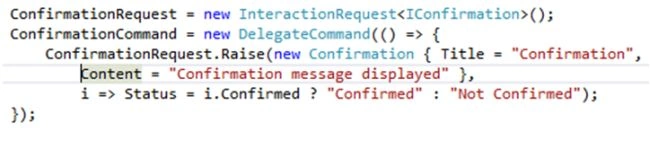
If you look at the preceding snippet closely, you will notice that in the case of Confirmation, we are handling Status in a slightly different manner.
Step 4
If you look at the preceding snippet closely, you will notice that in the case of Confirmation, we are handling Status in a slightly different manner.
Step 4
The next step is to update our View as we did for NotificationRequest.

Step 5
Step 5
Now everything is in place. Let's quickly run the application and click on the PopUp button:

Based on user's choice, whether OK or Cancel button is clicked, a status message will be displayed as shown:
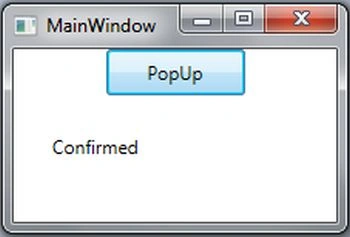
Based on user's choice, whether OK or Cancel button is clicked, a status message will be displayed as shown:
Gowtham RajamanickamPosted Apr 8, 2016, 8:51 AM
good
gonzalo sabogalPosted Dec 9, 2015, 5:22 PM
I am trying to create a custom Confirmation request dialog. However, when I inject my custom view into PopupWindowAction.WindowContent ,then the OK and Cancel buttons disappear.. I would like to pass data entered by the user in this popup window to the parent main window based on whether the user presses OK or Cancel. I understand how to do the passing, but I am not sure how to keep the OK and Cancel button from disappearing after I inject my custom view. I don't want to create OK and Cancel buttons on the custom view itself because these should be universal, acting as either confirmed or !confirmed regardless of the custom view injected.. any thoughts how to accomplish this? thank you
Abhishek pandeyPosted Sep 24, 2015, 8:00 AM
where can i get the source code