
Introduction
Power Automate is a powerful automation tool. But sometimes, it behaves in a confusing way.
A flow may smile, report “Succeeded”, and quietly do not do the thing you need.
No errors. No alerts. Just an automation–shaped hole where your business logic should be.
These are called silent failures, and they are some of the most dangerous problems in low-code automation.
In this blog, we will understand:
What silent failures are
Why they happen
How to detect and prevent them
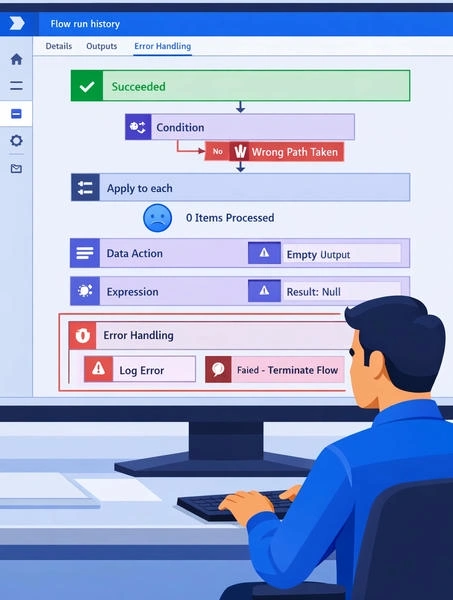
What is a Silent Failure?
A silent failure happens when:
The flow run status is Succeeded.
No error message is shown
But the expected outcome never happens.
For example:
A condition evaluates incorrectly and skips critical steps
An action runs but affects zero records
An API call returns an empty response without error
A loop runs zero times without warning.
Power automate assumes you meant to do that.
You did not.
Common Causes of Silent Failures
1. Conditions That Evaluate the “Wrong” Way
Conditions are the most common cause of silent failures.
Common mistakes:
Comparing a string with a number
Checking for null instead of an empty string
Assuming “Yes” equals true
Case sensitivity issues
Because of this, the flow goes into the wrong branch and skips important actions.
2. Empty Arrays and Zero-Iteration Loops
Actions like
Get items
List rows
Get emails
Can return zero records without any error.
If you use Apply to each, the loop simply does not run.
No errors. No warnings.
3. Actions That Succeed but Do Nothing
Some connectors report success even when nothing changes.
Example:
Updating an item with the ID is wrong.
Deleting a record that doesn’t exist
Sending an email with an empty “To” field resolved at runtime.
The action succeeds, but the result is missing.
4. Misconfigured Run After Settings
Run after is powerful but risky.
If you configure:
Run after has failed
Run after is skipped
But forget:
Run after has timed out
Then your error handling logic may never run.
5. Expressions That Return Null Silently
Expressions fail quietly when:
A property does not exist
JSON paths are wrong
Dynamic content is missing
Power Automate does not throw an error. It simply continues.
How to Catch Silent Failures
1. Validate Data Before Processing
Before doing anything important, verify assumptions.
Examples:
Check array length is greater than zero
Confirm required fields are not empty
Validate IDs and key exist
Use Conditions like:
 Length(body(‘Get_items’)?[‘value’])>0
If the condition fails, terminate the flow intentionally.
2. Use Terminate Actions Strategically
The Terminate action is very useful.
Use it to:
Stop the flow when preconditions are not met
Mark runs as Failed or Cancelled intentionally
Surface logic error early
A failed flow is easier to identify than a silent one.
3. Log What You Expect, Not Just What You Get
Use:
Compose
Append to string variable
Log details such as:
Number of records retrieved
Which condition branch was executed
Important variable values
Examples:
Retrieved 0 items from SharePoint
Condition evaluated to false
This makes troubleshooting easier.
4. Build a Dedicated Error Handling Scope
Wrap critical actions inside scopes:
Main logic
Error handler
Configure Error Handler to run after:
Has failed
Has timed out
Is skipped
Inside Error Handler:
Send an email or Teams notification
Log the run ID
Capture error details
5. Verify Output After Important Actions
After key actions, verify results:
After Update item, check returned ID
After Create record, confirm required fields exist
After Send email, verify Message ID is not null
If verification fails, terminate the flow.
6. Add “This Should Never Happen” Branches
In conditions:
Add an else branch for unexpected values
Treat unknown states as errors, not defaults
Silence helps bug hide. Logging exposes them.
Best Practice Tips:
Think of Power Automate as a very literal assistant
It will:
Do exactly what you tell it
Assume success unless told otherwise
Avoid raising errors unless forced
Your job is to:
Question assumptions
Validate results
Make failures visible
Summary
Silent failures are not Power Automate bugs.
They are missing conversations between you and your flow.
Make your flows
Chatty
Opinions.
Loud when something goes wrong
Green checkmarks feel good, but the truth is better.
A noisy failure is better than a silent success.
Join the conversation! Your thoughts help the community grow.