

In the modern financial landscape, Predictive Modeling has evolved from a static statistical exercise into a dynamic, real-time decision-making engine. For banks, the ability to predict cash flow shortages, credit risks, or fraudulent activities is not just a competitive advantage it is a regulatory and operational necessity. However, traditional predictive models often operate in silos, disconnected from the nuanced, ever-changing Bank Policies that govern financial conduct. This article explores how to build an enterprise-grade Predictive Modeling System using a Multi-Agent Architecture powered by LangGraph. By integrating Retrieval-Augmented Generation (RAG) for policy context, Long-Term Memory for historical patterns, and robust State Management, we create a system that doesn’t just predict outcomes but explains them within the bounds of compliance. We will focus on a critical use case: Predicting Liquidity Shortfalls in Corporate Accounts while ensuring adherence to internal lending and reporting policies.
1. The Evolution of Predictive Modeling in Finance
Traditional predictive modeling in banking relied on batch-processed historical data. While effective for long-term trends, it failed to capture real-time anomalies or contextual policy changes. Today, banks require systems that can ingest live transaction streams, cross-reference them with current regulatory guidelines, and provide actionable insights instantly. This shift demands an architecture that is both predictive and prescriptive.
2. Why Multi-Agent Systems? Breaking Down the Complexity
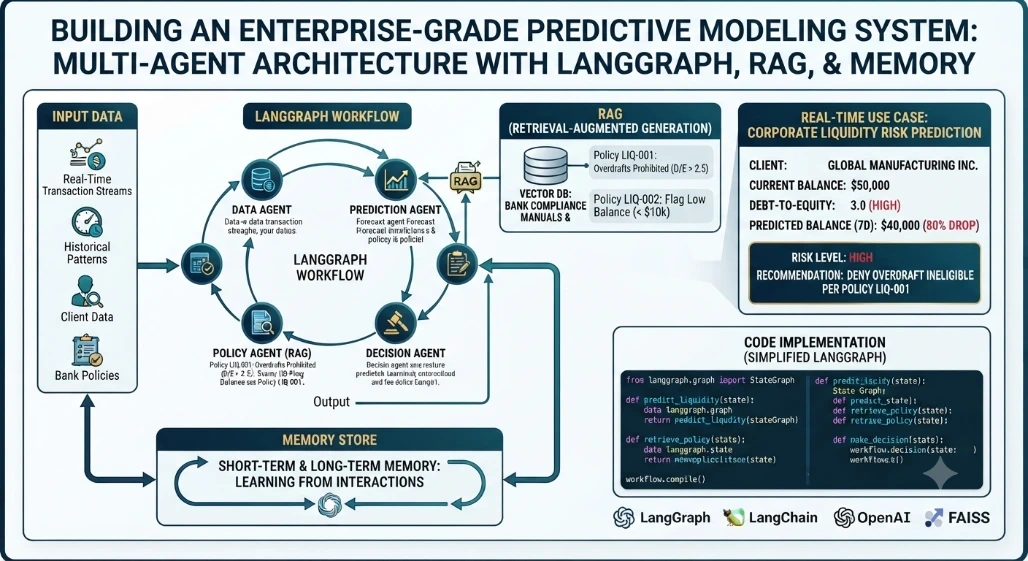
A single monolithic model struggles to handle the diverse tasks required for enterprise prediction: data ingestion, feature engineering, policy checking, and risk scoring. A Multi-Agent System divides these responsibilities:
Data Agent: Cleans and normalizes real-time transaction data.
Prediction Agent: Runs machine learning models to forecast liquidity levels.
Policy Agent (RAG): Retrieves relevant bank policies regarding liquidity thresholds and reporting requirements.
Decision Agent: Synthesizes predictions and policy constraints to generate recommendations.
3. Real-Time Use Case: Corporate Liquidity Risk Prediction
Consider a large corporate client, "Global Manufacturing Inc.," which has multiple accounts across different regions. The bank needs to predict if the client will face a liquidity shortfall in the next 7 days. If a shortfall is predicted, the system must check if the client is eligible for an overdraft facility based on current Bank Policy and their credit history.
The Challenge: The prediction must be accurate, but the recommendation must be compliant. For example, policy may state that overdrafts cannot be offered if the client’s debt-to-equity ratio exceeds 2.5, regardless of the liquidity prediction.
4. Architecture Overview: LangGraph, RAG, and State
We use LangGraph to orchestrate the workflow. The state object carries the transaction data, prediction results, retrieved policy documents, and final decision. RAG is used to fetch specific policy clauses from a vector database containing the bank’s internal compliance manuals. Memory stores past interactions, allowing the system to learn from previous false positives or negatives.
5. Code Implementation: Building the Predictive Agent Workflow
Below is a simplified implementation demonstrating the integration of prediction, policy retrieval, and state management.
from typing import TypedDict, List, Annotated
from langgraph.graph import StateGraph, END
import operator
import random

# Define the State
class LiquidityState(TypedDict):
    account_id: str
    current_balance: float
    predicted_balance_7d: float
    debt_to_equity_ratio: float
    retrieved_policy: str
    risk_level: str
    recommendation: str
    history: Annotated[List[str], operator.add]

# Mock Prediction Model
def predict_liquidity(state: LiquidityState) -> LiquidityState:
    # In production, this would call a trained ML model (e.g., Prophet, LSTM)
    # Simulating a 20% drop in balance for demonstration
    state['predicted_balance_7d'] = state['current_balance'] * 0.8
    return state

# Policy Retrieval via RAG
def retrieve_policy(state: LiquidityState) -> LiquidityState:
    # Simulate RAG retrieval from Vector DB
    policies = [
        "Policy LIQ-001: Overdrafts are prohibited if Debt-to-Equity > 2.5.",
        "Policy LIQ-002: Clients with predicted balance < $10,000 must be flagged for review."
    ]
    state['retrieved_policy'] = " | ".join(policies)
    return state

# Decision Engine
def make_decision(state: LiquidityState) -> LiquidityState:
    policy = state['retrieved_policy']
    predicted_bal = state['predicted_balance_7d']
    dte_ratio = state['debt_to_equity_ratio']

    # Check Policy Constraints
    if dte_ratio > 2.5:
        state['risk_level'] = "HIGH"
        state['recommendation'] = "DENY: Overdraft ineligible due to high Debt-to-Equity ratio per Policy LIQ-001."
    elif predicted_bal < 10000:
        state['risk_level'] = "MEDIUM"
        state['recommendation'] = "FLAG: Predicted low balance. Manual review required per Policy LIQ-002."
    else:
        state['risk_level'] = "LOW"
        state['recommendation'] = "APPROVE: No action needed."

    state['history'].append(f"Account {state['account_id']} assessed: {state['risk_level']}")
    return state

# Build the Graph
workflow = StateGraph(LiquidityState)
workflow.add_node("predict", predict_liquidity)
workflow.add_node("retrieve_policy", retrieve_policy)
workflow.add_node("decide", make_decision)

workflow.set_entry_point("predict")
workflow.add_edge("predict", "retrieve_policy")
workflow.add_edge("retrieve_policy", "decide")
workflow.add_edge("decide", END)

app = workflow.compile()

# Execution
initial_state = {
    "account_id": "CORP_12345",
    "current_balance": 50000.0,
    "predicted_balance_7d": 0.0,
    "debt_to_equity_ratio": 3.0, # High ratio
    "retrieved_policy": "",
    "risk_level": "",
    "recommendation": "",
    "history": []
}

result = app.invoke(initial_state)
print(f"Risk Level: {result['risk_level']}")
print(f"Recommendation: {result['recommendation']}")
6. Integrating Bank Policy via RAG
The Policy Agent uses RAG to ensure that every prediction is contextualized. Instead of hard-coding rules, the system queries a vector store of bank policies. This allows for easy updates; when regulations change, only the knowledge base needs updating, not the codebase.
7. The Role of Memory in Refining Predictions
The history field in the state acts as short-term memory. In a production environment, this would connect to a long-term database. If the system repeatedly flags accounts that never default, the Prediction Agent can be retrained using this feedback, reducing false positives over time.
Predictive modeling in banking is no longer just about algorithms; it’s about aligning those algorithms with strict regulatory frameworks. By leveraging a Multi-Agent LangGraph architecture with RAG and State Management, banks can create systems that are not only intelligent but also compliant and transparent. This approach ensures that predictions lead to actionable, policy-adherent decisions, safeguarding both the institution and its clients.
Join the conversation! Your thoughts help the community grow.