

Pre-requisite to understand this
Denial-of-Service attack (DoS): An attack that exhausts system resources so legitimate users cannot access the service.
AI Agent: A software system that uses an LLM and tools to autonomously perform tasks.
Rate Limiting: A mechanism that restricts how many requests a user or system can make within a time window.
API Gateway: A service that acts as an entry point for client requests and enforces security policies.
Circuit Breaker Pattern: Prevents cascading failures by stopping requests to failing services.
Token / Context Limits: Restrict the maximum prompt and output size an LLM can process.
Agent Tool Execution Limits: Restrict how many external tools an agent can call.
Introduction
AI agents built using large language models are capable of autonomous reasoning, tool usage, and multi-step execution. However, these capabilities introduce new security risks, including Denial-of-Service attacks. A malicious user can exploit the agent by sending extremely long prompts, triggering recursive reasoning loops, or forcing repeated tool invocations. These attacks exhaust system resources such as CPU, memory, tokens, or API quotas, resulting in degraded performance or complete system failure. Preventing DoS attacks requires a combination of architectural controls, runtime safeguards, and monitoring mechanisms across the AI system.
What problem we can solve with this?
Denial-of-Service protection ensures that AI agents remain stable, responsive, and cost-efficient even under malicious or heavy traffic conditions. Without safeguards, attackers can intentionally overload the system by creating excessive reasoning loops, repeated tool calls, or large context prompts. This can drastically increase infrastructure costs and degrade service for legitimate users. By implementing defensive mechanisms such as request validation, rate limiting, execution constraints, and monitoring, the AI system becomes resilient to resource exhaustion attacks. These protections maintain availability and improve the reliability of AI-driven services.
Problems addressed include:
Excessive prompt size: Attackers sending extremely large prompts to consume tokens.
Infinite agent loops: Recursive reasoning steps that never terminate.
Tool invocation abuse: Repeated API calls triggered by malicious prompts.
High compute cost: Increased infrastructure cost due to heavy model usage.
Service downtime: System crashes caused by overloaded AI services.
API quota exhaustion: External tools and APIs hitting usage limits.
How to implement/use this?
Preventing DoS attacks in AI agents requires a layered defense architecture. The first layer includes traffic filtering through an API gateway and rate limiting. The second layer validates the user request by checking prompt size and complexity. The agent execution environment then applies runtime controls such as step limits, tool invocation limits, and timeouts. Monitoring services track abnormal usage patterns and automatically trigger protection mechanisms such as circuit breakers or throttling. Finally, logging and observability systems help identify malicious patterns and continuously improve the security posture of the AI system.
Implementation steps:
API Gateway Filtering: Validate and throttle incoming requests.
Prompt Size Limiting: Restrict maximum input token size.
Agent Step Limiting: Limit the number of reasoning steps an agent can execute.
Tool Invocation Limits: Restrict how often external tools can be used.
Execution Timeout: Stop long-running agent processes.
Monitoring & Alerts: Detect abnormal request patterns.
Circuit Breaker: Temporarily block services under high load.
Sequence Diagram
The sequence diagram illustrates the request flow with DoS protection mechanisms. When a user sends a request, it first reaches the API gateway which acts as the system entry point. The rate limiter verifies whether the user has exceeded allowed request thresholds. If the request is allowed, the request validator ensures that the prompt size and complexity are within acceptable limits. The validated request is then forwarded to the AI agent. During execution, the agent may call external tools but is restricted by execution limits. Monitoring services record execution metrics such as token usage and tool calls. Finally, the AI agent returns the result to the user while abnormal behaviors are logged for analysis.
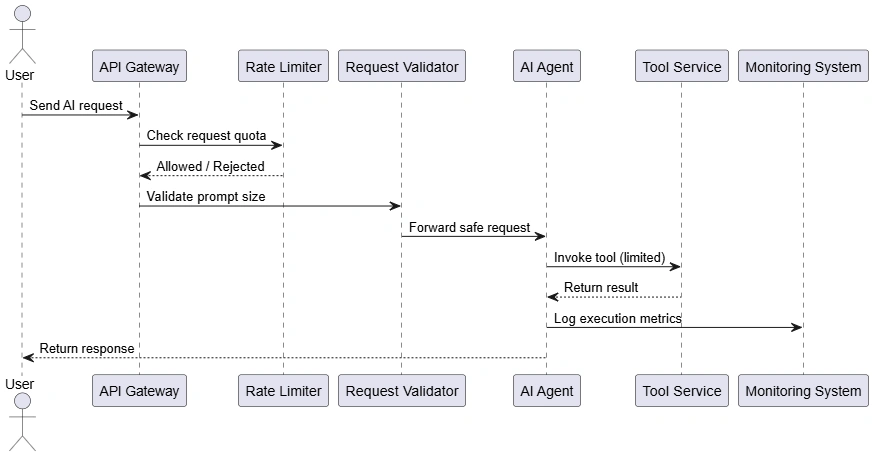
Steps explained:
User Request: A user sends a prompt to the AI agent system.
Gateway Filtering: API gateway processes incoming requests.
Rate Limit Check: Prevents excessive request frequency.
Prompt Validation: Ensures safe input size and format.
Agent Processing: AI agent performs reasoning.
Tool Invocation Control: External tools are accessed with limits.
Monitoring: System logs execution metrics for anomaly detection.
Response Delivery: Valid response returned to the user.
Component Diagram
The component diagram shows the logical architecture used to mitigate DoS attacks in AI agent systems. Each component performs a specific responsibility within the security pipeline. The client application sends requests through the API gateway which acts as a centralized control point. The rate limiter enforces request quotas and prevents traffic spikes. The request validator checks prompt constraints before the request reaches the AI agent service. The AI agent processes tasks and interacts with the tool execution service under strict limits. Meanwhile, the monitoring and logging component collects metrics such as token usage, latency, and error rates. This layered architecture ensures that potential DoS attacks are intercepted before they impact the core AI agent logic.
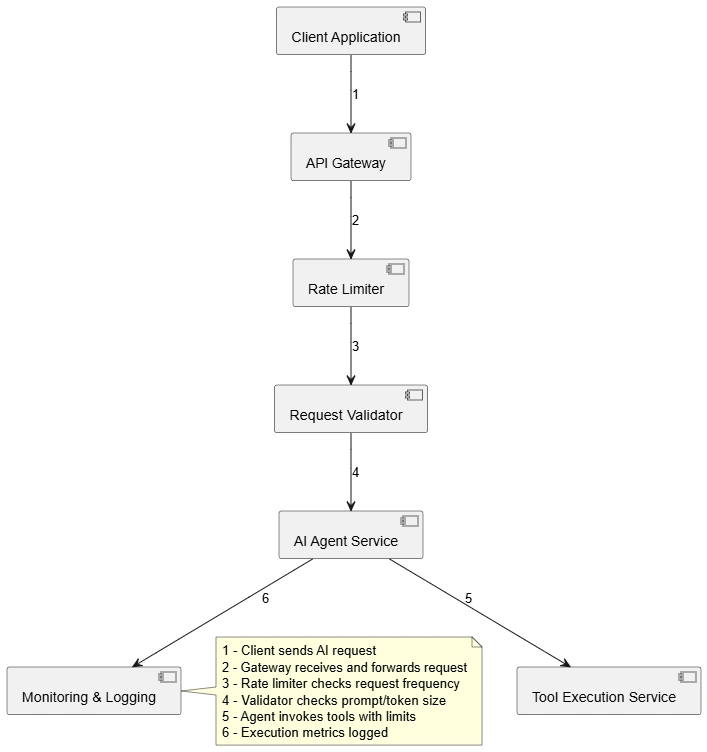
Component roles:
Client Application: Interface used by users to interact with the AI system.
API Gateway: Entry point enforcing authentication and traffic control.
Rate Limiter: Prevents excessive request frequency.
Request Validator: Ensures safe prompt size and structure.
AI Agent Service: Executes reasoning and decision-making tasks.
Tool Execution Service: Handles external tool calls.
Monitoring & Logging: Tracks metrics and detects abnormal patterns.
Deployment Diagram
The deployment diagram describes the physical infrastructure where the AI agent system is deployed. The user device hosts the client application that interacts with the system through the internet. Edge servers host the API gateway and rate limiter to filter traffic as early as possible. Application servers host the request validator and AI agent services responsible for processing prompts and executing tasks. Tool servers contain external APIs or services used by the agent during execution. Monitoring servers collect logs and metrics to detect unusual behavior such as repeated requests or excessive token usage. By distributing responsibilities across multiple nodes, the system becomes more resilient against DoS attacks and resource exhaustion.
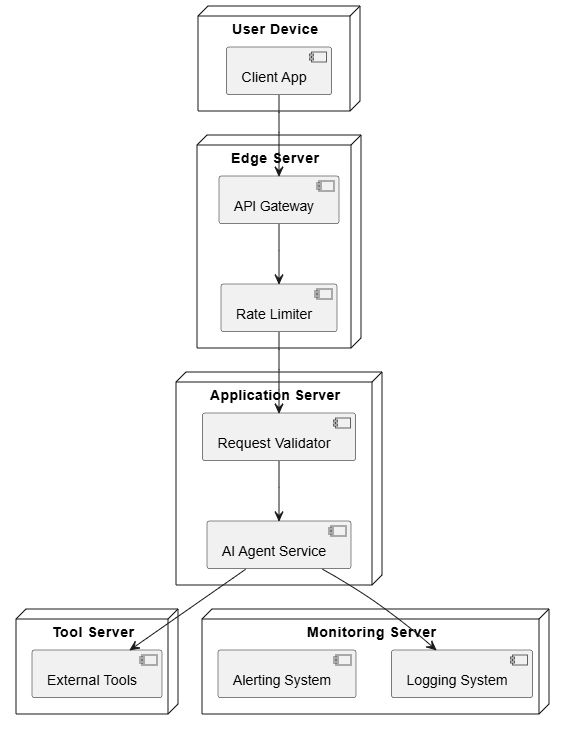
Deployment elements:
User Device: Location where the user sends AI requests.
Edge Server: Handles traffic filtering and rate limiting.
Application Server: Runs core AI agent services.
Tool Server: Hosts external APIs used by agents.
Monitoring Server: Tracks system performance and security events.
Advantages
Improved system availability: Prevents service disruption caused by malicious traffic.
Lower infrastructure costs: Reduces excessive token and compute usage.
Enhanced security: Protects AI agents from exploitation.
Better performance stability: Maintains consistent response times.
Scalable architecture: Supports high traffic with proper controls.
Early threat detection: Monitoring systems identify abnormal activity quickly.
Summary
Denial-of-Service attacks pose a serious risk to AI agent systems due to their reliance on computationally expensive models and external tool integrations. Attackers can exploit these characteristics by generating large prompts, triggering recursive reasoning loops, or forcing repeated API calls. Implementing a layered defense architecture helps mitigate these risks. Key techniques include API gateways, rate limiting, prompt validation, execution limits, monitoring systems, and circuit breakers. Using these mechanisms ensures that AI agents remain resilient, secure, and cost-efficient while providing reliable service to legitimate users.
Join the conversation! Your thoughts help the community grow.