

LangGraph agents look magical. In production retail environments, they develop pathological behaviors that destroy ROI and erode user trust:
Infinite Loops: An inventory agent queries the warehouse API, gets a null response, asks the clarification agent what "null" means, which triggers another warehouse query, ad infinitum—burning tokens and latency budget.
Dead Ends: A stock availability check fails silently because the conditional edge has no fallback path, leaving the customer staring at a loading spinner forever.
Unnecessary Chatter: Three agents pass messages back and forth negotiating who should answer a simple "Is this in stock?" question, adding 4 seconds of latency and $0.03 of token cost per query.
These aren't edge cases. They are the default failure modes of unconstrained multi-agent graphs. This article demonstrates battle-tested patterns for preventing all three, implemented in a real-time retail inventory and stock availability RAG system with full state management and memory.
Real-Time Use Case: Omnichannel Retail Inventory Intelligence
The Scenario
A national retailer with 800+ stores, 3 distribution centers, and an e-commerce platform needs a unified inventory intelligence layer. Store associates, customer service reps, and supply chain planners all query the same system:
"Do we have the Nike Air Max 90 in size 10 at the downtown Seattle store?"
"Why is SKU-48291 showing negative inventory in Dallas DC?"
"Recommend replenishment quantities for winter coats across Northeast region based on current sell-through."
The system must integrate five data sources: POS inventory snapshots (updated every 60s), WMS warehouse management APIs, product catalog PIM, historical sales data warehouse, and supplier lead time feeds.
Why Naive Multi-Agent Fails Here
| Failure Mode | Retail Impact | Root Cause |
|---|---|---|
| Loop: Stock check → Clarification → Stock check | Customer abandons chat; associate wastes time | No termination condition on null/ambiguous responses |
| Dead End: Warehouse API timeout → No fallback | CS rep gives wrong availability info | Missing error-handling edges in graph |
| Chatter: Catalog Agent ↔ Inventory Agent ↔ Pricing Agent for simple lookup | 6s latency vs. 200ms target | Over-decomposition; no routing pre-filter |
| State Drift: Agent uses stale inventory snapshot from prior turn | Overselling / underselling | No freshness validation in state transitions |
Architecture
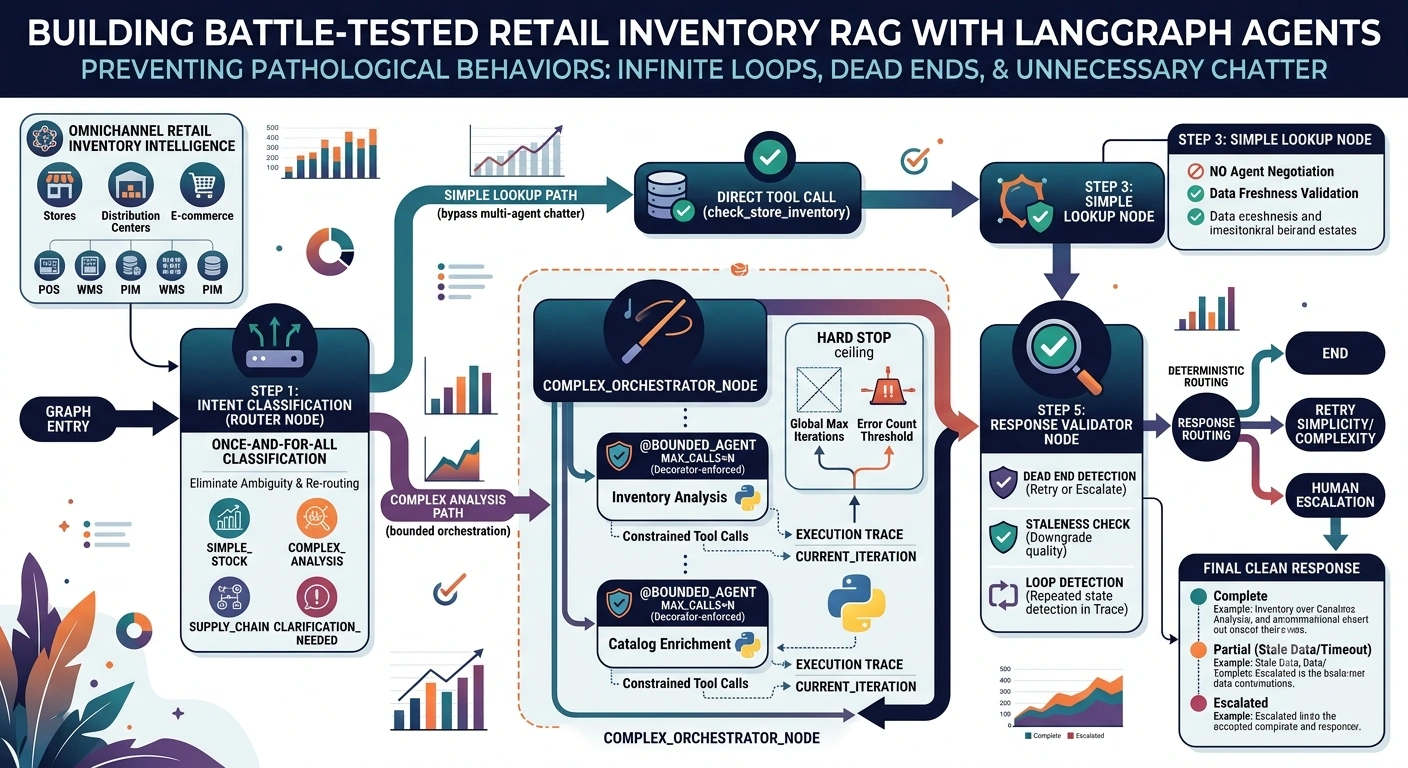
Implementation
Step 1: State Design with Anti-Pattern Prevention Built In
State isn't just data—it's your primary control surface for preventing failures.
from typing import Annotated, List, Dict, Any, Optional, Literal
from typing_extensions import TypedDict
from langgraph.graph.message import add_messages
from datetime import datetime, timedelta
import operator

class InventoryQueryState(TypedDict):
    """State with built-in guardrails against loops, dead ends, and chatter."""

    # Conversation history
    messages: Annotated[list, add_messages]

    # Original user query (immutable after first set)
    original_query: str

    # Classified intent (set once by router, never re-classified)
    query_intent: Optional[Literal["simple_stock", "complex_analysis", "supply_chain", "clarification_needed"]]

    # Execution metadata for loop prevention
    execution_trace: Annotated[List[Dict[str, Any]], operator.add]
    max_iterations: int  # Hard ceiling, set at graph entry
    current_iteration: int

    # Data freshness tracking
    data_freshness: Dict[str, datetime]  # {"store_inventory": ts, "warehouse": ts}
    max_data_age_seconds: int

    # Intermediate results (typed, not free-form messages)
    inventory_result: Optional[Dict[str, Any]]
    analysis_result: Optional[str]

    # Error recovery state
    error_count: int
    last_error: Optional[str]
    recovery_attempts: int

    # Final output
    final_response: Optional[str]
    response_quality: Optional[Literal["complete", "partial", "failed", "escalated"]]

    # Audit
    session_id: str
    latency_ms: float
🔑 Key Insight: Notice
query_intentis set once by the router and never re-evaluated. This single design decision eliminates the most common source of infinite loops: agents disagreeing about what the user asked and re-routing endlessly.
Step 2: Router Node — Eliminate Unnecessary Chatter at the Door
The router is your most important node. It prevents over-decomposition by classifying intent before any agent runs.
from langchain_openai import ChatOpenAI
from pydantic import BaseModel, Field

class IntentClassification(BaseModel):
    intent: Literal["simple_stock", "complex_analysis", "supply_chain", "clarification_needed"]
    confidence: float = Field(ge=0.0, le=1.0)
    extracted_entities: Dict[str, Any] = Field(default_factory=dict)
    reasoning: str

router_llm = ChatOpenAI(model="gpt-4o-mini", temperature=0).with_structured_output(IntentClassification)

ROUTER_PROMPT = """Classify this retail inventory query into exactly ONE category:

- simple_stock: Single SKU/store availability check. Answerable with one API call.
  Examples: "Is SKU-123 in stock at store 456?", "Do you have size 10?"

- complex_analysis: Requires joining multiple data sources or temporal reasoning.
  Examples: "Why did sell-through drop last week?", "Compare inventory across regions"

- supply_chain: Replenishment, forecasting, supplier lead times, DC operations.
  Examples: "Recommended order qty for winter coats", "Supplier delay impact"

- clarification_needed: Query is ambiguous or missing required parameters.
  Examples: "Is it available?" (which SKU? which store?), "Check stock" (where?)

Be AGGRESSIVE about classifying as simple_stock. Most retail queries are simple lookups.
Only escalate to complex_analysis if the query explicitly requires multi-source synthesis."""

async def router_node(state: InventoryQueryState) -> dict:
    """
    Single-pass intent classification. Sets intent ONCE.
    This prevents chatter from agents re-negotiating task ownership.
    """
    classification = await router_llm.ainvoke(ROUTER_PROMPT + f"\n\nQuery: {state['original_query']}")

    return {
        "query_intent": classification.intent,
        "execution_trace": [{
            "node": "router",
            "intent": classification.intent,
            "confidence": classification.confidence,
            "entities": classification.extracted_entities,
            "timestamp": datetime.utcnow().isoformat()
        }],
        "current_iteration": 0,
        "max_iterations": 5,  # Hard ceiling for entire graph
        "max_data_age_seconds": 120,  # Inventory data older than 2 min is stale
        "error_count": 0,
        "recovery_attempts": 0
    }
Step 3: Simple Lookup Path — Bypass Multi-Agent Entirely
For 70%+ of retail queries, multi-agent orchestration is unnecessary overhead. Route directly to a single tool call.
from langchain_core.tools import tool

@tool
async def check_store_inventory(sku: str, store_id: str) -> Dict[str, Any]:
    """Check real-time inventory for a specific SKU at a specific store."""
    # In production: call POS/WMS API with timeout and circuit breaker
    async with aiohttp.ClientSession(timeout=aiohttp.ClientTimeout(total=2)) as session:
        async with session.get(
            f"https://inventory-api.internal/stock/{sku}/{store_id}"
        ) as resp:
            if resp.status == 200:
                data = await resp.json()
                return {
                    "sku": sku,
                    "store_id": store_id,
                    "quantity": data["available_qty"],
                    "last_updated": data["snapshot_ts"],
                    "status": "found"
                }
            elif resp.status == 404:
                return {"sku": sku, "store_id": store_id, "quantity": 0, "status": "not_found"}
            else:
                return {"sku": sku, "store_id": store_id, "status": "api_error", "code": resp.status}


async def simple_lookup_node(state: InventoryQueryState) -> dict:
    """
    Direct tool invocation. NO agent negotiation. NO message passing.
    This is how you prevent chatter for simple queries.
    """
    entities = state["execution_trace"][0].get("entities", {})
    sku = entities.get("sku")
    store_id = entities.get("store_id")

    if not sku or not store_id:
        return {
            "final_response": "I need both a SKU and store ID to check inventory. Could you provide both?",
            "response_quality": "clarification_needed",
            "execution_trace": [{"node": "simple_lookup", "status": "missing_params"}]
        }

    result = await check_store_inventory.ainvoke({"sku": sku, "store_id": store_id})

    # Validate data freshness
    if result.get("status") == "found":
        data_age = (datetime.utcnow() - datetime.fromisoformat(result["last_updated"])).total_seconds()
        if data_age > state["max_data_age_seconds"]:
            return {
                "inventory_result": result,
                "final_response": f"⚠️ Inventory data is {data_age:.0f}s old (threshold: {state['max_data_age_seconds']}s). "
                                  f"{result['quantity']} units of {sku} were available at store {store_id} "
                                  f"as of {result['last_updated']}, but may have changed.",
                "response_quality": "partial",
                "data_freshness": {"store_inventory": datetime.fromisoformat(result["last_updated"])},
                "execution_trace": [{"node": "simple_lookup", "status": "stale_data", "age_s": data_age}]
            }

    # Format clean response
    if result["status"] == "found":
        response = f"✅ {result['quantity']} units of SKU {sku} available at store {store_id}. Last updated: {result['last_updated']}"
        quality = "complete"
    elif result["status"] == "not_found":
        response = f"❌ SKU {sku} not found at store {store_id}. Would you like me to check nearby stores?"
        quality = "complete"
    else:
        response = f"⚠️ Unable to retrieve inventory for {sku} at store {store_id} (API error {result.get('code')}). Please try again or contact support."
        quality = "failed"

    return {
        "inventory_result": result,
        "final_response": response,
        "response_quality": quality,
        "data_freshness": {"store_inventory": datetime.utcnow()},
        "execution_trace": [{"node": "simple_lookup", "status": result["status"]}]
    }
Step 4: Complex Analysis Path — Bounded Orchestration with Loop Prevention
When multi-agent coordination is necessary, constrain it ruthlessly.
# --- LOOP PREVENTION DECORATOR ---
def bounded_agent(max_calls: int = 3):
    """
    Decorator that enforces hard limits on agent tool invocations.
    Prevents infinite loops at the agent level, independent of graph-level limits.
    """
    def decorator(func):
        async def wrapper(state: InventoryQueryState, *args, **kwargs):
            trace = state.get("execution_trace", [])
            agent_name = func.__name__

            # Count previous calls to THIS agent
            agent_calls = sum(1 for t in trace if t.get("node") == agent_name)

            if agent_calls >= max_calls:
                return {
                    "execution_trace": [{
                        "node": agent_name,
                        "status": "BOUND_EXCEEDED",
                        "calls": agent_calls,
                        "limit": max_calls
                    }],
                    "error_count": state.get("error_count", 0) + 1,
                    "last_error": f"{agent_name} exceeded {max_calls} call limit"
                }

            result = await func(state, *args, **kwargs)
            return result
        return wrapper
    return decorator


# --- INVENTORY ANALYSIS AGENT (Bounded) ---
@bounded_agent(max_calls=3)
async def inventory_analysis_agent(state: InventoryQueryState) -> dict:
    """Analyzes inventory discrepancies across stores/DCs."""
    # Agent logic here...
    # Each tool call increments execution_trace via the decorator
    pass


# --- CATALOG ENRICHMENT AGENT (Bounded) ---
@bounded_agent(max_calls=2)
async def catalog_enrichment_agent(state: InventoryQueryState) -> dict:
    """Enriches inventory data with product attributes from PIM."""
    pass


# --- ORCHESTRATOR WITH EXPLICIT TERMINATION ---
async def complex_orchestrator_node(state: InventoryQueryState) -> dict:
    """
    Orchestrates sub-agents with EXPLICIT termination conditions.
    Never delegates termination decisions to LLM judgment alone.
    """
    iteration = state["current_iteration"]
    max_iter = state["max_iterations"]

    # HARD STOP: Global iteration ceiling
    if iteration >= max_iter:
        return {
            "final_response": "Analysis timed out. Providing partial results based on available data.",
            "response_quality": "partial",
            "execution_trace": [{"node": "orchestrator", "status": "MAX_ITERATIONS_REACHED", "iteration": iteration}]
        }

    # ERROR STOP: Too many failures
    if state["error_count"] >= 3:
        return {
            "final_response": "Multiple data sources unavailable. Escalating to human analyst.",
            "response_quality": "escalated",
            "execution_trace": [{"node": "orchestrator", "status": "ERROR_THRESHOLD", "errors": state["error_count"]}]
        }

    # Determine which sub-agent to invoke based on deterministic rules (NOT LLM)
    trace = state["execution_trace"]
    has_inventory = any(t.get("node") == "inventory_analysis_agent" and t.get("status") == "success" for t in trace)
    has_catalog = any(t.get("node") == "catalog_enrichment_agent" and t.get("status") == "success" for t in trace)

    if not has_inventory:
        result = await inventory_analysis_agent(state)
        return {**result, "current_iteration": iteration + 1}

    elif not has_catalog:
        result = await catalog_enrichment_agent(state)
        return {**result, "current_iteration": iteration + 1}

    else:
        # ALL REQUIRED DATA COLLECTED → SYNTHESIZE AND TERMINATE
        # This explicit "done" condition prevents the orchestrator from looping
        synthesis = await synthesize_analysis(state)
        return {
            "analysis_result": synthesis,
            "final_response": synthesis,
            "response_quality": "complete",
            "current_iteration": iteration + 1,
            "execution_trace": [{"node": "orchestrator", "status": "SYNTHESIS_COMPLETE"}]
        }
Step 5: Response Validator — Catch Dead Ends Before They Reach Users
Every path through the graph terminates at the validator. It ensures no response escapes without meeting quality thresholds.
async def response_validator_node(state: InventoryQueryState) -> dict:
    """
    Final gatekeeper. Validates completeness, freshness, and coherence.
    Routes to recovery or escalation instead of returning broken responses.
    """
    response = state.get("final_response")
    quality = state.get("response_quality")

    # DEAD END DETECTION: No response generated
    if not response:
        if state["recovery_attempts"] < 2:
            return {
                "recovery_attempts": state["recovery_attempts"] + 1,
                "execution_trace": [{"node": "validator", "status": "NO_RESPONSE_RETRY"}],
                # Signal to retry the appropriate path
                "_retry_signal": state.get("query_intent", "simple_stock")
            }
        else:
            return {
                "final_response": "I wasn't able to generate a complete answer. Connecting you with a specialist.",
                "response_quality": "escalated",
                "execution_trace": [{"node": "validator", "status": "ESCALATED_AFTER_RETRIES"}]
            }

    # STALENESS CHECK
    freshness = state.get("data_freshness", {})
    max_age = state.get("max_data_age_seconds", 120)
    stale_sources = [
        source for source, ts in freshness.items()
        if (datetime.utcnow() - ts).total_seconds() > max_age
    ]

    if stale_sources and quality == "complete":
        # Downgrade quality but don't fail entirely
        return {
            "response_quality": "partial",
            "final_response": f"⚠️ Note: Data from {', '.join(stale_sources)} may be stale. " + response,
            "execution_trace": [{"node": "validator", "status": "DOWNGRADED_STALE", "sources": stale_sources}]
        }

    # LOOP DETECTION: Check for repeated identical states in trace
    trace_nodes = [t["node"] for t in state.get("execution_trace", [])]
    if len(trace_nodes) >= 6:
        # Look for repeating subsequences
        for window_size in range(2, len(trace_nodes) // 2 + 1):
            for i in range(len(trace_nodes) - window_size * 2):
                seq = tuple(trace_nodes[i:i+window_size])
                next_seq = tuple(trace_nodes[i+window_size:i+window_size*2])
                if seq == next_seq:
                    return {
                        "final_response": "Analysis encountered a processing loop. Providing best available results.",
                        "response_quality": "partial",
                        "execution_trace": [{"node": "validator", "status": "LOOP_DETECTED", "pattern": list(seq)}]
                    }

    # Response is valid
    return {
        "execution_trace": [{"node": "validator", "status": "PASSED", "quality": quality}]
    }


def route_after_validation(state: InventoryQueryState) -> str:
    """Deterministic routing after validation. No LLM involved."""
    retry_signal = state.get("_retry_signal")
    if retry_signal and state["recovery_attempts"] < 2:
        return f"retry_{retry_signal}"

    quality = state.get("response_quality")
    if quality == "escalated":
        return "human_escalalation"

    return "end"
Step 6: Assemble the Constrained Graph
from langgraph.graph import StateGraph, START, END
from langgraph.checkpoint.postgres import PostgresSaver

workflow = StateGraph(InventoryQueryState)

# Add nodes
workflow.add_node("router", router_node)
workflow.add_node("simple_lookup", simple_lookup_node)
workflow.add_node("complex_orchestrator", complex_orchestrator_node)
workflow.add_node("response_validator", response_validator_node)

# Router → Deterministic fan-out (NO LLM routing)
def route_by_intent(state: InventoryQueryState) -> str:
    intent = state.get("query_intent")
    if intent == "simple_stock":
        return "simple_lookup"
    elif intent in ("complex_analysis", "supply_chain"):
        return "complex_orchestrator"
    elif intent == "clarification_needed":
        return "end"  # Router already set clarification response
    return "end"

workflow.add_edge(START, "router")
workflow.add_conditional_edges("router", route_by_intent, {
    "simple_lookup": "simple_lookup",
    "complex_orchestrator": "complex_orchestrator",
    "end": "response_validator"
})

# All paths converge at validator
workflow.add_edge("simple_lookup", "response_validator")
workflow.add_edge("complex_orchestrator", "response_validator")

# Validator routes deterministically
workflow.add_conditional_edges("response_validator", route_after_validation, {
    "retry_simple_stock": "simple_lookup",
    "retry_complex_analysis": "complex_orchestrator",
    "human_escalalation": END,
    "end": END
})

# Compile with persistence
checkpointer = PostgresSaver.from_conn_string("postgresql://retail-rag-db")
app = workflow.compile(checkpointer=checkpointer)
Step 7: Execute with Full Observability
config = {"configurable": {"thread_id": "session-associate-7842-store-sea01"}}

result = await app.ainvoke({
    "original_query": "Do we have Nike Air Max 90 size 10 at downtown Seattle?",
    "messages": [],
    "session_id": "assoc-7842-20240805-143022"
}, config=config)

print(f"Response: {result['final_response']}")
print(f"Quality: {result['response_quality']}")
print(f"Iterations: {result['current_iteration']}")
print(f"Trace: {[t['node'] + ':' + t.get('status','') for t in result['execution_trace']]}")
# Expected: ['router:simple_stock', 'simple_lookup:found', 'validator:PASSED']
# NOT: ['router', 'inventory_agent', 'catalog_agent', 'router', 'inventory_agent', ...]
Anti-Pattern Prevention Cheat Sheet
| Failure Mode | Prevention Pattern | Where Enforced |
|---|---|---|
| Infinite Loop | Hard max_iterations ceiling + loop sequence detection in validator | Graph state + Validator node |
| Agent-Level Loop | @bounded_agent(max_calls=N) decorator counting execution_trace entries | Per-agent wrapper |
| Re-Routing Loop | Intent classified ONCE at router; never re-evaluated | Router node immutability |
| Dead End | Every path terminates at response_validator; no orphan nodes | Graph topology enforcement |
| Silent Failure | Validator checks for empty response → retry or escalate | Response validator |
| Unnecessary Chatter | Router pre-filters; simple queries bypass multi-agent entirely | Router + simple_lookup path |
| LLM Routing Indecision | All conditional edges use deterministic Python functions, never LLM | Edge routing functions |
| Stale Data Responses | Freshness timestamps in state; validator downgrades quality | State + Validator |
| Error Cascade | error_count threshold triggers escalation, not more retries | Orchestrator + Validator |
Production Metrics to Monitor
Track these to verify your anti-pattern controls are working:
# After each invocation, emit metrics
metrics = {
    "iterations_used": result["current_iteration"],
    "trace_length": len(result["execution_trace"]),
    "response_quality": result["response_quality"],
    "recovery_attempts": result["recovery_attempts"],
    "loop_detected": any(t.get("status") == "LOOP_DETECTED" for t in result["execution_trace"]),
    "bound_exceeded": any(t.get("status") == "BOUND_EXCEEDED" for t in result["execution_trace"]),
    "latency_ms": result.get("latency_ms", 0),
    "intent": result.get("query_intent")
}
Healthy baselines for retail inventory RAG:
Average iterations: ≤ 2 for simple_stock, ≤ 4 for complex_analysis
Loop detection rate: < 0.1% of requests
Bound exceeded rate: < 1% of requests
Escalation rate: < 3% of requests
P95 latency: < 3s for simple, < 8s for complex
If any metric exceeds thresholds, your constraints need tightening—not loosening.
Conclusion
Preventing loops, dead ends, and chatter in multi-agent RAG is not about smarter agents. It is about dumber, more constrained graphs. The patterns demonstrated here share a common philosophy:
Classify once, execute deterministically. Never let agents renegotiate intent.
Bound everything. Iterations, tool calls, retries, error counts—all have hard ceilings.
Validate at the exit. Every path ends at a validator that catches failures before users see them.
Route with code, not LLMs. Conditional edges should be Python functions, not model calls.
Make state your control plane. Freshness, iteration counts, and error budgets live in state, not in prompts.
In retail inventory RAG, the cost of a loop isn't just wasted tokens—it's a store associate giving wrong stock information to a customer, or a supply chain planner making replenishment decisions on stale data. The constraints aren't engineering overhead; they're business requirements encoded in graph topology.
Join the conversation! Your thoughts help the community grow.