

Pre-requisite to understand this
AI Agent Architecture – Understanding how an AI agent interacts with users, tools, APIs, and databases.
Personally Identifiable Information (PII) – Data that can identify an individual such as email, phone number, or national ID.
Prompt Engineering – The technique of structuring prompts to control AI model behavior.
Retrieval Augmented Generation (RAG) – Architecture where an LLM retrieves data from external knowledge sources.
Access Control (RBAC/ABAC) – Security mechanism that restricts data access based on roles or attributes.
Data Masking and Redaction – Techniques used to hide sensitive information before exposure.
Secure API Gateway – Middleware that enforces authentication, authorization, and security policies.
Introduction
AI agents interact with users, enterprise systems, and external knowledge sources to perform intelligent tasks. While this improves productivity and automation, it introduces significant security risks, particularly Sensitive Information Disclosure. AI models can unintentionally expose Personally Identifiable Information (PII) if safeguards are not implemented. For example, a user might trick the AI agent through prompt injection attacks to reveal confidential records or sensitive customer information. To mitigate such risks, organizations must implement multiple security layers such as input validation, output filtering, role-based access control, secure retrieval pipelines, and monitoring mechanisms. These controls ensure that sensitive data is never exposed even if malicious prompts are used. A robust AI security architecture prevents unauthorized access and protects user privacy.
What problem we can solve with this?
AI agents can unintentionally reveal confidential data when interacting with enterprise systems, especially in RAG-based architectures. For example, if the AI retrieves information from internal databases without proper access controls, it might reveal sensitive records such as personal addresses or financial data. Attackers can also manipulate prompts to bypass restrictions and extract hidden information. Preventing sensitive information disclosure ensures that AI systems comply with privacy regulations and maintain user trust. It also protects organizations from legal liabilities and reputational damage. By implementing layered security controls, enterprises can safely deploy AI agents while protecting confidential data.
Problems addressed:
PII Data Leakage – Prevents AI from exposing personal data such as phone numbers or ID numbers.
Prompt Injection Attacks – Stops attackers from manipulating prompts to extract sensitive information.
Unauthorized Data Access – Ensures users only access information permitted by their role.
Regulatory Non-Compliance – Prevents violations of privacy regulations such as GDPR.
Internal Data Exposure – Stops leakage of confidential enterprise documents or records.
Model Memorization Risk – Reduces the chance of models revealing previously processed sensitive data.
How to implement/use this?
Preventing sensitive information disclosure requires a multi-layered security architecture around the AI agent. Instead of allowing direct interaction between users and the language model, a security pipeline should validate every input and output. First, user requests must pass through input filtering mechanisms that detect and redact sensitive data before sending the prompt to the model. Second, the system should enforce authorization checks to ensure the user has permission to access requested information. Third, retrieval systems should only fetch sanitized documents that do not contain confidential fields. Finally, before returning a response to the user, an output filter must scan the response to detect and remove any PII. Logging and monitoring components should also track suspicious activity.
Implementation steps:
Input Validation Layer – Detect and mask PII from user prompts before sending to the model.
Prompt Guardrails – Define system prompts that prohibit revealing confidential data.
Access Control Enforcement – Verify whether the user is authorized to access requested data.
Secure Retrieval Pipeline – Ensure only sanitized documents are retrieved from vector databases.
Output Filtering – Scan LLM responses to detect and remove sensitive information.
Monitoring and Logging – Track requests and detect abnormal data extraction attempts.
Sequence Diagram
The sequence diagram illustrates how a secure AI agent architecture prevents sensitive information disclosure during request processing. A user begins by sending a query through an API gateway, which acts as the first security checkpoint. The request is forwarded to a PII filtering service that scans the input for sensitive data patterns and masks them if detected. Next, the authorization service verifies whether the user has permission to access the requested data. Once validated, the sanitized prompt is sent to the AI agent. The agent retrieves relevant knowledge from a vector database containing sanitized documents. Before returning the response to the user, the output guard scans the generated response to ensure that no sensitive information is included. Finally, a safe response is returned to the user.

Sequence steps:
User Request – User sends a query to the AI system.
API Gateway Validation – The gateway acts as the first security boundary.
PII Input Filtering – Sensitive data patterns are detected and masked.
Authorization Check – The system verifies the user’s role and permissions.
Secure Data Retrieval – Only sanitized documents are retrieved from storage.
Output Guard Check – The response is scanned for sensitive data leakage.
Safe Response Delivery – The filtered response is returned to the user.
Component Diagram
The component diagram shows the architectural components responsible for securing the AI agent. The user interface allows users to interact with the AI system. All requests pass through the API gateway, which enforces authentication and request validation. The input PII filter scans incoming prompts and removes any sensitive information before forwarding them to the access control service. The access control component checks the user's permissions to ensure that the requested information is allowed. The AI agent engine processes the request and retrieves knowledge from a vector database containing pre-filtered documents. Before delivering the response, the output guard service inspects the response to detect any sensitive information. Finally, the response service delivers a safe answer to the user.
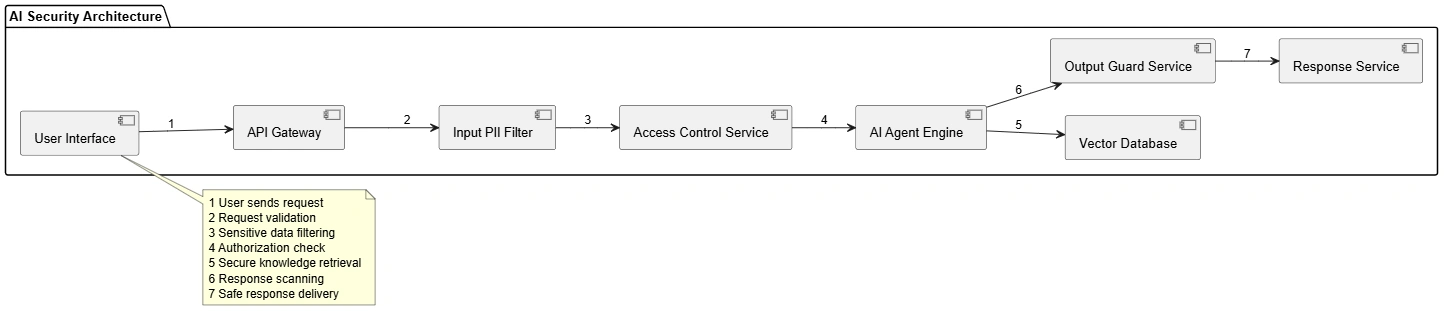
Component roles:
User Interface – Entry point where users interact with the AI agent.
API Gateway – Security boundary that validates incoming requests.
Input PII Filter – Detects and masks sensitive information in prompts.
Access Control Service – Enforces role-based authorization policies.
AI Agent Engine – Processes requests using the language model.
Vector Database – Stores sanitized knowledge used by the AI agent.
Output Guard Service – Prevents sensitive information from leaving the system.
Deployment Diagram
The deployment diagram illustrates how secure AI components are distributed across infrastructure layers. The user interacts with the system through a web client running on a user device. Requests are routed to an API layer containing the gateway, PII detection service, and authorization service. These components enforce security policies before the request reaches the AI platform. The AI platform hosts the AI agent service responsible for generating responses using the language model. The output guard ensures that no sensitive data leaves the platform. The data layer stores sanitized knowledge bases and vector databases used for retrieval. By separating these layers and enforcing security controls at each stage, the architecture minimizes the risk of sensitive information disclosure.

Deployment elements:
User Device Layer – Client interface used to interact with the AI system.
API Security Layer – Handles validation, filtering, and authorization.
AI Platform Layer – Hosts the AI agent responsible for reasoning and responses.
Data Layer – Stores sanitized knowledge sources and embeddings.
Output Guard Layer – Prevents sensitive data from leaving the AI system.
Network Segmentation – Separates infrastructure layers to reduce attack surface.
Advantages
Enhanced Data Privacy – Prevents accidental disclosure of sensitive personal data.
Improved Security Posture – Protects enterprise systems from prompt injection attacks.
Regulatory Compliance – Helps meet data protection requirements such as GDPR.
Controlled Data Access – Ensures users only access authorized information.
Secure AI Deployment – Enables safe adoption of AI agents in enterprises.
Monitoring and Auditability – Provides logs for security monitoring and incident response.
Summary
AI agents introduce powerful automation capabilities but also create new security risks related to sensitive data exposure. Without proper safeguards, AI systems may reveal personally identifiable information through prompt manipulation, insecure retrieval pipelines, or improper authorization mechanisms. Implementing layered security controls such as input filtering, access control enforcement, secure retrieval pipelines, and output guard mechanisms significantly reduces these risks. Architectural patterns involving API gateways, PII detection services, and response scanners help ensure that sensitive information never leaves the system. By combining secure design principles with monitoring and compliance frameworks, organizations can deploy AI agents safely while protecting user privacy and confidential enterprise data.
Join the conversation! Your thoughts help the community grow.