

This article is the first module of the Azure az-900 course, and we will talk about:
- Cloud computing, services, storage, and their benefits
- Cloud deployment models
- Types of cloud services and management responsibilities
What is cloud computing?
Cloud computing provides various categories of computing services ranging from servers, storage, databases, networking, software, analytics, to artificial intelligence, DevOps, IoT, and moreover, the internet to offer faster innovation, flexible resources, and economies of scale. You typically pay only for what you use, helping lower your operating costs, and run your infrastructure more efficiently.
Cloud computing services
The computing services offered tend to vary by the cloud provider. However, typically they include compute power and storage.
Compute power
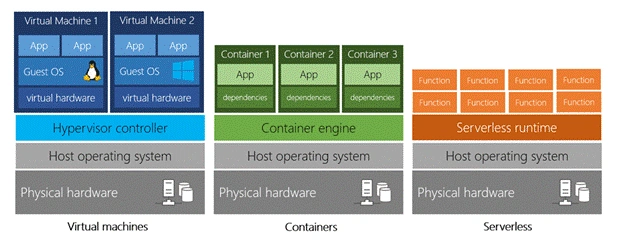
The popular cloud computer power options are - Virtual Machines, containers and serverless computing.
What is a VM?
A Virtual Machine, or VM, is an emulation of a computer. Each VM includes an operating system and hardware that appears to the user like a physical computer running Windows or Linux.
What are containers?
They're similar to VMs except they don't require a guest operating system. Instead, the application and all its dependencies are packaged into a "container" and then a standard runtime environment is used to execute the app. This allows the container to start up in just a few seconds because there's no OS to boot and initialize. You only need the app to launch (ex - Docker).
What is serverless computing?
Serverless computing is a method of providing backend services on an as-used basis. Servers are still used, but a company that gets backend services from a serverless vendor is charged based on usage, not a fixed amount of bandwidth or number of servers.
The below diagram comparing the three compute approaches that we have covered.
Storage
In all internet uses cases, data is either read or written. The type of data and how it's stored can be different in each use case.
Cloud providers typically offer services that can handle all types of data.
The advantage of using cloud-based data storage is you can scale to meet your needs automatically - so you pay for exactly what you need at any given point in time.
Benefits of cloud computing
Cost - by paying only for cloud services you use, Azure is helping lower your operating costs.
Speed - most cloud computing services provide a self-service and on demand option, and just with a few mouse clicks, vast amounts of computing resources can be provisioned in minutes.
Global scale - Cloud allows you to increase or decrease automatically the resources and services used based on the demand or workload at any given time.
Productivity - The cloud increases team productivity by removing IT management chores, (racking and stacking, hardware set up, software patching) and letting them focus and spend time on achieving more important business goals.
Performance - The cloud network and data centers are regularly upgraded to the latest generation of fast and efficient computing hardware. This offers several benefits including reduced network latency for applications and greater economies of scale.
Security - Cloud providers offer a broad set of policies, technologies, controls, and expert technical skills that help protect your data, apps, and infrastructure from potential threats.
Cloud deployment models
There are three different cloud deployment models.
Public cloud
Everything runs on your cloud provider’s hardware, you have no local hardware to manage or keep up-to-date.
Advantages
- High scalability/agility
- Pay only for what you use,
- You’re not responsible for maintenance or updates of the hardware
- Minimal technical knowledge to set up and use
Disadvantages
- Not all security requirements and all business requirements can be met by using the public cloud
- You cannot manage the hardware or services as you may want to
Private cloud
In this case, you create a cloud environment in your own datacenter and provide self-service access to your internal resources. You also have to purchase and maintain the hardware and software services you provide.
Advantages
- Private clouds can meet strict security, compliance, or legal requirements and you have the complete control of it.
- You can manage the hardware or services as you may want to
Disadvantages
- You have upfront costs and you need to purchase the hardware for startup and maintenance
- To scale you must buy, install, and set up new hardware
- Private clouds require IT skills and expertise that's hard to come by.
Hybrid cloud
It allows you to use the services of both public and private deployment models. For example, you could host a website in the public cloud and link it to a highly secure database hosted in your private cloud
Advantages
- You can keep any system running and accessible that uses out-of-date hardware or an out-of-date operating system
- You have flexibility with what you run locally versus in the cloud
- You can take advantage of economies of scale from public cloud providers for services and resources where it's cheaper, and then supplement with your own equipment when it's not
- You can use your own equipment to meet security, compliance, or legacy scenarios where you need to completely control the environment
Disadvantages
- It can be more expensive and complicated to set up and manage than selecting one deployment model
Types of cloud services
There are three major categories of cloud computing,
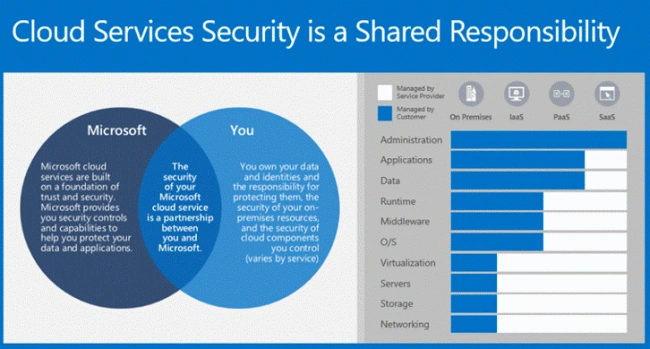
Infrastructure as a service (IaaS) is the most flexible category of cloud services, it allows you to rent an instant computing infrastructure, provisioned and managed over the internet and gives you complete control over it.
This is a category of cloud computing services that provides a platform allowing users to develop, test, and deploy software applications without the complexity of building and maintaining the infrastructure typically associated with developing and launching an app.
Software as a service (SaaS) is a software distribution model in which a third-party provider hosts applications and makes them available to customers over the Internet, Office 365 and Skype are perfect examples of SaaS software.
Management responsibilities
Summary
In this article, you've learned about cloud computing, what it is and what its key characteristics are.
Viknaraj ManogararajahPosted Jul 10, 2019, 6:48 PM
Nice Article for beginners.
Rebai HamidaPosted Jul 4, 2019, 7:47 AM
Nice article !
Aakash MauryaPosted May 29, 2019, 7:15 AM
Really helpful for beginners. Waiting for more from your end.
Talaviya BhavdipPosted May 22, 2019, 6:12 AM
Good article Marwa Balhoudi
Cris GomezPosted May 21, 2019, 10:06 AM
Very helpfull this tutorial. Im a newbie in could comp, so thanks for share it!