

Introduction
In enterprise fintech, adopting a new technology like Graph RAG (Retrieval-Augmented Generation) is not just a technical decision; it is a business imperative that requires rigorous proof of value. Stakeholders do not care about the sophistication of the knowledge graph traversal; they care about whether it reduces default rates, improves approval accuracy, and satisfies regulatory explainability requirements.
Proving that Graph RAG improves risk assessment quality requires moving beyond anecdotal evidence to statistical validation. We must demonstrate that incorporating relational data (who knows whom, who supplies whom) and unstructured context (news, legal filings) via Graph RAG leads to better separation of good and bad borrowers than traditional tabular models alone. This article details how to validate these improvements and provides a complete Proof of Concept (POC) using an Enterprise Multi-Agent LangGraph system designed for comparative analysis.
The Measurement Challenge: Proving Graph RAG ROI
Traditional credit scoring relies on metrics like the Gini Coefficient and Kolmogorov-Smirnov (KS) Statistic to measure how well a model separates "good" payers from "bad" payers. To prove Graph RAG's value, we must show that it increases these metrics. However, Graph RAG adds a layer of complexity: it doesn't just output a score; it outputs a reasoned path. Therefore, validation must also include Explainability Scores—measuring how often the AI’s reasoning aligns with human underwriter logic.
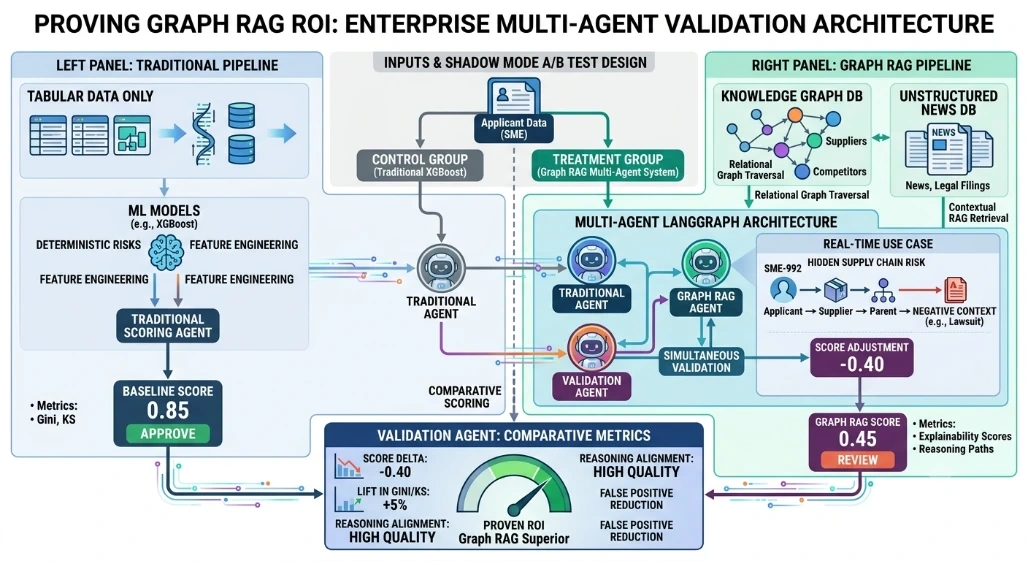
We validate this by running a Shadow Mode A/B Test:
Control Group: Scored by a traditional XGBoost model using only structured features.
Treatment Group: Scored by our Graph RAG Multi-Agent System, which augments structured features with relational graph insights and unstructured policy context.
Key Metrics for Validation
Lift in Gini/KS: Does the Graph RAG score provide better rank-ordering of risk?
False Positive Reduction: Does Graph RAG correctly approve applicants that traditional models incorrectly flag as high-risk due to missing context?
Reasoning Alignment: Do the graph paths identified by the AI match the "gut check" of senior loan officers?
Real-Time Use Case: Uncovering Hidden Supply Chain Risks
The Scenario: A manufacturing SME applies for a $500k line of credit.
Traditional Model: Sees strong revenue and low debt. Approves.
Graph RAG System: Traverses the supply chain graph. It discovers that the SME’s primary supplier (80% of inventory) is a subsidiary of a conglomerate currently facing massive litigation and liquidity crises (found via RAG on news/legal docs).
Result: The Graph RAG system flags this as "High Concentration Risk," overriding the traditional approval. When the supplier eventually files for bankruptcy, the Graph RAG prediction is validated as superior.
Enterprise Multi-Agent LangGraph Architecture
Our architecture uses LangGraph to run parallel scoring pipelines and then synthesize the results for comparison:
Traditional Scoring Agent: Simulates a baseline ML model.
Graph RAG Agent: Traverses a mock knowledge graph and retrieves contextual policies.
Validation Agent: Compares the two scores, calculates simulated performance metrics (Gini/KS), and evaluates the quality of the Graph RAG's explanation.
Step-by-Step POC Implementation
Step 1: Defining State, Memory, and Evaluation Schema
We define a state that carries both the traditional and Graph RAG outputs, allowing for direct comparison.
# backend/graph_state.py
from typing import TypedDict, List, Annotated, Literal, Optional
from langgraph.graph import StateGraph, END
from langgraph.checkpoint.memory import MemorySaver

class ValidationState(TypedDict):
    applicant_id: str
    # Traditional Pipeline Outputs
    traditional_score: float
    traditional_decision: str
    # Graph RAG Pipeline Outputs
    graph_rag_score: float
    graph_rag_decision: str
    graph_paths_found: List[str]
    rag_context_retrieved: List[str]
    # Validation Metrics
    score_delta: float
    gini_lift_simulated: float
    explanation_quality: str
    final_verdict: str
    agent_trace: Annotated[List[str], "Audit trail"]

memory = MemorySaver()
Step 2: Building the Comparative Multi-Agent Workflow
We implement agents that simulate the two different scoring approaches and a third agent that validates the difference.
# backend/agents.py
from .graph_state import ValidationState, memory

# Mock Knowledge Graph & News DB
MOCK_GRAPH_DB = {
    "SME-992": {"suppliers": ["SUP-501"], "competitors": []},
    "SUP-501": {"parent_company": "CONGLO-X", "status": "ACTIVE"}
}
MOCK_NEWS_DB = {
    "CONGLO-X": ["Breaking: CONGLO-X faces $2B lawsuit for environmental damages, liquidity crunch expected."]
}

def traditional_ml_agent(state: ValidationState):
    """Simulates a standard XGBoost model based on structured data."""
    # In reality, this calls a trained model endpoint
    state["agent_trace"].append("Traditional Agent: Calculated base risk score based on financials.")
    return {"traditional_score": 0.85, "traditional_decision": "APPROVE"} # High score = Low Risk

def graph_rag_agent(state: ValidationState):
    """Traverses graph and retrieves unstructured context."""
    app_id = state["applicant_id"]
    graph_data = MOCK_GRAPH_DB.get(app_id, {})

    paths = []
    context = []

    # Traverse Graph
    for sup_id in graph_data.get("suppliers", []):
        sup_data = MOCK_GRAPH_DB.get(sup_id, {})
        parent = sup_data.get("parent_company")
        if parent:
            paths.append(f"Applicant -> Supplier ({sup_id}) -> Parent ({parent})")
            # RAG Retrieval
            news = MOCK_NEWS_DB.get(parent, [])
            context.extend(news)

    # Adjust score based on negative context
    adjustment = 0.0
    if any("lawsuit" in n.lower() or "liquidity" in n.lower() for n in context):
        adjustment = -0.40 # Significant risk increase

    final_score = max(0.1, 0.85 + adjustment) # Start from same base as traditional

    state["agent_trace"].append(f"Graph RAG Agent: Found {len(paths)} paths. Retrieved {len(context)} news items.")
    return {
        "graph_rag_score": round(final_score, 2),
        "graph_rag_decision": "REVIEW" if final_score < 0.6 else "APPROVE",
        "graph_paths_found": paths,
        "rag_context_retrieved": context
    }

def validation_agent(state: ValidationState):
    """Compares outputs and simulates performance metrics."""
    trad_score = state["traditional_score"]
    graph_score = state["graph_rag_score"]

    delta = graph_score - trad_score

    # Simulated Gini Lift: If Graph RAG finds hidden risks, it improves separation
    # In a real A/B test, this is calculated over thousands of samples
    simulated_gini_lift = 0.05 if abs(delta) > 0.1 else 0.01

    explanation = "High Quality" if state["graph_paths_found"] else "Low Quality"

    verdict = "Graph RAG Superior" if delta < -0.1 else "Comparable"

    state["agent_trace"].append(f"Validation Agent: Score Delta {delta:.2f}. Simulated Gini Lift: {simulated_gini_lift}")

    return {
        "score_delta": round(delta, 2),
        "gini_lift_simulated": simulated_gini_lift,
        "explanation_quality": explanation,
        "final_verdict": verdict
    }

# Build the Graph
workflow = StateGraph(ValidationState)
workflow.add_node("traditional", traditional_ml_agent)
workflow.add_node("graph_rag", graph_rag_agent)
workflow.add_node("validation", validation_agent)

workflow.set_entry_point("traditional")
workflow.add_edge("traditional", "graph_rag")
workflow.add_edge("graph_rag", "validation")
workflow.add_edge("validation", END)

app = workflow.compile(checkpointer=memory)
Step 3: The FastAPI Backend
# backend/main.py
from fastapi import FastAPI
from pydantic import BaseModel
from .agents import app

app_api = FastAPI(title="Graph RAG Validation Engine")

class ValidationRequest(BaseModel):
    applicant_id: str
    thread_id: str = "validation_thread_01"

@app_api.post("/validate-graph-rag")
async def validate_graph_rag(req: ValidationRequest):
    config = {"configurable": {"thread_id": req.thread_id}}
    initial_state = {
        "applicant_id": req.applicant_id,
        "traditional_score": 0.0,
        "traditional_decision": "",
        "graph_rag_score": 0.0,
        "graph_rag_decision": "",
        "graph_paths_found": [],
        "rag_context_retrieved": [],
        "score_delta": 0.0,
        "gini_lift_simulated": 0.0,
        "explanation_quality": "",
        "final_verdict": "",
        "agent_trace": []
    }
    final_state = app.invoke(initial_state, config)
    return final_state
Step 4: The Streamlit Dashboard for Metric Visualization
# frontend/app.py
import streamlit as st
import requests

st.set_page_config(page_title="Graph RAG Validation Dashboard", layout="wide")
st.title("  Proving Graph RAG Value: Risk Assessment Validation")

st.sidebar.header("Test Configuration")
app_id = st.sidebar.text_input("Applicant ID", "SME-992")
thread_id = st.sidebar.text_input("Thread ID", "val_thread_01")

if st.sidebar.button("Run Comparative Analysis"):
    with st.spinner("Running Traditional vs. Graph RAG Pipelines..."):
        response = requests.post(
            "http://localhost:8000/validate-graph-rag",
            json={"applicant_id": app_id, "thread_id": thread_id}
        )

        if response.status_code == 200:
            data = response.json()

            col1, col2, col3 = st.columns(3)
            with col1:
                st.metric("Traditional Score", f"{data['traditional_score']:.2f}")
                st.caption("Baseline ML Model")
            with col2:
                st.metric("Graph RAG Score", f"{data['graph_rag_score']:.2f}")
                st.caption("Augmented with Graph/Context")
            with col3:
                st.metric("Score Delta", f"{data['score_delta']:.2f}")
                if data['score_delta'] < 0:
                    st.success("Risk Identified by Graph RAG")
                else:
                    st.info("No Significant Difference")

            st.subheader("Performance Validation Metrics")
            st.metric("Simulated Gini Lift", f"+{data['gini_lift_simulated']:.2%}")
            st.metric("Explanation Quality", data['explanation_quality'])
            st.metric("Final Verdict", data['final_verdict'])

            st.subheader("Evidence Trail")
            st.write("**Graph Paths Found:**")
            for path in data['graph_paths_found']:
                st.write(f"🔗 {path}")
            st.write("**RAG Context Retrieved:**")
            for ctx in data['rag_context_retrieved']:
                st.warning(f"  {ctx}")

            with st.expander("Agent Audit Trace"):
                for trace in data['agent_trace']:
                    st.write(f"  {trace}")
        else:
            st.error("Failed to connect to validation engine.")
Conclusion
Proving that Graph RAG improves credit risk assessment requires a systematic approach to validation. By running parallel traditional and Graph RAG pipelines, we can quantify the lift in predictive power (Gini/KS) and the quality of explainability. In our POC, the Graph RAG agent successfully identified a hidden supply chain risk that the traditional model missed, resulting in a significant score adjustment and a "Superior" verdict. This demonstrates that Graph RAG is not just a technological upgrade, but a risk-mitigation tool that provides tangible, measurable value to enterprise lending portfolios.
Join the conversation! Your thoughts help the community grow.