

Introduction
Blockchain has become one of the most influential technologies of the digital era, enabling decentralized applications across finance, healthcare, supply chain management, digital identity, and many other domains. Its security is primarily built upon cryptographic techniques that ensure transaction authenticity, data integrity, and user authentication. Every blockchain transaction depends on cryptographic keys, which are responsible for signing transactions, verifying identities, and establishing trust between participating nodes.
While blockchain itself provides an immutable ledger, its security is only as strong as the cryptographic mechanisms protecting these keys. If an attacker gains access to a user's private key or successfully intercepts the key exchange process, the integrity of blockchain transactions can be compromised regardless of how secure the blockchain architecture may be.
Most existing blockchain networks rely on classical cryptographic techniques for generating and exchanging cryptographic keys. These techniques have proven reliable for decades, but they are based on mathematical problems that could eventually become vulnerable with the advancement of large-scale quantum computers. Although practical quantum attacks are still under development, organizations worldwide are already exploring technologies capable of protecting sensitive communications against future threats.
One promising solution is Quantum Key Distribution (QKD). Instead of depending on computational complexity, QKD uses the fundamental laws of quantum mechanics to securely distribute cryptographic keys between communicating parties. Any attempt to intercept or measure quantum information inevitably alters its quantum state, allowing legitimate users to detect eavesdropping before using the generated key.
Unlike traditional encryption algorithms, Quantum Key Distribution does not replace blockchain consensus mechanisms or digital signature algorithms. Instead, it enhances blockchain security by protecting one of its most critical components, the secure exchange of cryptographic keys. This makes QKD an attractive technology for future blockchain ecosystems where confidentiality, trust, and secure communication are essential.
In this article, we will explore how Quantum Key Distribution works, understand the BB84 protocol, examine the role of quantum communication in blockchain networks, and discuss how QKD can strengthen secure key exchange for next-generation decentralized systems.
Why Secure Key Exchange Matters in Blockchain?
When discussing blockchain security, the conversation often focuses on cryptographic algorithms, consensus mechanisms, or digital signatures. However, before any encrypted communication can begin, two parties must first establish a shared secret key. This process, known as key exchange, forms the foundation of secure communication in virtually every digital system.
Imagine two blockchain validator nodes that need to exchange confidential information before validating transactions. Even if they use a highly secure encryption algorithm such as AES, the encryption key itself must first be shared securely. If an attacker intercepts or compromises this key during transmission, the strength of the encryption algorithm becomes irrelevant because the attacker already possesses the secret required to decrypt the communication.
This challenge is not unique to blockchain. Traditional internet protocols such as TLS, VPNs, and secure messaging applications all rely on secure key exchange mechanisms before encrypted communication can begin. Blockchain networks are no exception. Nodes frequently exchange sensitive information, synchronize distributed ledgers, authenticate peers, and establish encrypted communication channels. Therefore, protecting cryptographic keys is just as important as protecting blockchain transactions themselves.
Traditional key exchange methods rely on mathematical problems that are computationally difficult for classical computers to solve. Their security is based on the assumption that solving these problems would require an impractical amount of computational power. However, this assumption may change as quantum computing technologies continue to advance. Instead of relying solely on mathematical complexity, researchers are exploring security mechanisms that derive protection directly from the laws of physics.
Quantum Key Distribution represents one such breakthrough. Rather than making key theft computationally difficult, QKD makes unauthorized interception physically detectable. During the key exchange process, any attempt by an eavesdropper to observe quantum information changes its state, immediately alerting the legitimate communicating parties. This unique property introduces a fundamentally different security model that complements existing blockchain protection mechanisms.
For blockchain ecosystems handling high-value financial transactions, government records, healthcare data, or digital identity systems, ensuring that cryptographic keys remain confidential is essential. Secure key exchange is therefore not merely a supporting process—it is a foundational requirement for maintaining trust in decentralized networks.
What is Quantum Key Distribution (QKD)?
In every secure communication system, encryption is only one part of the security process. Before encrypted data can be exchanged, the communicating parties must first establish a secret cryptographic key. This shared key enables both parties to encrypt and decrypt information securely. Consequently, the security of any communication depends not only on the encryption algorithm but also on how securely the secret key is exchanged.
Traditionally, cryptographic keys are exchanged using mathematical techniques whose security is based on the computational difficulty of solving certain mathematical problems. While these approaches have protected digital communications for decades, their security ultimately relies on the assumption that an attacker lacks sufficient computational power to solve these problems within a practical timeframe.
Quantum Key Distribution (QKD) introduces a completely different approach. Instead of relying on computational complexity, QKD uses the fundamental laws of quantum mechanics to establish a shared secret key between two communicating parties. Its security is not based on difficult mathematical calculations but on the physical behavior of quantum particles.
This distinction makes QKD one of the most significant developments in modern cryptography. Even if future computers become significantly more powerful, the security of Quantum Key Distribution remains rooted in the laws of physics rather than the limitations of computation.
In a blockchain environment, this capability is particularly valuable. Validator nodes, distributed ledgers, consortium blockchains, and enterprise blockchain platforms constantly exchange sensitive information. Establishing encryption keys through a quantum-secure communication channel can significantly reduce the risk of key interception before confidential blockchain communication begins.
It is important to understand that Quantum Key Distribution does not encrypt blockchain transactions. Instead, it securely distributes the encryption keys that are later used by conventional encryption algorithms such as AES for protecting data during transmission. In other words, QKD strengthens the foundation of secure communication rather than replacing existing encryption techniques.
This complementary role allows blockchain systems to continue using proven cryptographic algorithms while significantly improving the security of the key exchange process.
Fundamental Principles of Quantum Communication
The remarkable security offered by Quantum Key Distribution originates from the unique properties of quantum mechanics. Unlike classical communication, where digital information is represented using electrical signals or binary bits, quantum communication transmits information through quantum states of particles such as photons.
A photon is the smallest unit of light and serves as the information carrier in most QKD systems. Instead of representing information simply as 0s and 1s, photons can be prepared in different polarization states. These quantum states carry the information required for generating a secret cryptographic key.
The security of quantum communication is based on several important principles of quantum physics.
1. Quantum Superposition
One of the defining characteristics of quantum particles is their ability to exist in multiple possible states until they are measured. Although Quantum Key Distribution uses carefully selected polarization states rather than exploiting full superposition, this principle highlights the fundamental difference between classical and quantum information.
Unlike classical bits, which always represent either 0 or 1, quantum information behaves according to the laws of quantum mechanics, making it impossible to observe without influencing the system itself.
2. Measurement Disturbs the Quantum State
Perhaps the most important security feature of QKD is that measuring a quantum particle changes its state.
In classical communication, an attacker can copy transmitted data without altering the original message. Digital files, network packets, and transmitted bits can be duplicated without leaving any evidence of interception. Quantum communication behaves differently. If an unauthorized person attempts to measure a photon while it is traveling through a quantum channel, the act of measurement changes its quantum state. As a result, the receiver observes unexpected measurement outcomes that reveal the presence of an eavesdropper. This property transforms security from a computational challenge into a physical guarantee provided by nature itself.
3. The No-Cloning Theorem
Another fundamental principle behind Quantum Key Distribution is the No-Cloning Theorem. This theorem states that an unknown quantum state cannot be copied perfectly. In classical communication, making an exact duplicate of digital information is straightforward. Files, messages, and cryptographic keys can all be copied without affecting the original data. Quantum information cannot be treated in the same way. If an attacker attempts to duplicate a photon carrying quantum information, quantum mechanics prevents the creation of an identical copy. This limitation makes traditional eavesdropping techniques ineffective because an attacker cannot secretly create a duplicate, keep one copy, and forward the other without introducing detectable errors. The No-Cloning Theorem is one of the primary reasons why Quantum Key Distribution provides a level of security that classical communication cannot achieve.
4. Quantum Channels and Classical Channels
A complete Quantum Key Distribution system relies on two separate communication channels working together. The quantum channel carries photons that encode the quantum states used to generate the secret key. This channel may consist of optical fibers or free-space optical communication links. The classical channel is used after the quantum transmission has completed. It allows the communicating parties to compare selected measurement information, identify transmission errors, and verify whether the exchanged key has been compromised. Importantly, the classical channel does not reveal the secret key itself; it only supports the verification process required to establish a secure shared key.
This combination enables QKD to detect unauthorized interception while preserving the confidentiality of the final cryptographic key.
Alice, Bob, and Eve: Understanding the QKD Communication Model
To explain Quantum Key Distribution, researchers traditionally use three fictional participants:
Alice - the sender who generates and transmits quantum information.
Bob - the legitimate receiver who measures the incoming photons and reconstructs the secret key.
Eve - the eavesdropper attempting to intercept the communication without being detected.
These names have become standard terminology in cryptography because they simplify the explanation of secure communication. The communication process begins when Alice prepares a sequence of randomly polarized photons and transmits them to Bob through the quantum channel. Bob independently measures each incoming photon using randomly selected measurement bases. Once the transmission is complete, Alice and Bob communicate over a classical channel to compare only the measurement bases they used, not the actual bit values. Whenever both parties used the same basis, the corresponding bits are retained. Bits generated using different bases are discarded because they may not accurately represent the transmitted information. If Eve attempts to intercept the photons during transmission, her measurements inevitably disturb some of their quantum states. When Alice and Bob later compare a subset of their generated bits, the resulting error rate increases beyond the expected threshold, indicating the presence of an unauthorized observer. They immediately discard the compromised key and initiate a new key exchange session. This ability to detect eavesdropping distinguishes Quantum Key Distribution from conventional key exchange mechanisms. Rather than assuming communication is secure, QKD continuously verifies the integrity of the key exchange process using the laws of quantum mechanics.
Basic Quantum Key Distribution Communication Model
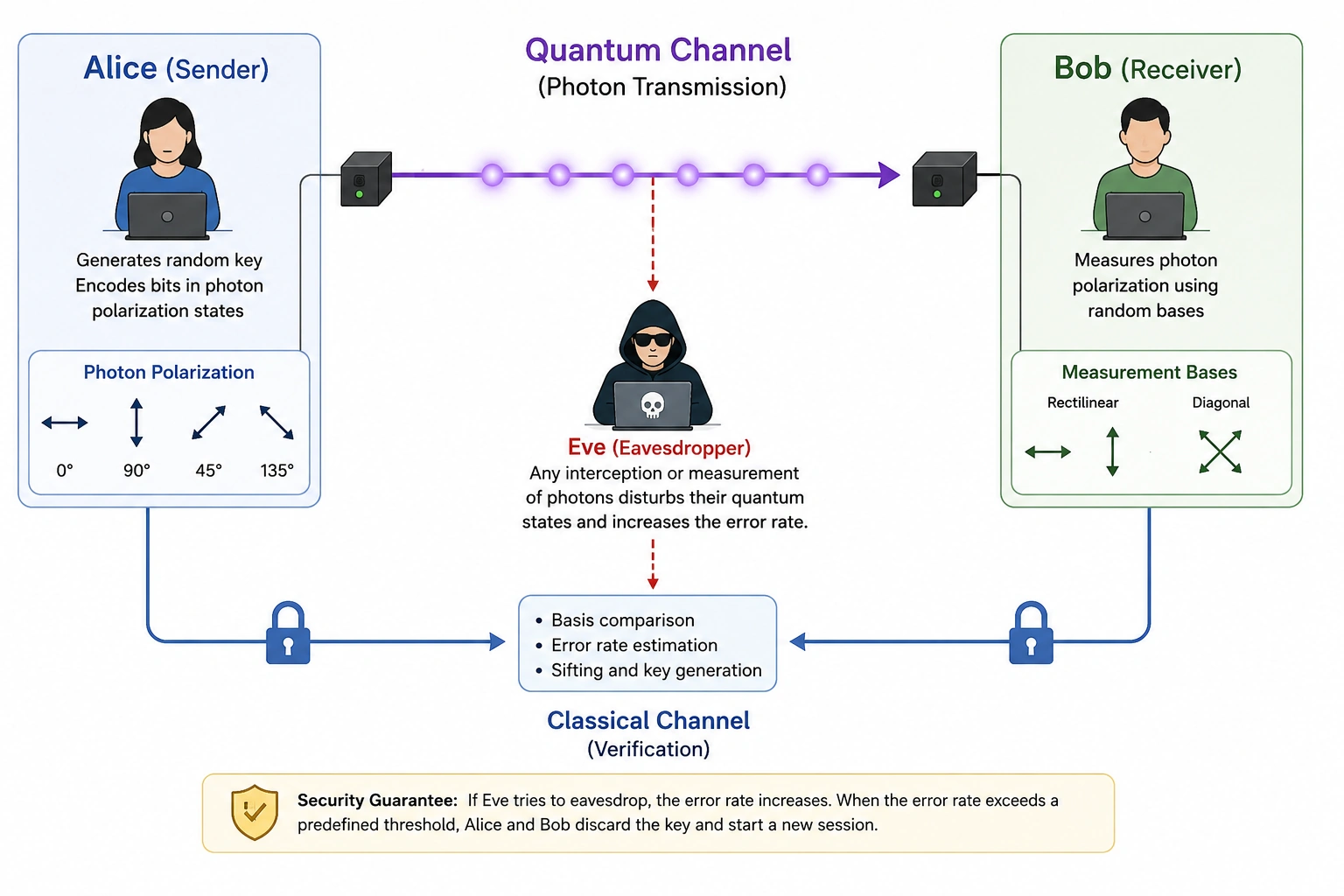
Figure 1. Basic Quantum Key Distribution Communication Model Quantum Channel
This diagram illustrates Quantum Key Distribution (QKD) using the BB84 protocol, where Alice sends photon-encoded bits to Bob over a quantum channel while choosing from four polarization states (0 degree, 90 degree, 45 degree, 135 degree). Bob measures these incoming photons using randomly selected bases (rectilinear or diagonal), after which they compare their basis choices over a classical channel to discard non-matching measurements and sift out a shared secret key. Because quantum physics dictates that any interception alters the photons' states, an eavesdropper (Eve) attempting to spy will inevitably introduce measurable errors. By calculating this error rate during classical verification, Alice and Bob can easily detect Eve's presence; if the errors exceed a safe threshold, they discard the compromised key and restart the session.
Understanding the BB84 Protocol
The BB84 protocol is the most widely known and historically significant Quantum Key Distribution protocol. It was proposed in 1984 by Charles Bennett and Gilles Brassard, and its name is derived from the initials of their surnames and the year of publication. BB84 is considered the foundation of practical QKD systems because it demonstrates how two communicating parties can generate a shared secret key while detecting any attempt at eavesdropping through the laws of quantum mechanics.
Unlike classical key exchange protocols, BB84 does not rely on difficult mathematical computations. Instead, it uses the polarization states of photons to encode information. The protocol allows two legitimate participants, Alice and Bob, to establish a secret key even when an attacker has complete access to the communication channel.
Photon Polarization States
In the BB84 protocol, each bit is encoded into a photon using one of two polarization bases.
Rectilinear Basis (+)
Horizontal polarization (0°) represents bit 0
Vertical polarization (90°) represents bit
Diagonal Basis (×)
45° polarization represents bit 0
135° polarization represents bit 1
These two bases are mutually incompatible. A photon prepared in one basis cannot be measured correctly using the other basis without introducing uncertainty.
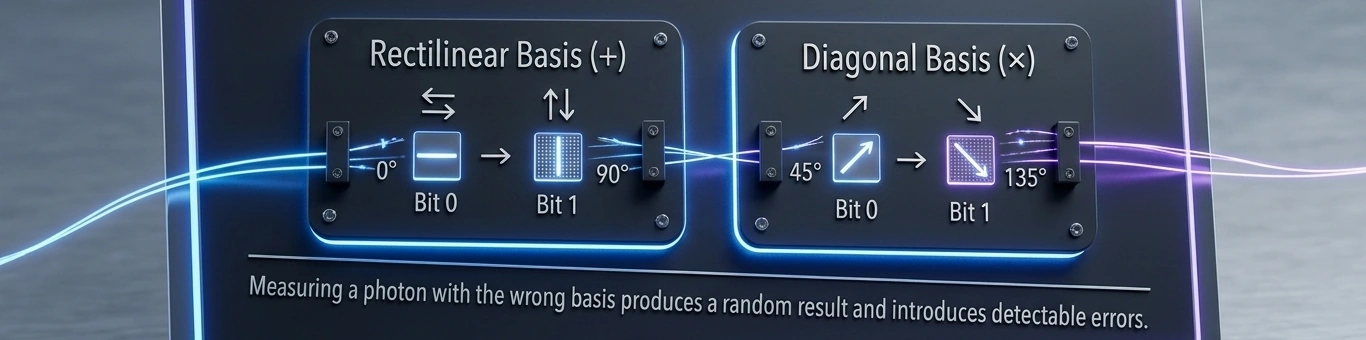
Figure 2: Photon Polarization States Used in BB84
The two polarization bases are mutually incompatible. A photon prepared in one basis cannot be measured correctly using the other basis without introducing uncertainty, which is the core security principle behind BB84.
Step-by-Step Working of BB84
The protocol operates through a sequence of well-defined stages.
Step 1: Alice Generates Random Bits
Alice begins by generating a random sequence of binary bits.
| Position | 1 | 2 | 3 | 4 | 5 | 6 |
|---|---|---|---|---|---|---|
| Bit | 0 | 1 | 1 | 0 | 0 | 1 |
These bits will later become part of the secret cryptographic key.
Step 2: Alice Chooses Random Bases
For each bit, Alice randomly selects either the rectilinear basis (+) or the diagonal basis (×).
| Position | 1 | 2 | 3 | 4 | 5 | 6 |
|---|---|---|---|---|---|---|
| Basis | + | × | + | × | + | × |
Step 3: Photon Transmission
Alice encodes each bit into a photon according to the selected basis and transmits the photons through the quantum channel.
| Bit | Basis | Polarization |
|---|---|---|
| 0 | + | 0° |
| 1 | × | 135° |
| 1 | + | 90° |
| 0 | × | 45° |
| 0 | + | 0° |
| 1 | × | 135° |
Step 4: Bob Measures the Photons
Bob does not know which basis Alice used. He independently selects a random basis for each incoming photon.
| Position | 1 | 2 | 3 | 4 | 5 | 6 |
|---|---|---|---|---|---|---|
| Bob's Basis | + | + | + | × | × | × |
If Bob chooses the same basis as Alice, he obtains the correct bit value. Otherwise, the measurement result is random. Step 5: Basis Comparison
After transmission, Alice and Bob communicate over the classical channel and compare only the bases they used.
| Position | Alice | Bob | Keep? |
|---|---|---|---|
| 1 | + | + | Yes |
| 2 | × | + | No |
| 3 | + | + | Yes |
| 4 | × | × | Yes |
| 5 | + | × | No |
| 6 | × | × | Yes |
Only positions with matching bases are retained.
Step 6: Shared Secret Key
The remaining bits form the shared secret key.
| Position | 1 | 3 | 4 | 6 |
|---|---|---|---|---|
| Key Bit | 0 | 1 | 0 | 1 |
The final secret key becomes:
Shared Secret Key
0 1 0 1
Generated only from positions where Alice and Bob used the same basis
This key can now be used for secure encryption of blockchain communication.
How BB84 Detects Eavesdropping?
Suppose Eve attempts to intercept the photons during transmission.
Because she does not know the correct basis, she must guess.
If she guesses correctly, the photon remains unchanged.
If she guesses incorrectly, the photon’s polarization is altered.
When Bob later measures the disturbed photon, the probability of obtaining an incorrect result increases. Alice and Bob can therefore estimate the error rate by publicly comparing a small subset of their generated bits.
For Example
Expected error rate without Eve: 1–2%
Error rate with Eve’s interception: 15–25% or higher
If the observed error rate exceeds the acceptable threshold, the key is immediately discarded.
This property provides a significant security advantage over classical key exchange methods, where an attacker may copy transmitted information without leaving any evidence of interception.
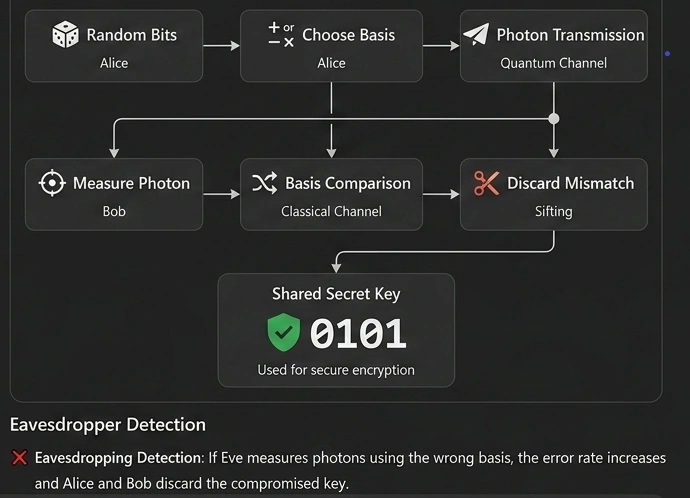
The workflow shows how Alice and Bob generate a shared secret key through photon transmission and basis comparison. Any incorrect measurement by Eve introduces errors, allowing the communicating parties to detect eavesdropping before accepting the key.
Why BB84 is Important for Blockchain Networks?
The BB84 protocol provides a practical method for generating symmetric encryption keys that can later be used to secure blockchain communication channels. In a blockchain environment, the process may work as follows:
Validator nodes establish a quantum communication channel.
BB84 generates a shared secret key between the nodes.
The generated key is used with AES or another symmetric algorithm.
Blockchain transactions and synchronization messages are transmitted securely.
This approach creates a hybrid security model:
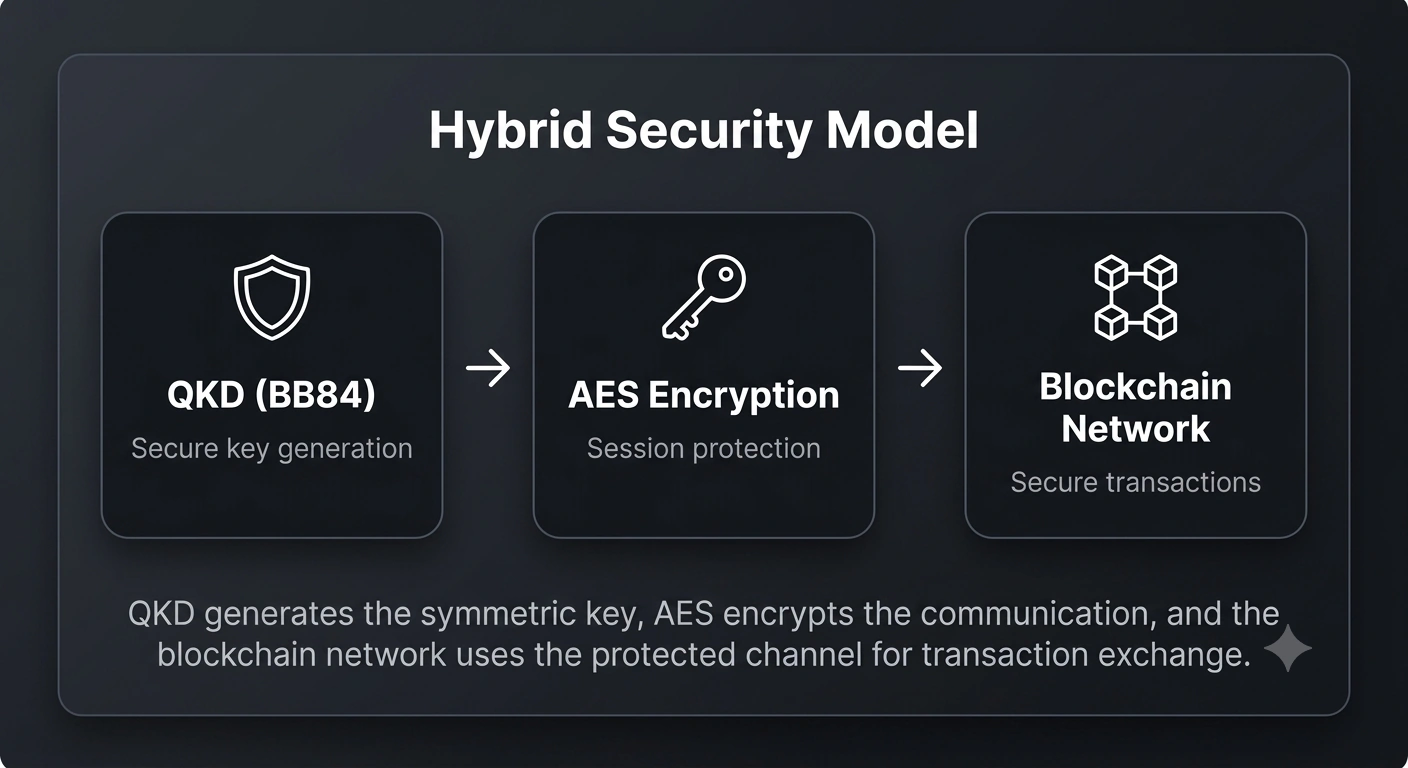
QKD generates the encryption key, conventional cryptography protects the data, and blockchain continues to provide decentralized transaction validation. As a result, BB84 does not replace blockchain technology; it enhances the security of the communication layer that supports future decentralized systems.
Quantum Communication in Blockchain Networks
Traditional blockchain networks are designed to operate over classical communication infrastructure, where participating nodes exchange transactions, synchronize distributed ledgers, verify digital signatures, and reach consensus through standard Internet communication protocols. Although these communication channels are protected using strong encryption algorithms, the underlying security still depends on the secure distribution of cryptographic keys.
Quantum Key Distribution introduces an additional security layer by enabling blockchain nodes to establish encryption keys through quantum communication before exchanging sensitive information. Rather than replacing the existing blockchain infrastructure, QKD complements it by securing the communication channel that connects distributed nodes.
In a QKD-enabled blockchain network, two validator nodes first establish a quantum communication link through an optical fiber or free-space optical channel. Using the BB84 protocol, both nodes generate an identical secret key without transmitting the key itself over the network. Once the key generation process is successfully completed and verified, the shared key is used by conventional symmetric encryption algorithms, such as AES, to protect subsequent blockchain communication.
This hybrid approach combines the strengths of both technologies. Blockchain continues to provide decentralization, immutability, and consensus, while Quantum Key Distribution ensures that the cryptographic keys protecting network communication are exchanged with an exceptionally high level of security.
The communication sequence can be summarized as follows:
Two blockchain nodes establish a quantum communication channel.
BB84 generates a shared secret key.
Alice and Bob verify the integrity of the generated key.
The secret key is supplied to the encryption module.
Blockchain transactions are encrypted using the generated key.
Secure communication continues through conventional network infrastructure.
The key observation is that QKD secures the communication before blockchain data transmission begins. This proactive protection significantly reduces the possibility of compromised encryption keys during communication setup.
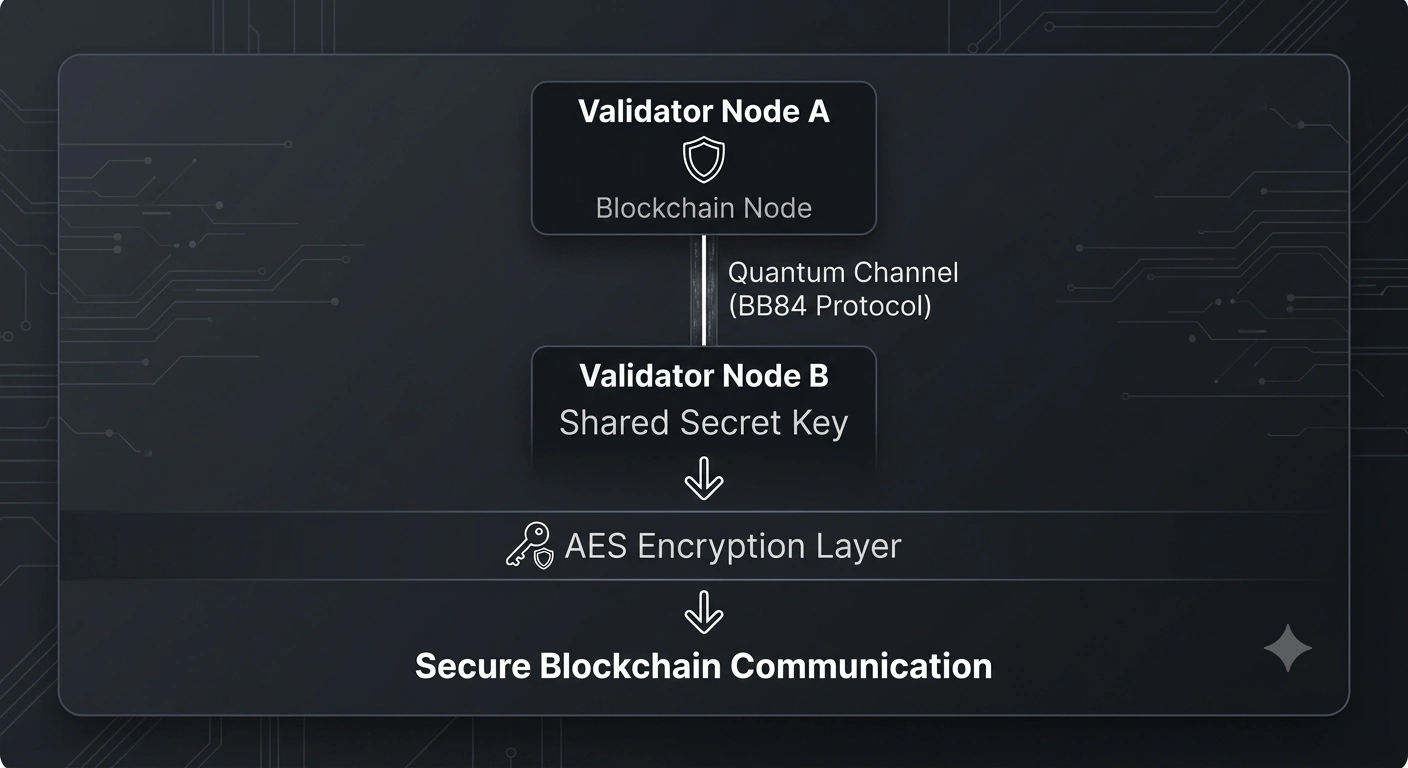
Figure 4. QKD-Enabled Blockchain Communication
Figure 4 illustrates how Quantum Key Distribution operates alongside a blockchain network. The quantum channel is responsible only for generating the shared secret key, while the encrypted blockchain communication continues through the conventional communication network.
Secure Key Exchange Using QKD
The primary objective of Quantum Key Distribution is to establish a secret cryptographic key that can later be used for secure communication. Unlike conventional methods, QKD never transmits the secret key directly. Instead, both communicating parties independently generate the same key through quantum measurements and classical verification.
This distinction provides an important security advantage.
In traditional communication systems, the confidentiality of the exchanged key depends largely on the computational strength of the underlying mathematical algorithms. An attacker with sufficient computational resources may eventually recover the exchanged key.
QKD approaches the problem differently. Since the secret key is never actually transmitted across the communication channel, there is no key available for an attacker to intercept. Instead, both communicating parties construct the same key independently based on the quantum states exchanged during the BB84 protocol. Moreover, any attempt to observe these quantum states changes their physical properties, introducing detectable transmission errors. Alice and Bob continuously estimate the Quantum Bit Error Rate (QBER) during key generation. If the measured error exceeds an acceptable threshold, they immediately discard the generated key and initiate a new communication session. Consequently, the security of the generated key is verified before it is ever used for encryption. This verification process distinguishes Quantum Key Distribution from every conventional key exchange mechanism currently deployed in classical communication systems.
Classical Key Exchange vs Quantum Key Distribution
The following comparison highlights the fundamental differences between conventional key exchange mechanisms and Quantum Key Distribution.
| Feature | Classical Key Exchange | Quantum Key Distribution |
|---|---|---|
| Security Foundation | Mathematical complexity | Quantum mechanics |
| Secret Key Transmission | Indirectly exchanged | Never transmitted directly |
| Eavesdropping Detection | Not possible during exchange | Immediate detection through QBER |
| Security Assumption | Limited computational capability | Laws of physics |
| Protection Against Future Quantum Attacks | Limited | Designed for quantum-secure communication |
Rather than competing with conventional cryptography, QKD complements existing encryption technologies by securing one of the most vulnerable stages of secure communication the key establishment process.
Practical Blockchain Integration Using QKD
Integrating Quantum Key Distribution into blockchain infrastructure does not require redesigning the blockchain protocol itself. Instead, QKD operates as an additional communication layer positioned below the blockchain application layer.
A simplified architecture is illustrated below.
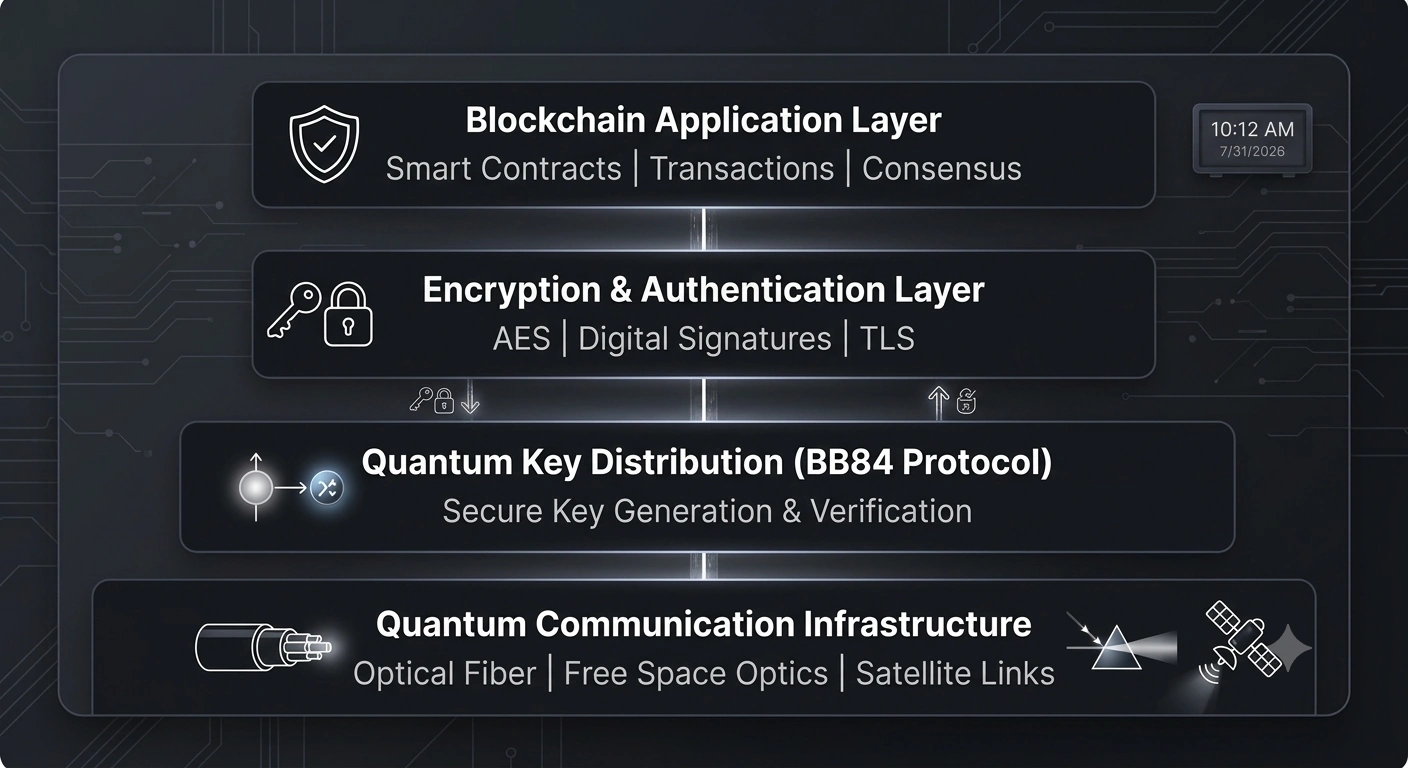
Figure 5. Hybrid Blockchain Architecture with QKD
In this architecture, each layer performs a specific responsibility.
The Blockchain Application Layer manages transactions, smart contracts, and consensus mechanisms.
The Encryption Layer protects transmitted blockchain data using established cryptographic algorithms.
The QKD Layer securely generates and distributes cryptographic keys.
Finally, the Quantum Communication Infrastructure provides the physical medium through which photons are transmitted between communicating nodes.
This layered approach allows existing blockchain platforms to adopt QKD incrementally without replacing their core consensus mechanisms or transaction processing logic.
Real-World Deployment Scenarios
Although Quantum Key Distribution is still an emerging technology, several practical deployment scenarios are already being explored.
Financial Institutions
Banks handling high-value digital transactions require secure communication between geographically distributed data centers. QKD can protect inter-bank communication by generating encryption keys that are resistant to interception.
Government Networks
Government organizations exchange highly confidential information across multiple departments. Integrating QKD with permissioned blockchain platforms can enhance communication security for digital governance and classified data exchange.
Healthcare Systems
Hospitals frequently exchange patient records, diagnostic reports, and medical research data. Secure quantum-generated encryption keys can strengthen the confidentiality of healthcare information stored and transmitted through blockchain-based medical systems.
Data Centers
Cloud service providers increasingly deploy distributed infrastructure across multiple locations. QKD can secure communication channels between data centers, reducing the risk of compromised cryptographic keys.
Critical Infrastructure
Energy grids, transportation systems, defense communication networks, and smart city platforms are becoming increasingly interconnected. Since these systems often rely on blockchain for transparency and trust, integrating QKD can significantly improve communication security.
Why QKD Complements Blockchain Instead of Replacing It?
A common misconception is that Quantum Key Distribution is intended to replace blockchain cryptography.
This is not the case. Blockchain and QKD solve different security problems.
Blockchain ensures:
Data immutability
Decentralized trust
Transaction integrity
Consensus among distributed nodes
Quantum Key Distribution ensures:
Secure cryptographic key establishment
Detection of communication interception
Secure communication channels
Enhanced confidentiality during data transmission
When both technologies operate together, they provide stronger end-to-end security than either technology can achieve independently. Rather than viewing QKD as an alternative to blockchain, it should be considered a complementary security technology capable of protecting the communication infrastructure supporting future decentralized systems.
Benefits of Quantum Key Distribution for Blockchain Networks
As blockchain applications continue to expand into financial services, healthcare, digital identity, and critical infrastructure, ensuring secure communication between distributed nodes becomes increasingly important. Quantum Key Distribution strengthens blockchain communication by securing the exchange of cryptographic keys before sensitive information is transmitted.
Unlike conventional security mechanisms that rely solely on computational assumptions, QKD introduces a physics-based approach to secure communication. This provides several practical advantages for blockchain ecosystems.
1. Information-Theoretic Security
The security of QKD is based on the laws of quantum mechanics rather than mathematical complexity. Even if future computers become significantly more powerful, the security principles of QKD remain unchanged because they depend on the behavior of quantum particles instead of computational limitations.
2. Eavesdropping Detection
One of the most significant advantages of Quantum Key Distribution is its ability to detect unauthorized interception during the key exchange process. If an attacker attempts to observe the transmitted photons, the quantum states are disturbed, increasing the Quantum Bit Error Rate (QBER). This allows legitimate participants to identify compromised communication before using the generated key.
3. Stronger Communication Between Blockchain Nodes
Blockchain validators constantly exchange transactions, consensus messages, and synchronization data. QKD enables these nodes to establish highly secure communication channels before exchanging sensitive information, reducing the risk of compromised encryption keys.
4. Complements Existing Encryption Standards
QKD does not replace widely accepted encryption algorithms such as AES. Instead, it securely generates the cryptographic keys required by these algorithms. This allows organizations to enhance communication security without redesigning their existing blockchain applications.
5. Future-Ready Security
Many blockchain applications are expected to remain operational for decades. Financial records, government documents, healthcare data, and digital identity information often require long-term confidentiality. By adopting quantum-secure key distribution mechanisms today, organizations can better prepare their communication infrastructure for future technological advancements.
Current Challenges
Despite its significant advantages, Quantum Key Distribution is still an emerging technology with several practical limitations that must be addressed before large-scale deployment becomes feasible.
Infrastructure Requirements
Most practical QKD systems require dedicated optical fiber links or specialized free-space optical communication equipment. Establishing this infrastructure can be expensive, particularly for geographically distributed blockchain networks.
Distance Limitations
Photon signals gradually weaken as they travel through optical fibers, limiting the communication distance without additional quantum networking technologies such as quantum repeaters.
Deployment Cost
Quantum communication devices, single-photon detectors, and specialized optical equipment remain costly compared to conventional networking hardware. As the technology matures, these costs are expected to decrease.
Scalability
Large public blockchain networks may contain thousands of participating nodes distributed across different countries. Establishing quantum communication channels between every node presents considerable scalability challenges.
Standardization
Although organizations such as the European Telecommunications Standards Institute (ETSI) and the National Institute of Standards and Technology (NIST) are actively working toward quantum security standards, widespread interoperability frameworks are still evolving. Continued research and industry collaboration will play an important role in achieving global adoption.
Future Outlook
Quantum communication is progressing from theoretical research toward practical implementation. Governments, research organizations, and technology companies are investing heavily in quantum networking infrastructure to prepare for the next generation of secure communication.
One of the most promising developments is the emergence of the Quantum Internet, where quantum communication channels will enable secure information exchange over long distances. Within such an ecosystem, blockchain platforms could establish cryptographic keys using QKD while continuing to rely on conventional encryption algorithms for data protection and decentralized consensus for transaction validation.
Satellite-based QKD projects have already demonstrated secure quantum communication across hundreds of kilometers, indicating that large-scale quantum networks may become a practical reality in the coming years.
Rather than replacing existing cybersecurity solutions, the future is likely to involve hybrid security architectures that combine classical encryption, Post-Quantum Cryptography (PQC), Quantum Key Distribution (QKD), and blockchain technologies. Each technology addresses a different aspect of security, creating a more resilient digital ecosystem capable of supporting future applications.
Classical Key Exchange vs Quantum Key Distribution
| Feature | Classical Key Exchange | Quantum Key Distribution (QKD) |
|---|---|---|
| Security Foundation | Mathematical Complexity | Quantum Mechanics |
| Key Distribution | Computational Methods | Quantum Communication |
| Secret Key Transmission | Indirectly Exchanged | Never Transmitted Directly |
| Eavesdropping Detection | Not Available | Built-in Detection |
| Security Against Future Quantum Attacks | Limited | Designed for Quantum-Secure Communication |
| Security Model | Computational Security | Information-Theoretic Security |
| Communication Medium | Classical Network | Quantum + Classical Channels |
| Long-Term Confidentiality | Depends on Computational Assumptions | Based on Physical Principles |
Conclusion
Blockchain technology has transformed digital trust by providing secure, transparent, and decentralized transaction processing. However, the security of blockchain communication depends not only on encryption algorithms but also on the secure exchange of cryptographic keys.
Quantum Key Distribution introduces a new approach to key establishment by leveraging the principles of quantum mechanics instead of computational complexity. Through protocols such as BB84, QKD enables communicating parties to generate shared secret keys while detecting any attempt at unauthorized interception during the key exchange process.
Although practical deployment still faces challenges related to infrastructure, scalability, and cost, the technology demonstrates significant potential for strengthening secure communication in future blockchain networks. Rather than replacing blockchain or conventional cryptography, QKD complements existing security mechanisms by protecting one of the most fundamental elements of secure communication—the cryptographic key itself.
As quantum technologies continue to evolve, integrating Quantum Key Distribution with blockchain networks may become an important step toward building resilient, trustworthy, and future-ready decentralized systems.
Join the conversation! Your thoughts help the community grow.