

I've been following the Qwen team at Alibaba for a while now. Covered their text models, their vision models, their coding models — you name it. But when the Qwen-VLA paper dropped on May 29, 2026, I stopped what I was doing and read the whole thing in one sitting. Because this one felt different.
Not just another model. An attempt to give AI a body.
Why Robots Have Always Been Dumb — Even the Smart Ones
Let me give you a mental picture. Imagine hiring a new employee who is brilliant at exactly one thing — say, picking up red cups and placing them on a shelf. That's all they do. You can't ask them to go get you a coffee from the other room. You can't ask them to sort files on a desk. One job, one person.
That's basically how most industrial robots work today. And, embarrassingly, that's also how most robotics AI systems have worked until very recently. You'd train a model to pick up objects from a conveyor belt, and it would do that job beautifully. But ask the same model to navigate to the storage room? Blank stare. Put it on a different robot arm with different joints? Completely lost.
This is what researchers call the fragmentation problem. Specialized models for specialized tasks. One model for manipulation (grabbing and moving things). A separate model for navigation (moving around spaces). Yet another model tuned for a specific robot platform. The moment you change any one of these variables - new environment, new robot, new task - you're basically starting from scratch with a new training run.
I've seen this problem up close while exploring robotics research for my cloud infrastructure work. The engineering overhead is wild. Companies deploy dozens of narrowly trained models to handle what a moderately capable human employee could do with common sense.
The Qwen team asked a simple but audacious question: what if one model could do all of it?
Enter Qwen-VLA: One Brain, Many Bodies
VLA stands for Vision-Language-Action. It's exactly what it sounds like. The model takes in what it sees (vision), understands what you tell it (language), and then does something physical in the world (action).
Qwen-VLA, announced by Alibaba's Qwen team, is a unified embodied foundation model. That's a fancy way of saying: it's a single AI model that can be dropped into different robot bodies and different tasks, with minimal extra training needed. The robot can pick up objects, navigate rooms, and predict motion paths - all from the same underlying model.
Think of it like this. If language models (like the ones behind ChatGPT or Qwen itself) learned to understand and generate text, Qwen-VLA learns to understand the physical world and generate actions. It's the logical next step: from models that talk about the world to models that act in it.
How Does It Actually Work? (The Non-Jargon Version)
The technical paper has a lot of moving parts but let me break it down into something digestible.
Related Image: © Qwen
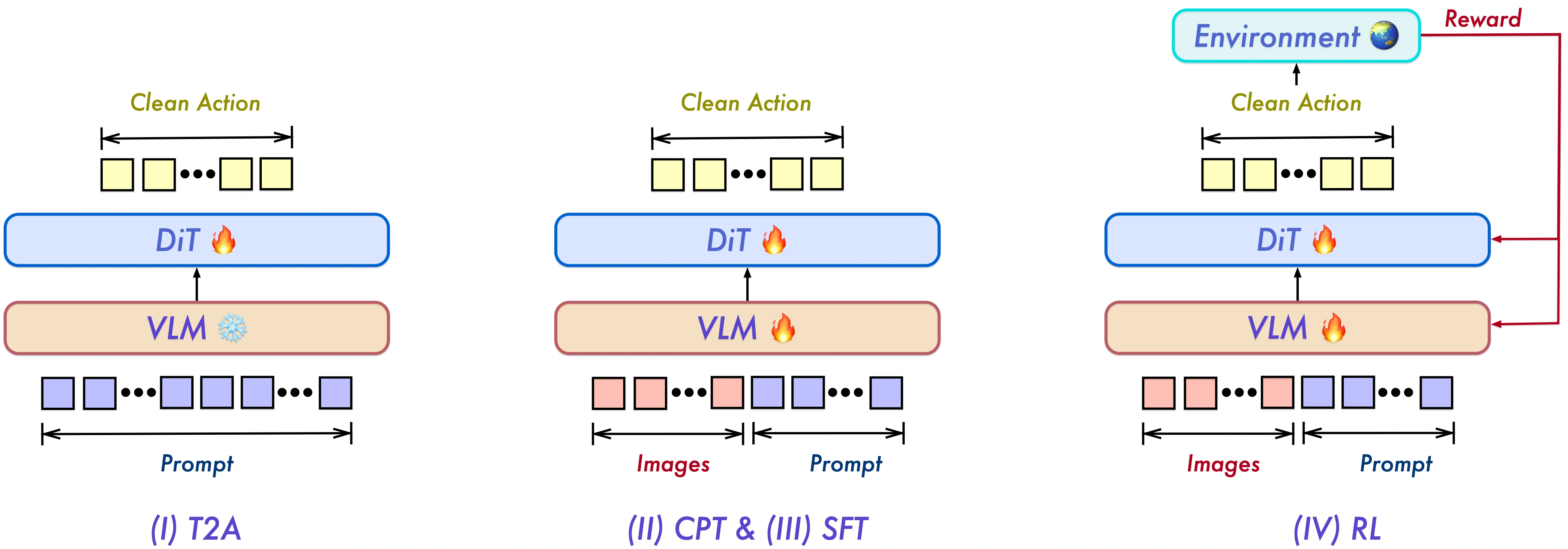
Step 1: It starts with vision and language understanding.
Qwen-VLA is built on top of Qwen3.5-4B — the same kind of vision-language backbone that powers Qwen's image-understanding models. So it already knows how to look at a scene and understand what's in it, what objects are present, what a natural language instruction means.
Step 2: A separate action decoder translates understanding into movement.
Here's where it gets clever. The team added a 1.15 billion parameter action decoder called a DiT (short for Diffusion Transformer). Think of this as the "muscle" connected to the brain. The brain understands what to do; the DiT figures out the precise physical movements needed to do it.
This isn't like typing text — it's generating continuous motion trajectories. Where exactly should the robot arm move at this precise millisecond? At what speed? With how much force? That's what the action decoder outputs: smooth, continuous action sequences.
Step 3: You describe the robot, and it adapts.
Here's the genuinely clever part. Different robots have different bodies. A single-arm robot moves differently from a dual-arm robot. A robot on wheels navigates differently from one on legs. Historically, you'd need separate models for each.
Qwen-VLA handles this through what the researchers call "embodiment-aware prompt conditioning." You literally just describe the robot in plain text — something like "this is a dual-arm ALOHA robot with a control frequency of 50Hz" — and the model adapts its outputs accordingly. No architectural changes. No retraining. Just a text prompt.
This is the kind of elegant solution that makes you slap your forehead and go "why didn't someone think of this earlier?"
What Can It Actually Do?
The model handles three major families of tasks, which previously required three separate specialized systems.
Manipulation — This is the classic robot arm stuff. Picking up objects, placing them precisely, coordinating both arms for tasks that need two hands. Think: a robot in a kitchen picking up ingredients, or a manufacturing arm assembling small components.
Navigation — Moving through indoor spaces while following language instructions. "Go to the kitchen table. Turn left at the corridor. Find the blue box near the window." These kinds of long-horizon navigation tasks require both spatial awareness and language comprehension.
Trajectory Prediction — This is the more abstract one. Given a visual scene, predict where objects or agents will move. Useful for things like anticipating where a person is walking so a robot can avoid them, or planning a path through a cluttered environment.
All three tasks, unified under one model. That alone would be impressive. But the numbers are what really made me sit up.
The Benchmark Results That Raised My Eyebrows
Benchmarks aren't everything, and I always take them with a grain of salt. But these results deserve attention because Qwen-VLA is being compared against specialist models — models that were trained for one specific task and one specific robot. A generalist beating specialists is genuinely surprising.
On LIBERO, a standard manipulation benchmark, Qwen-VLA-Instruct scored 97.9% success. That's near state-of-the-art, matching models that do nothing else.
On RoboTwin-Hard (a difficult dual-arm coordination benchmark), it hit 87.2%. On Simpler-WidowX (a real robot evaluation), 73.7%.
The real-world ALOHA dual-arm robot results are the ones I found most interesting. In familiar, in-domain conditions, it achieved 83.6% average success. But here's the number that matters: in out-of-distribution conditions — meaning environments it had never specifically trained on, with different backgrounds, different object positions, different lighting — it achieved 76.9% average success.
For context, π₀.5 from Physical Intelligence (one of the most respected robotics AI labs in the world) achieved 71.6% in-domain and only 41.5% out-of-distribution on similar evaluations.
A generalist model outperforming a specialist on unfamiliar territory. That's the headline.
It also showed zero-shot capability on DOMINO, a dynamic manipulation benchmark where objects are moving. The model had never been trained on dynamic tasks, and it still achieved 26.6% success from scratch. Not perfect — but this isn't a task it ever saw during training.
The Training Philosophy Behind It
One thing I genuinely respect about this research is the thoughtfulness behind the training approach. Training a model that handles both language and physical movement is tricky because these are very different kinds of outputs. Text tokens are discrete (finite set of words). Physical actions are continuous (infinite real-number coordinates).
Related Image: © Qwen
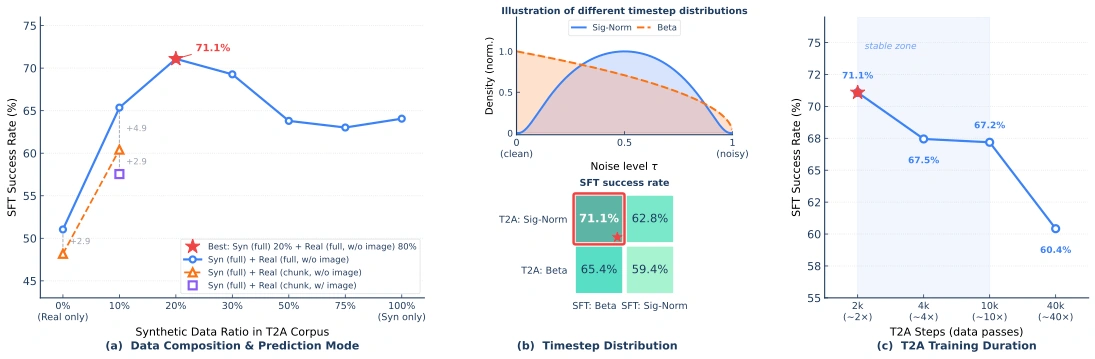
The team solved this with a four-stage training recipe that's almost pedagogical in its logic.
First, they trained the action decoder on language instructions only — no visual input. Force it to learn: "when someone says 'pick up the cup,' what family of motions does that imply?" It builds an abstract understanding of action from words alone.
Second, they introduced visual input. Now the model can ground those action priors in what it actually sees: "there's a blue cup on the left side of the table, so the motion should arc in this direction."
Third, supervised fine-tuning on curated demonstrations — like showing a student worked examples before the exam.
Fourth, reinforcement learning, where the model is rewarded for actually succeeding at tasks in simulation. This is where it starts developing something like judgment.
The progression makes intuitive sense. You wouldn't teach a new employee by throwing them into live customer calls on day one. You'd give them context, show them examples, then let them practice with stakes attached.
What Does the Training Data Look Like?
The scale of the data is staggering. Robotics manipulation trajectories alone account for 74.2% of the training mix — this includes publicly available datasets like DROID and RT-1, over 1,000 hours of proprietary teleoperation recordings where human operators physically controlled robots while the AI watched and learned, and roughly 8 million synthetic simulation trajectories.
They also included human egocentric video — footage shot from a first-person perspective showing humans doing everyday tasks. Cooking, cleaning, assembling furniture. This is a clever shortcut: humans generate far more diverse manipulation data than robots do, and a robot can learn hand-eye coordination by studying how humans move their hands.
Navigation data, trajectory data, and general vision-language data round out the rest. Altogether, a heterogeneous mix designed to prevent the model from becoming narrowly adapted to any one distribution.
Why This Matters Beyond the Lab
Here's my honest take on why this release matters, outside of the academic benchmark game.
The robotics industry right now is fragmented in a way that reminds me of the early days of cloud computing. Every task required a custom solution. Every vendor had their own proprietary stack. Deployment was expensive, slow, and brittle.
The generalist model approach that Qwen-VLA represents could do for robotics what foundation models did for NLP. Instead of training a new model from scratch for every new robot or every new task, you start from a strong generalist base and fine-tune minimally. The research shows that fine-tuning from the Qwen-VLA pretrained base dramatically outperforms training from scratch — even on specialized real-world tasks.
This matters for manufacturing, where you'd want a robotic arm that can handle varied objects on an assembly line without reprogramming. It matters for home assistance, where the tasks are inherently diverse and unpredictable. It matters for logistics, where conditions change constantly.
Crucially, the model is open-sourced. Code, weights, and technical report are all available on GitHub. That's consistent with Qwen's track record of releasing powerful models to the community — something I respect deeply, especially as someone who runs an open-access learning platform. Closed research doesn't move the field forward nearly as fast.
Where Qwen-VLA Fits in the Bigger Picture
Qwen-VLA isn't operating in a vacuum. NVIDIA has GR00T, their humanoid robot foundation model. Physical Intelligence has π₀ and π₀.5. Google DeepMind has been publishing work in this space for years. The race toward general-purpose robot intelligence is very real, and it's heating up fast.
What makes Qwen-VLA's positioning interesting is the combination of strong performance and open availability. Most of the cutting-edge robot AI work from the big labs is closed — you can read the paper, but you can't run the model. Qwen-VLA changes that calculus for researchers and startups who want to actually build on top of state-of-the-art.
The model also sits within Qwen's broader ecosystem, which already includes strong vision-language understanding. That foundation gives Qwen-VLA a head start on the perceptual side that purely robotics-native models don't have.
What's Still Hard — And Where We're Headed
I'd be doing you a disservice if I made this sound like a solved problem. It isn't.
The 26.6% zero-shot success on dynamic manipulation (moving objects) is promising, but it also tells you how hard that problem is. The gap between simulation and real-world performance remains significant in robotics AI. Models that ace simulation benchmarks often struggle with real-world physical variation — different lighting, different friction, different object weights.
Embodiment-aware prompting is elegant, but it assumes someone has correctly described the robot in the first place. Real deployment will surface edge cases that descriptions can't anticipate.
And the training data, while massive, is still dominated by certain types of robots and certain types of tasks. Truly novel robot morphologies or genuinely unprecedented task categories will require more data and likely more fine-tuning.
But here's the thing — every one of these limitations is being actively worked on, and the direction of progress is clear. The generalist approach is winning. The question is how fast.
Closing Thoughts
There's a quote I keep coming back to when I think about where AI is headed: the difference between a tool that understands the world and a tool that can act in it is the difference between a consultant and an employee.
For decades, AI was firmly in the consultant camp - incredibly good at analyzing, describing, recommending. But acting? That required a human in the loop.
Qwen-VLA is part of a wave of research that is seriously challenging that boundary. A single model that can see a scene, understand a natural language instruction, and physically manipulate the world around it - across multiple different robot bodies, without task-specific retraining — would have sounded like ambitious speculation just two or three years ago.
Now it's a research paper you can read on arXiv and a model you can download from GitHub.
That's not a small thing. That's a before-and-after moment in the history of how AI interacts with the physical world.
Join the conversation! Your thoughts help the community grow.