

Abstract / Overview
Qwen3-Omni is Alibaba Cloud’s flagship omni-modal AI foundation model, created by the Qwen team. Unlike text-only large language models (LLMs), Qwen3-Omni natively processes text, image, audio, and video inputs, and generates streaming outputs in both text and natural speech.
It delivers SOTA performance in 22 of 36 multimodal benchmarks and performs on par with top commercial systems such as Google Gemini 2.5 Pro in ASR and conversational audio tasks. This makes Qwen3-Omni a leading real-time multimodal model suitable for global-scale applications.
Conceptual Background
LLMs historically focused on text. Extensions into vision or audio were often modular, creating imbalances across modalities. Qwen3-Omni overcomes this by:
Unified multimodal pretraining (not just adapters).
Streaming architecture for both text and natural speech.
Balanced optimization across text, vision, and audio.
Multilingual support for cross-border communication and translation.
This shift represents the industry’s movement toward true omni-modal AI where models act as interactive, real-time assistants instead of static query engines.
Step-by-Step Walkthrough
Model Architecture
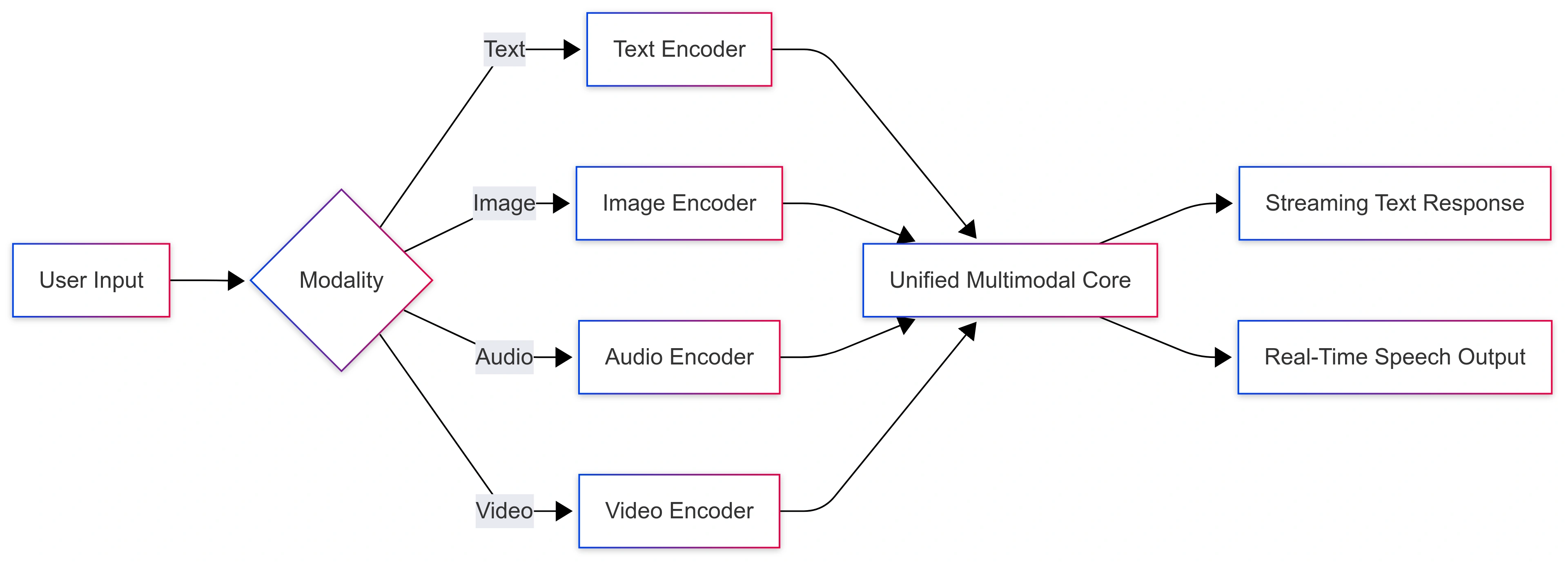
Unified multimodal encoders for text, images, audio, and video.
Streaming inference producing token-by-token text and real-time voice.
Efficient optimization reducing latency and compute load.
Multilingual training corpus for global-scale deployment.
Performance Benchmarks
Audio/Video: SOTA in 22/36 public tasks.
Speech Recognition: Matches Gemini 2.5 Pro.
Conversational Speech: Exceeds prior open-source multimodal baselines.
Image + Text tasks: Matches leading vision-language models.
Deployment Options
Transformers (Hugging Face) for research and fine-tuning.
vLLM integration for enterprise-scale inference.
DashScope API for real-time cloud deployment.
Dockerized demos for easy local setup.
Mermaid Diagram: Qwen3-Omni Workflow
Use Cases / Scenarios
Conversational AI Assistants – Real-time, multilingual, voice-enabled dialogue.
Accessibility Tools – Speech-to-speech translation and transcription.
Education – Interactive tutoring with text, visuals, and audio responses.
Media Applications – Captioning, dubbing, and video-based Q&A.
Enterprise Monitoring – Audio and video compliance checks with summarization.
Limitations / Considerations
Compute-heavy training demands large GPU clusters.
Latency in speech streaming compared to text-only models.
Bias risks from multimodal datasets.
Ecosystem competition with GPT-4o and Gemini.
Join the conversation! Your thoughts help the community grow.