On 16 November 2026, the Qwen team released Qwen4-Max, the first model of the Qwen4 generation. Their launch post carries a friendly title: "Your New Teammate Has Arrived." As an Alibaba Cloud MVP, I get asked about Qwen models all the time, so I read the announcement closely. This article is my attempt to explain what Qwen4-Max is, what has actually changed, and who should care, without the jargon.
First, what is Qwen?
Qwen is the family of AI models built by Alibaba Cloud. Some of them are small enough to run on a laptop. Others are huge models that live in the cloud and do the heavy lifting. "Max" is the top of the range: the biggest and most capable model in each generation. Qwen4-Max replaces Qwen3.8-Max as the flagship.
The "teammate" idea
Most people still think of an AI model as a chatbot. You ask a question, you get an answer, and the conversation ends. Alibaba is pushing a different picture with this release. The team describes Qwen4-Max as a 24/7 AI teammate that keeps the big picture in view and moves a project forward over many steps.
That is not just a marketing line. It shows where the whole industry is heading. The useful jobs are no longer "write me a paragraph" but "go through these files, build the report, check your own work, and come back when it is done." Qwen4-Max is designed for that kind of long, multi-step work.
What is under the hood
Here are the main specifications from the official post, explained simply.
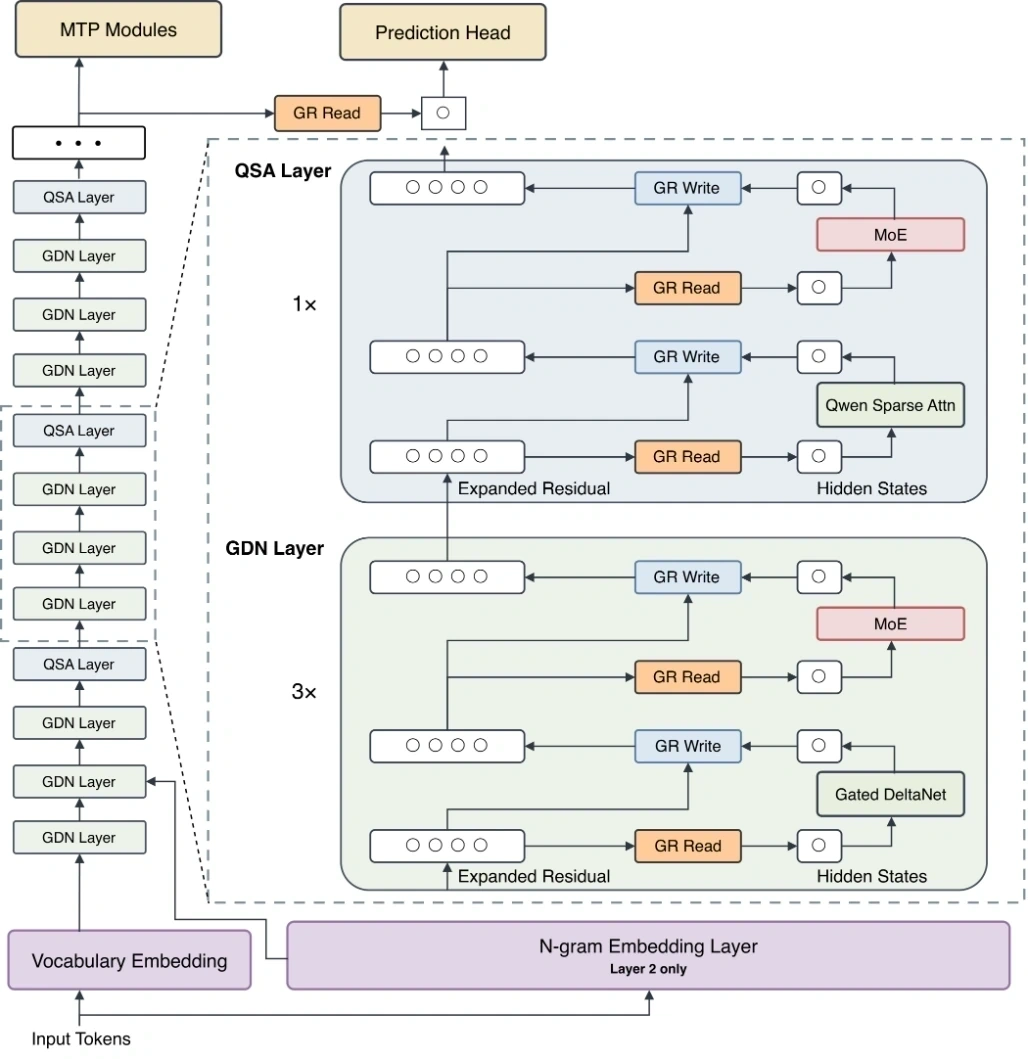
A new architecture. Qwen4-Max is built on a new architecture created for the Qwen4 series. It is a mixture-of-experts model. Think of it as a very large team of specialists, where only the right specialists work on each piece of text. The backbone has 2.4 trillion parameters, but only about 71 billion are active for any single token. This is why a model so large can still respond at a reasonable speed and cost. The team also adds 328 billion extra N-gram embedding parameters on top.
GDN + Qwen Sparse Attention (QSA): Three Gated DeltaNet layers compress history into fixed-size states for every QSA layer. QSA uses a lightweight indexer to select relevant context at micro-block granularity, reducing both attention and indexing costs for long sequences.
Gated Residual (GR): Four parallel residual branches use dynamic read and write gates to strengthen information flow across layers and improve training stability.
N-gram Embedding: Context-based lookups provide representations of local token patterns at the second layer, expanding model capacity with little additional computation.
Related Image: © qwen.ai
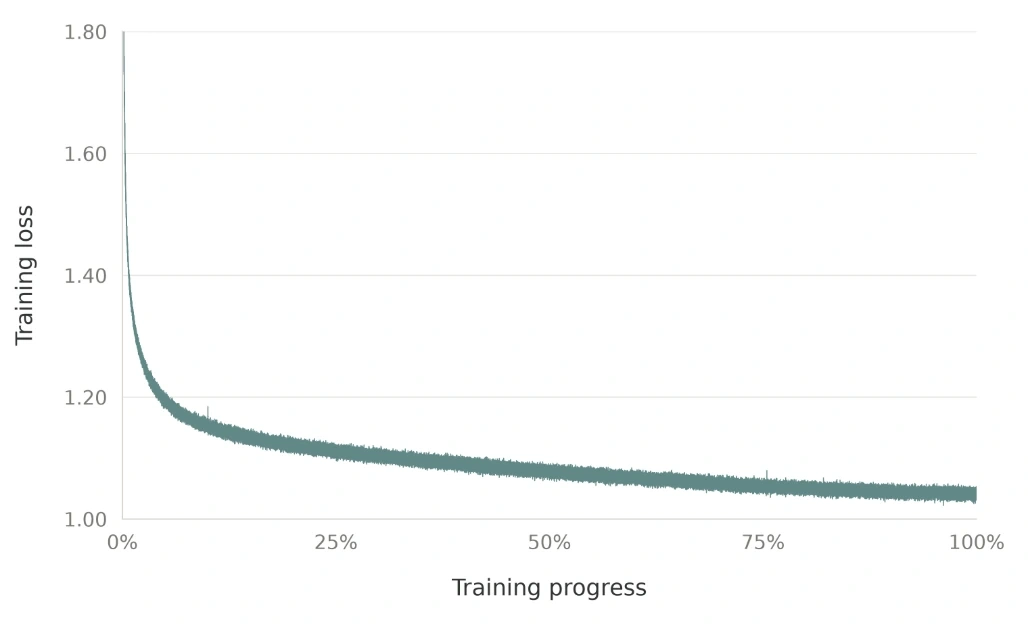
Training at the 2.4T-parameter scale progressed smoothly, with loss decreasing steadily and no loss spikes throughout the run. We attribute this stability primarily to improvements in model architecture and training optimization.
Related Image: © qwen.ai
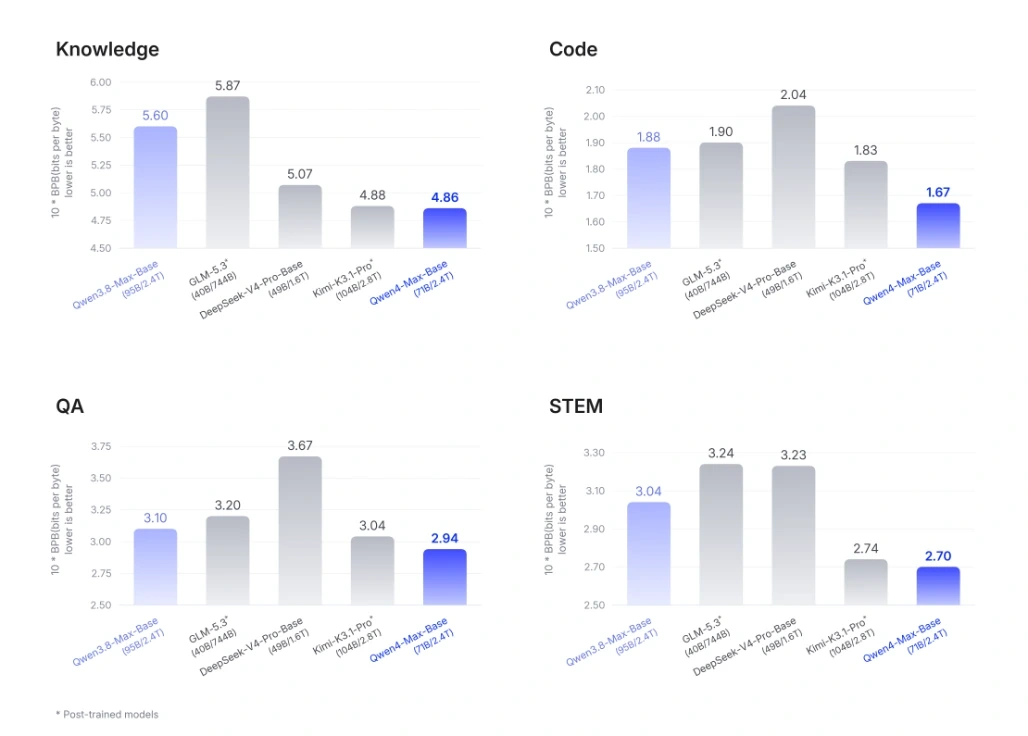
On in-house evaluations across Knowledge, Code, QA, and STEM, Qwen4-Max-Base achieves the lowest bits per byte (BPB) among all five evaluated checkpoints. It improves on Qwen3.8-Max-Base in every domain, with approximately 5–13% lower BPB while activating 25% fewer parameters.
Related Image: © qwen.ai
In-house evaluations: 10 × BPB, lower is better. GLM-5.3 and Kimi-K3.1-Pro are post-trained checkpoints, which may affect comparisons with base models.
The part I find most interesting: doing more with less
Bigger models usually mean bigger bills. Qwen4-Max tries to break that pattern, and I think this is the real story of the release.
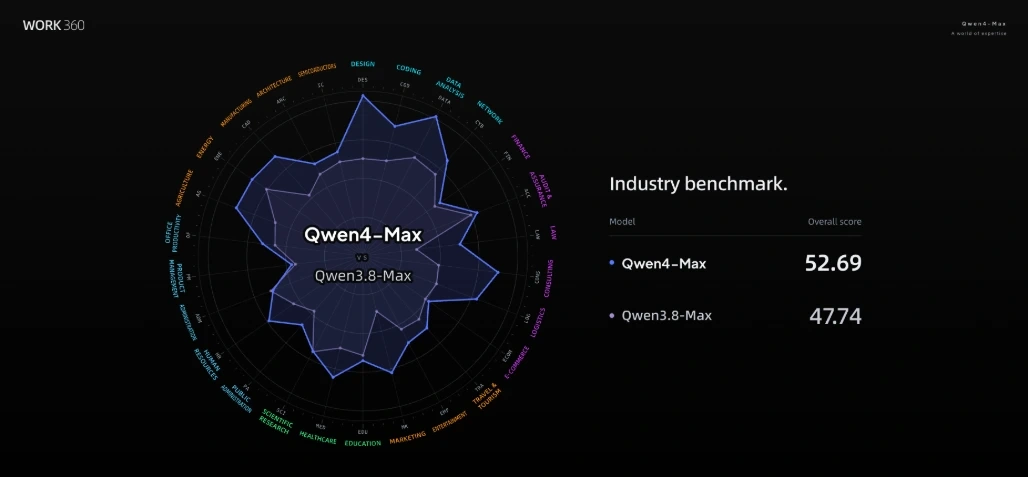
According to Alibaba, Qwen4-Max beats its predecessor while using up to about 50 percent fewer tokens on some tasks. Fewer tokens means the model is thinking and writing more efficiently, so you wait less and pay less. On Work360, Alibaba's own benchmark for professional work, the average cost per task dropped from $4.43 to $1.67, a saving of around 62 percent. The same test score rose from 47.74 to 52.69.
The price list supports this. The API costs $1.50 per million input tokens and $4.50 per million output tokens. A small honest note: the 62 percent saving compares Qwen4-Max with Alibaba's own older model, not with rival companies. It is a good sign for Qwen users, but it is not a claim about every competitor.
[IMAGE 4: Work360 results and cost chart from the blog. Credit: Qwen Team.]
What is Work360?
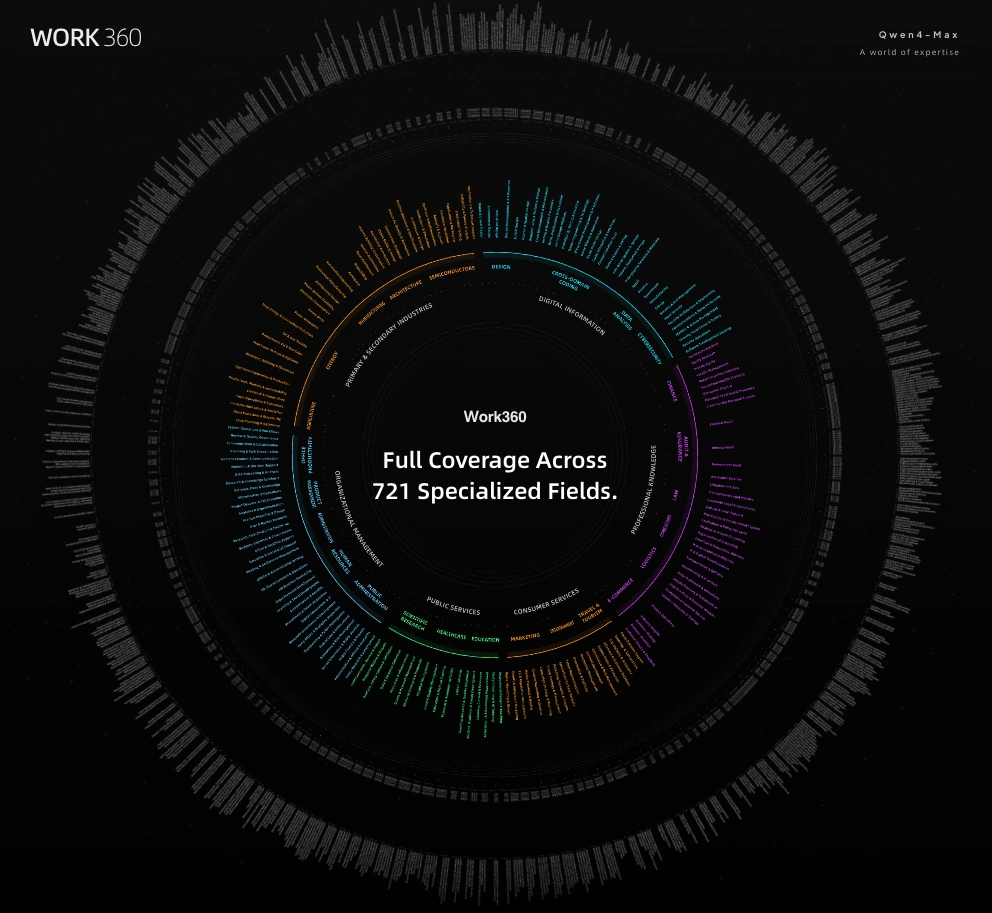
Work360 is a benchmark that Alibaba built to measure real professional work rather than puzzles. It covers 26 domains, 182 subdomains, and 721 specialised fields. One example from the launch material comes from manufacturing: programming a single workpiece took the AI about 24 minutes, against roughly 475 minutes by hand. Examples like this are the company's own showcase, so treat them as a direction, not a guarantee. But they show what kind of work Alibaba wants this model to take on.
Related Image: © qwen.ai
Related Image: © qwen.ai
How does it perform?
The numbers are good in some places and modest in others, and I think it is worth saying both.
Where it shines:
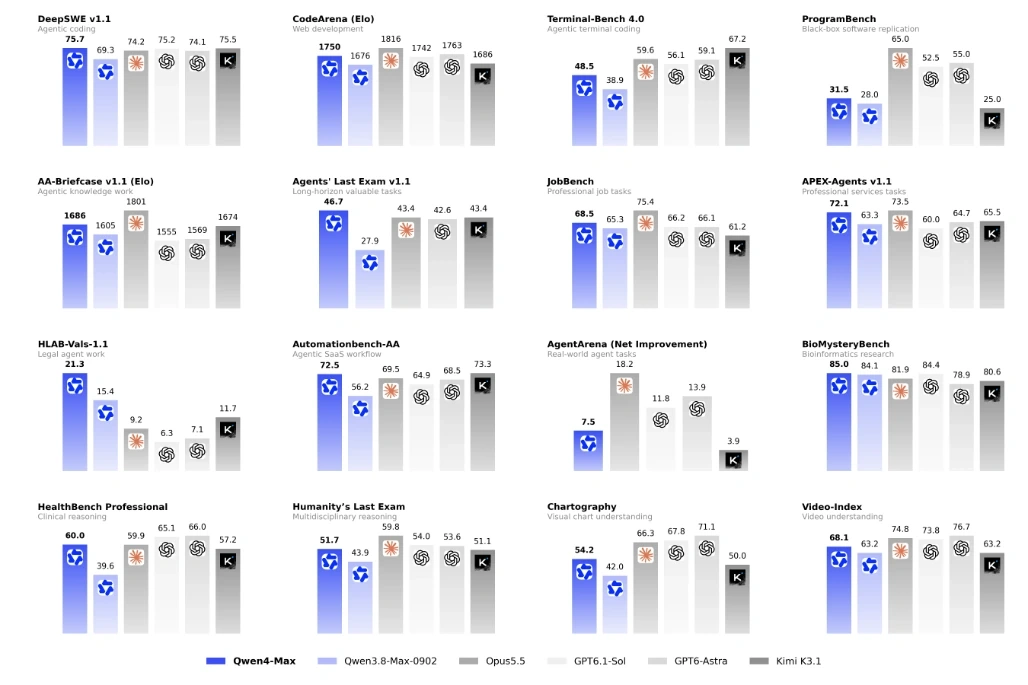
On DeepSWE v1.1, a test of coding agents that fix real software problems, it scored 75.7, up from 69.3 for Qwen3.8-Max. In Alibaba's chart, that is the top score.
On Agents' Last Exam v1.1, which measures long, valuable tasks, it jumped from 27.9 to 46.7.
On the Code Arena web development leaderboard it reached 1750 Elo, sixth place, though that ranking is still marked preliminary.
On the Artificial Analysis Intelligence Index, it rose from 34 to 43.
Where it still trails:
On Terminal-Bench 4.0, which tests command-line tasks, it scored 48.5. That is a big step up from 38.9, but leading rivals score higher.
On ProgramBench, it scored 31.5 against 65.0 for Claude Opus 5.5.
On the Artificial Analysis index, the very top models from other labs still score above 43.
In short, Qwen4-Max is a large, real improvement over the previous Qwen flagship, and in some agent and coding tests it is right at the front. It does not win everything, and Alibaba does not claim that it does. I find that honesty reassuring.
Related Image: © qwen.ai
Real work in finance, law and healthcare
The launch post spends a lot of time on high-stakes professions, where a wrong answer is expensive. Alibaba calls this a move from "information retrieval" to "professional-grade delivery." Here are the three examples it shows.
Investment research. In one demo, the model calls on about 90 tools to pull market prices, financial statements, interest rates and dividend data across A-shares, Hong Kong and US stocks, bonds, funds and derivatives. It then cross-checks the numbers against public disclosures. In a CSI 300 index futures case, it worked out the theoretical futures price from financing costs, dividends and contract dates, compared it with the real market discount, and studied the gap between implied and historical volatility. The result came as an Excel workbook and an editable PowerPoint deck. The detail I like most is traceability. Cells link back to the original data source, and the charts in the slides match the Excel file one to one, so an analyst can check every figure.
Legal due diligence before an IPO. The model was handed 198 working papers with messy names and formats. It sorted them into 14 folders by content, built an index, searched public records on company registration, intellectual property, court cases and credit, and compared them with the documents. It also spotted risky contract terms, for example a reinstatement clause in a valuation adjustment agreement, and suggested fixes. The final report ran 86 pages, covering 12 review areas and 14 specific legal issues, with every conclusion linked to a source paper.
Critical care. This is the most striking example. A patient had developed a dangerous heart rhythm after a carotid stent, and the record included dozens of lab reports, long progress notes, several sets of doctor's orders and 1,433 medical images. In one conversation, the model found specific lab values, built a six-day timeline, reviewed hundreds of CT slices using several sub-agents, and proposed four management steps that matched what the physician actually ordered that day.
A fair reminder: these are Alibaba's own showcases. They show what the model can attempt, not what you should trust blindly. Alibaba's own ethics statement says the model is meant to assist people, not replace professional judgment, and that human oversight remains essential where decisions carry serious consequences.
Agents that keep working, and keep you in control
A 24/7 agent is a model that can plan a long task, work on it for hours, and improve its own results along the way. The worry with long tasks is simple: if you only see the output at the end, a mistake early on can ruin everything.
Qwen4-Max answers this with a feature called Live Delivery. Instead of disappearing for hours, the agent hands you a usable first version early, then keeps releasing improved versions. At each release you can check progress, correct a mistake or change direction. Alibaba is also open-sourcing the Qwen-Live-Delivery-Plugin, so you can try the approach yourself.
The model helping to run Alibaba Cloud itself
This is the part that interests me most as a cloud person. Qwen4-Max can model and solve operations research problems, meaning planning under goals and limits. Alibaba has used it inside real Alibaba Cloud scenarios, working with its MindOpt solver. The model writes candidate algorithms, the solver scores them, and the model improves the code from that feedback.
The reported results are practical:
The cost of scheduling model calls for data annotation fell by an average of 10.42 percent against the baseline.
Whole-machine idle time for GPUs in online allocation improved by 4.62 percent.
For offline CPU rescheduling, the solver reached the best result more than 14.6 times faster.
In plain words, the model is improving the very systems that run, serve and train it. Savings there become more computing power for the next model.
Helping with scientific discovery
Two examples show how far Alibaba wants to push long, autonomous work.
A new coolant material. Data centers running powerful chips need better cooling. Working inside Deep Principle's Mira platform, Qwen4 ran for 48 hours straight. It built a pool of 2.7 million candidate molecules, screened them, predicted their properties, planned the chemistry and directed an automated wet lab to make and test the samples. After four rounds of design, synthesis and learning, it produced a physical, experimentally validated coolant molecule.
Drug discovery for Alzheimer's research. On DP Technology's PharmMaster platform, Qwen4-Max worked on a protein called NLRP3, which is linked to brain inflammation. It searched papers and patents, designed and refined molecules over many rounds, and made 454 tool calls and 3,239 computational evaluations to optimise 24 candidates. Its top pick was estimated to bind its target about 3.6 times better than the starting molecule. Note that this is a computer estimate. Experts at DP Technology said the molecule deserves further lab testing, which is the honest next step.
Built together with real products
One more point from the post: Qwen4-Max was developed through co-design of the model, the agent harness and the product, working with teams such as Qoder. The idea is to start from how people really work, especially everyday office tasks and professional design, and judge the model on finished deliverables instead of isolated test questions.
A word on safety
The launch post includes a safety section with real numbers. On Last Secure Code Bench, the share of function-level answers that are both correct and secure rose from 22.0 percent to 31.8 percent. That means the model is better at writing code that is safe, not only code that works. For any company thinking about letting an AI write code, this matters as much as raw speed.
The share of code that is secure at the function, file and repository levels at the same time nearly doubled, from 8 percent to 14.7 percent. Alibaba says the model is especially better at avoiding common risks such as injection attacks, memory safety problems and broken access control.
For cybersecurity, the team filtered its training data by purpose. It kept material for defensive work such as finding, checking and fixing vulnerabilities, and removed material aimed at building attack skills. Internal experts reviewed long task records, including the model's full reasoning, and reported stronger defence and no capabilities that pose large-scale cyber risk. For chemical, biological, radiological and nuclear topics, Alibaba added dedicated safety data and post-training. Its internal review found the model flagged more risky requests without refusing too much, and found no meaningful uplift for someone trying to cause harm. These are Alibaba's own internal assessments, so independent testing will tell us more over time.
The launch also comes with an ethics statement. In short, Qwen is for lawful and constructive use. It must not be used to harm people, spread disinformation, commit fraud or abuse security systems, and users are responsible for making sure the data, images and videos they upload are used lawfully and with permission.
Where can you use it?
Qwen4-Max is available now through QwenCloud, where the model name in the API is qwen4-max. You can also reach it through the Token Plan and inside Qwen's own products: Qwen Work, Qoder, and Qwen Studio. Some third-party tools have added it too.
One important limit: Qwen4-Max is a cloud-only model for now. The weights are not available to download, so you cannot run it on your own machine. The team says smaller Qwen4 models are on the way, and many developers are hoping those will be open weights for local use.
Who should pay attention?
Developers and engineering teams who want a capable coding agent at a lower cost per task will find the most direct value here.
Business teams working with long documents, spreadsheets, charts, and reports can use the million-token window and native vision to handle bigger jobs in one go.
Startups watching their budget may like the price. A frontier-level model at $1.50 and $4.50 per million tokens changes the maths for products that make many calls.
Creative teams can explore the 3D and visual generation features.
My take
I do not think the interesting thing about Qwen4-Max is a single score on a single chart. It is the direction. The industry is moving from models that answer to models that work, and from "how smart is it?" to "how much finished work do I get per dollar?" On that second question, Qwen4-Max makes a strong case.
If you are already building on Alibaba Cloud, it is easy to try on your own tasks, which is the only test that really matters. Benchmarks tell you what a model can do in a lab. Your own workflow tells you whether it is a good teammate.
The Qwen team has also said that Max is only the first look at Qwen4, so more models are coming. I will be watching closely, and I would love to hear what you build with it.
Sources
Official
Qwen Team, Qwen4-Max: Your New Teammate Has Arrived (16 November 2026). Main source for the architecture, finance, legal and healthcare examples, Live Delivery, cloud scheduling, scientific discovery, co-design, safety and ethics sections.
Qwen Developers on X, Qwen4-Max launch announcement (16 November 2026).
Alibaba Cloud, Model Studio pricing and Qwen4-Max model page.


Join the conversation! Your thoughts help the community grow.