

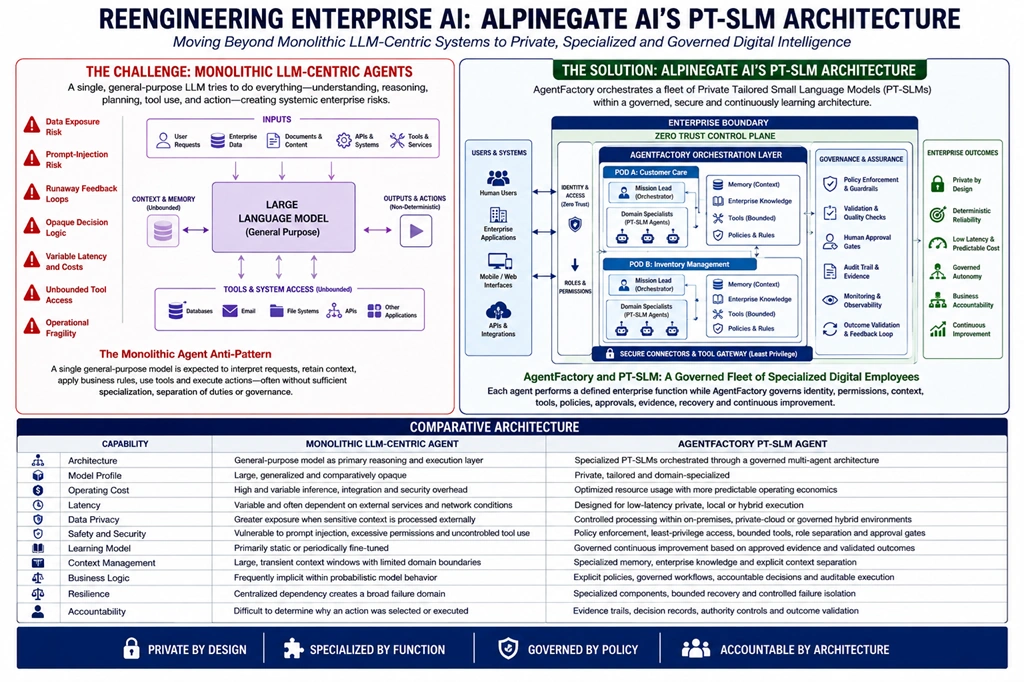
Moving Beyond Monolithic LLM-Centric Systems to Private, Specialized and Governed Digital Intelligence
THE CHALLENGE: MONOLITHIC LLM-CENTRIC AGENTS
Monolithic agent architectures place a large, general-purpose language model at the center of reasoning, orchestration and execution.
Although this approach can accelerate experimentation, it introduces significant enterprise risks when deployed without strong architectural boundaries. These risks include prompt injection, unintended data exposure, opaque reasoning, excessive tool permissions, unpredictable feedback loops, variable latency and escalating operating costs.
The fundamental issue is not the use of large language models. It is the concentration of context, authority, business logic and execution responsibility within a single probabilistic component.
Caption beneath the left diagram:
The Monolithic Agent Anti-Pattern
A single general-purpose model is expected to interpret requests, retain context, apply business rules, use tools and execute actions—often without sufficient specialization, separation of duties or governance.
Suggested diagram labels:
Data Exposure Risk
Prompt-Injection Risk
Runaway Feedback Loops
Opaque Decision Logic
Variable Latency
Unbounded Tool Access
Operational Fragility
THE SOLUTION: ALPINEGATE AI’S PT-SLM ARCHITECTURE
AlpineGate AI’s AgentFactory applies the Private Tailored Small Language Model—PT-SLM—architecture to create specialized, governed and continuously improving digital employees.
Instead of depending on one general-purpose model, AgentFactory coordinates a fleet of domain-specific agents. Each agent operates within an explicit role, bounded authority, approved toolset and governed business context.
PT-SLM agents can run within on-premises, private-cloud or controlled hybrid environments. They combine specialized models, enterprise knowledge, deterministic workflows, policy enforcement, human approval gates and auditable evidence.
This architecture is designed to deliver greater privacy, lower and more predictable latency, improved operational control, stronger accountability and more sustainable economics for business-critical workloads.
Caption beneath the right diagram:
AgentFactory and PT-SLM: A Governed Fleet of Specialized Digital Employees
Each agent performs a defined enterprise function while AgentFactory governs identity, permissions, context, tools, policies, approvals, evidence, recovery and continuous improvement.
COMPARATIVE ARCHITECTURE
| Capability | Monolithic LLM-Centric Agent | AgentFactory PT-SLM Agent |
|---|---|---|
| Architecture | General-purpose model acting as the primary reasoning and execution layer | Specialized PT-SLMs coordinated through a governed multi-agent architecture |
| Model Profile | Large, generalized and comparatively opaque | Private, tailored and domain-specialized |
| Operating Cost | High and variable inference, integration and security overhead | Optimized resource usage with more predictable operating economics |
| Latency | Variable and often dependent on external services and network conditions | Designed for low-latency private, local or hybrid execution |
| Data Privacy | Greater exposure when sensitive context is processed externally | Controlled processing within on-premises, private-cloud or governed hybrid environments |
| Safety and Security | Vulnerable to prompt injection, excessive permissions and uncontrolled tool use | Policy enforcement, least-privilege access, bounded tools, role separation and approval gates |
| Learning Model | Primarily static or periodically fine-tuned | Governed continuous improvement based on approved evidence and validated outcomes |
| Context Management | Large, transient context windows with limited domain boundaries | Specialized memory, enterprise knowledge and explicit context separation |
| Business Logic | Frequently implicit within probabilistic model behavior | Explicit policies, governed workflows, accountable decisions and auditable execution |
| Resilience | Centralized dependency creates a broad failure domain | Specialized components, bounded recovery and controlled failure isolation |
| Accountability | Difficult to determine why an action was selected or executed | Evidence trails, decision records, authority controls and outcome validation |
Private by design. Specialized by function. Governed by policy. Accountable by architecture.
Join the conversation! Your thoughts help the community grow.