

Pre-requisite to Understand This
Artificial Intelligence (AI) – Field of building machines that simulate human intelligence.
Machine Learning (ML) – Subset of AI where systems learn from data.
Deep Learning (DL) – Neural-network-based ML technique using large datasets.
Natural Language Processing (NLP) – AI domain focused on understanding human language.
Generative Models – Models that generate new content (text, image, audio, code).
Large Language Models (LLMs) – Deep learning models trained on massive text datasets.
APIs – Interfaces that allow software systems to communicate.
Introduction
Modern AI systems are layered technologies working together. NLP enables machines to understand language, LLMs are advanced deep-learning models trained on massive text corpora, Generative AI (Gen-AI) produces new content, AI Chatbots provide conversational interfaces, and AI Agents take action autonomously using reasoning and tools. OpenAI is an organization that develops advanced LLMs like ChatGPT built on GPT-4.
These technologies are not separate, they are interconnected layers in an AI ecosystem.
Relationship Overview
AI (Parent Field)

 ├── NLP (Language Understanding Domain)

 │     └── LLM (Advanced NLP Model)

 │            └── Generative AI (Content Generation Capability)

 │                   └── AI Chatbot (Conversational Interface)

 │                          └── AI Agent (Autonomous Decision + Action System)

 │

 └── OpenAI (Organization building LLMs & AI systems)
What Problem Can We Solve With This?
Organizations face challenges in automation, scalability, knowledge retrieval, and decision support. Traditional systems require rigid rule-based logic and human intervention. With LLM-powered AI Agents and Chatbots, businesses can automate conversations, generate documents, assist developers, analyze data, and even execute workflows.
Generative AI enhances creativity and productivity, while AI Agents go beyond conversation and perform real actions (API calls, database queries, workflow automation). NLP ensures machines understand human input accurately. Together, they reduce operational costs, improve customer experience, and enable intelligent automation at scale.
Problems Solved:
Automating customer support conversations
Generating reports, emails, and documentation
Code generation and debugging assistance
Intelligent data analysis and summarization
Workflow automation using AI agents
Knowledge base question answering
Personalized recommendations
How To Implement / Use This?
To implement such a system, we typically integrate an LLM (via API) into an application. The chatbot interface collects user input. The backend sends prompts to the LLM. For AI agents, an orchestration layer adds reasoning logic and tool access (APIs, DB, external services). NLP processing happens within the LLM.
Developers define system prompts, tool definitions, and context handling. Deployment can occur in cloud infrastructure. Monitoring and logging ensure reliability. Security layers manage authentication and API access.
Implementation Steps:
Select an LLM provider (e.g., OpenAI API)
Build chatbot frontend (Web/Mobile)
Create backend orchestration logic
Add memory/context management
Integrate tools (database/API access)
Deploy
Monitor, log, and optimize prompts
Sequence Diagram
The user initiates interaction via chatbot UI. The backend forwards input to AI Agent logic. The agent formats a prompt and calls the LLM API. The LLM generates a response. If needed, the agent invokes external tools (database/API). The final processed response is returned to the user.
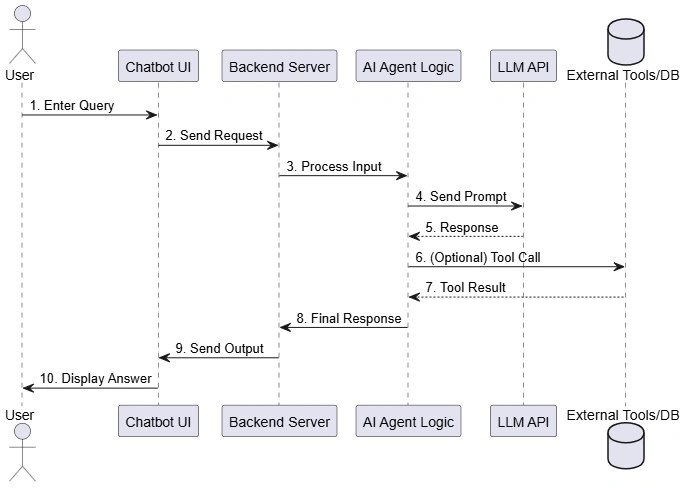
Sequence Flow:
User provides input
Backend forwards request
Agent performs reasoning
LLM generates text
Optional tool execution
Final response returned
Component Diagram
The client layer handles user interaction. The application layer manages conversation and agent orchestration. The AI layer provides LLM capabilities. The integration layer connects to databases and APIs. The orchestrator coordinates reasoning, LLM calls, and tool execution.
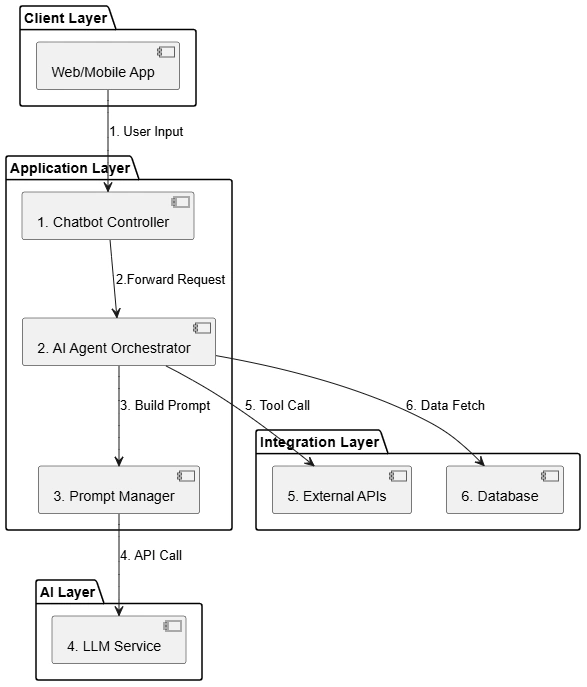
Component Roles:
Chatbot Controller – Manages user sessions
AI Agent Orchestrator – Handles reasoning
Prompt Manager – Structures LLM prompts
LLM Service – Generates language output
External APIs – Perform actions
Database – Stores knowledge
Deployment Diagram
The user interacts via browser/app. Requests go to cloud backend services. The AI Agent service communicates with the external LLM provider (like OpenAI). Enterprise systems provide data and actions. Secure HTTPS and API authentication ensure protected communication.
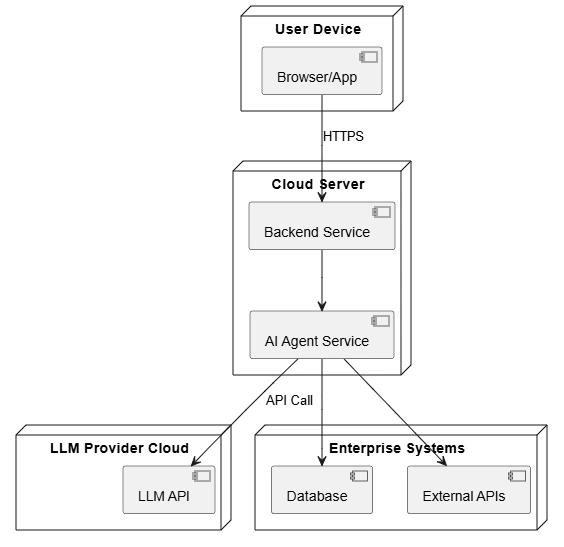
Deployment Layers:
User Device – Interface layer
Cloud Backend – Application logic
LLM Provider Cloud – Model execution
Enterprise Systems – Data & integration
Secure Communication – HTTPS/API keys
Advantages
Scalable intelligent automation
Natural human-like interaction
Reduces operational costs
Improves productivity
Enables autonomous decision-making
Easy API-based integration
Continuous learning improvements
Summary
AI systems are hierarchical and interconnected. NLP enables language understanding, LLMs power advanced reasoning and generation, Generative AI creates content, AI Chatbots provide conversational interfaces, and AI Agents execute autonomous actions. Organizations like OpenAI build foundational LLMs such as GPT-4 that power modern AI solutions.
Together, these technologies form an intelligent ecosystem capable of automating conversations, generating content, supporting decisions, and performing real-world actions transforming how software systems interact with humans and data.
Join the conversation! Your thoughts help the community grow.