

Introduction
Welcome to the SharePoint 2013 REST Series. In my previous article, we have seen how to remove attachment from list item in SharePoint 2013 REST API.
In this article, we will discuss how to remove a file from a Document Library in a SharePoint List using the REST API.
SharePoint 2013 environment adds the ability for you to remotely interact with SharePoint sites by using REST. So you can talk to SharePoint objects by using any technology that supports standard REST capabilities. In this way, SharePoint data can be accessed anywhere and everywhere.
List of REST Access Points
The following is a list of access points that gives you entry into granular access points.
- Site
http://server/site/_api/site
- Web
http://server/site/_api/web
- User Profile
http:// server/site/_api/SP.UserProfiles.PeopleManager
- Search
http:// server/site/_api/search
- Publishing
http:// server/site/_api/publishing
List of REST End Points
The following is a list of endpoints that are the most commonly used in a SharePoint list.
- http://server/site/_api/web/lists
- http://server/site/_api/lists/getbytitle('listname')
- http://server/site/_api/web/lists(‘guid’)
- http://server/site/_api/web/lists/getbytitle(‘Title’)
Note: The following code is tested in my SP 2013 online environment.
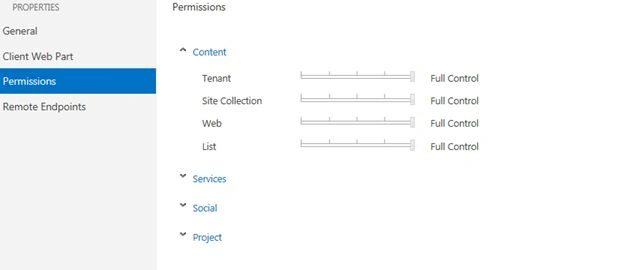
Step 1: Before writing your code, please ensure you have sufficient permission to access cross-domain requests. So I have given full permission to all the contents listed below.
|
Tenant |
Full Permission |
|
Site Collection |
Full Permission |
|
Web |
Full Permission |
|
List |
Full Permission |
Code
- 'use strict';
- var hostweburl;
- var appweburl;
- // This code runs when the DOM is ready and creates a context object which is
- // needed to use the SharePoint object model
- $(document).ready(function () {
- //Get the URI decoded URLs.
- hostweburl =
- decodeURIComponent(
- getQueryStringParameter("SPHostUrl"));
- appweburl =
- decodeURIComponent(
- getQueryStringParameter("SPAppWebUrl"));
- // Resources are in URLs in the form:
- // web_url/_layouts/15/resource
- var scriptbase = hostweburl + "/_layouts/15/";
- // Load the js file and continue to load the page with information about the list top level folders.
- // SP.RequestExecutor.js to make cross-domain requests
- // Load the js files and continue to the successHandler
- $.getScript(scriptbase + "SP.RequestExecutor.js", execCrossDomainRequest);
- });
- // Function to prepare and issue the request to get
- // SharePoint data
- function execCrossDomainRequest() {
- // executor: The RequestExecutor object
- // Initialize the RequestExecutor with the app web URL.
- var executor = new SP.RequestExecutor(appweburl);
- var digest = $("#__REQUESTDIGEST").val();
- // Issue the call against the app web.
- // To get the title using REST we can hit the endpoint:
- // appweburl/_api/web/lists/getbytitle('listname')/items
- // The response formats the data in the JSON format.
- // The functions successHandler and errorHandler attend the
- // sucess and error events respectively.
- executor.executeAsync(
- {
- url:
- appweburl +
- "/_api/SP.AppContextSite(@target)/web/getfilebyserverrelativeurl('/MyLibrary/2013.txt')?@target='" +
- hostweburl + "'",
- method: "POST",
- headers: {
- "IF-MATCH": "*",
- "X-HTTP-Method": "DELETE"
- },
- success: function (data) {
- alert("success: " + JSON.stringify(data));
- },
- error: function (err) {
- alert("error: " + JSON.stringify(err));
- }
- }
- );
- }
- // This function prepares, loads, and then executes a SharePoint query to get
- // the current users information
- //Utilities
- // Retrieve a query string value.
- // For production purposes you may want to use
- // a library to handle the query string.
- function getQueryStringParameter(paramToRetrieve) {
- var params =
- document.URL.split("?")[1].split("&");
- for (var i = 0; i < params.length; i = i + 1) {
- var singleParam = params[i].split("=");
- if (singleParam[0] == paramToRetrieve)
- return singleParam[1];
- }
- }
- //Retrieve the form digest value.
- //Store the value of the form digest.
- function contextSuccessHandler(data) {
- alert("List Created Successfully");
- }
- function contextErrorHandler(data, errorCode, errorMessage) {
- alert(data);
- alert(errorCode);
- alert("Could not get context info: " + errorMessage);
- }
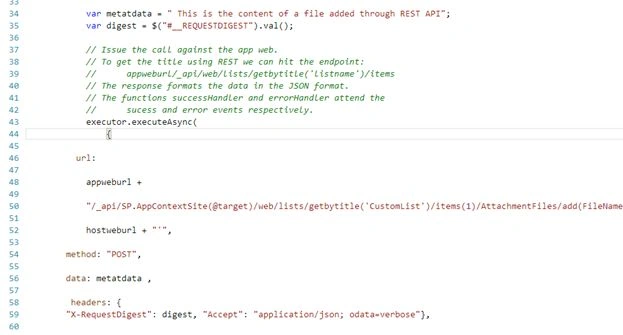
Screenshot

Step 3: When deploying, you will be prompted with the following screen. Press Trust it and proceed with the deployment.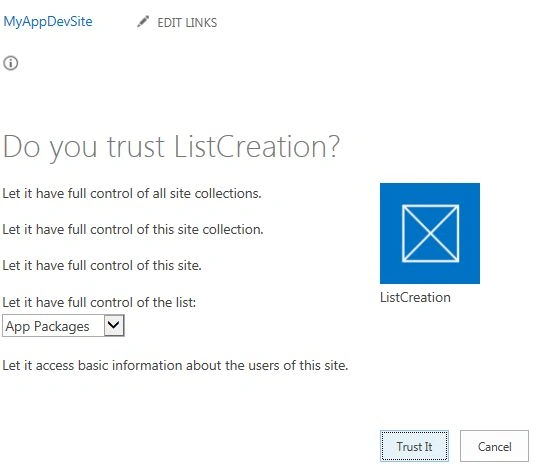
Code Walkthrough
A. Post Method in REST API
SharePoint 2013 REST service supports sending POST commands that include object definitions to endpoints that represent collections. In this example, Test List is a custom SharePoint list where list items are updated.
B. Request Executor.JS
The cross-domain library lets you interact with more than one domain in your remote app page through a proxy. SP.RequestExecutor.js acts as a cross-domain library to fetch or create a SharePoint list from your APP domain.
- function execCrossDomainRequest() {
- // executor: The RequestExecutor object
- // Initialize the RequestExecutor with the app web URL.
- var executor = new SP.RequestExecutor(appweburl);
Summary
I hope this article helps you.
Gowtham RajamanickamPosted Mar 27, 2015, 1:58 AM
awesome...
Divya SharmaPosted Jun 18, 2014, 3:07 AM
nice one