

Introduction
Automation has transformed the manufacturing industry over the past two decades. From traditional factory operations to today's Smart Factory environments, technology has continuously evolved to improve efficiency, productivity, and quality.
This article marks the beginning of a series focused on Robotics and Automation. In this first article, we will explore how manufacturing automation has evolved, understand the concepts of inbound and outbound processes, and lay the foundation for the topics that will be covered throughout this series.
Automation in the Past
In 2007, I began working in South Korea as a Software Engineer in the manufacturing industry. During this period, I worked on developing enterprise software solutions such as:
Line Monitoring Systems
Manufacturing Execution Systems (MES)
Enterprise Resource Planning (ERP)
Warehouse Management Systems (WMS)
Manufacturing Operation Systems (MOS)
As Smart Factory initiatives started gaining momentum during the early 2010s, I transitioned into Smart Factory integration and development.
Working with emerging technologies provided opportunities to solve challenging manufacturing problems and gain experience across various factory automation projects.
What Is a Smart Factory?
A Smart Factory is a modern manufacturing environment that integrates automation technologies to improve operational efficiency while reducing manual processes.
In a Smart Factory, manufacturing facilities, warehouses, and production systems work together as an integrated ecosystem.
A typical manufacturing process involves:
Receiving raw materials
Storing materials in warehouses
Supplying materials to production
Manufacturing finished products
Performing quality inspections
Delivering products to customers or storing them for future distribution
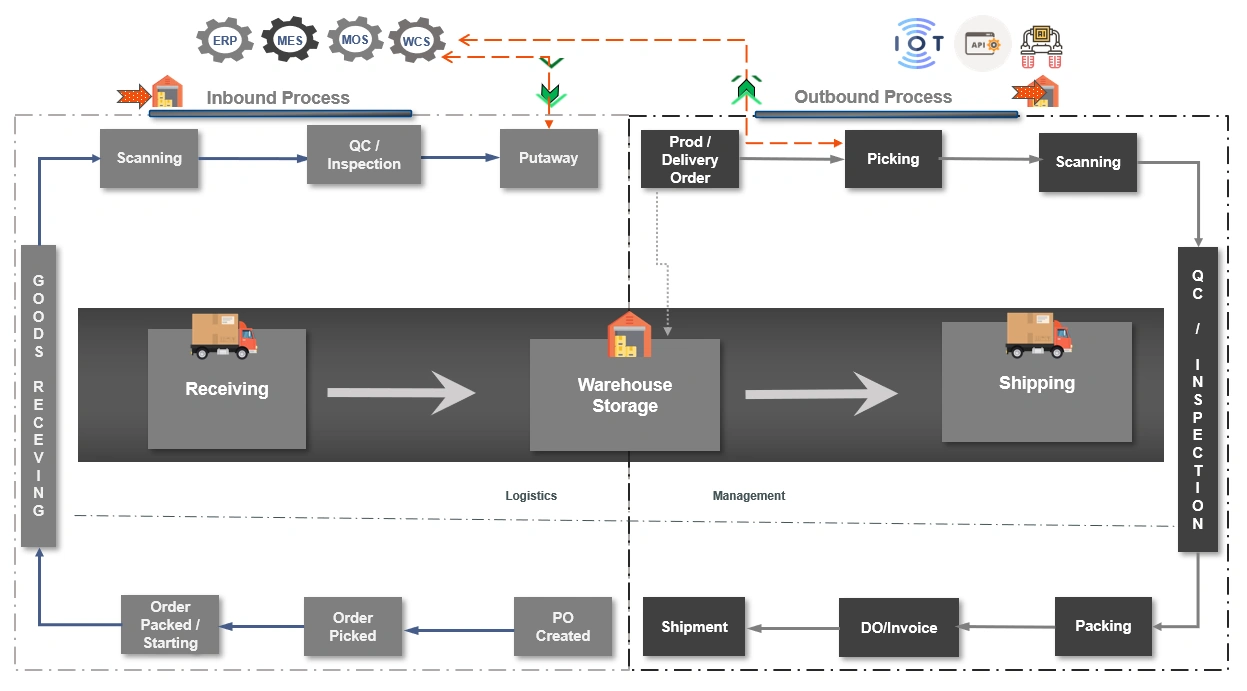
Manufacturing operations are generally divided into two major processes:
Inbound Process
Outbound Process
Inbound Process
The inbound process covers the receipt of raw materials and their storage within the warehouse.
The primary enterprise systems involved include:
Warehouse Management System (WMS)
Enterprise Resource Planning (ERP)
Manufacturing Execution System (MES)
The process typically follows these steps:
Purchase Orders are created using the ERP or MES system.
Raw materials arrive at the factory.
Materials undergo partial or complete Quality Check (QC), depending on industry requirements.
Approved materials are stored in the warehouse.
ERP and MES systems communicate with the WMS through system interfaces.
Incoming materials are tracked from receipt through storage while maintaining quality inspection records.
Together, ERP, MES, and WMS ensure that all inbound material movements are accurately managed and synchronized.
Outbound Process
The outbound process begins with the production plan generated by the Manufacturing Execution System (MES).
The workflow includes:
MES creates the daily production schedule.
MES requests the required raw materials from the Warehouse Management System (WMS).
WMS identifies and supplies the required materials to the production line.
MES manages the complete production process.
Finished products are sent for Quality Check (QC).
After successful quality inspection, products are either:
Delivered directly to customers, or
Stored in the warehouse for future delivery.
Final production information is synchronized with the ERP system.
This integrated workflow ensures efficient movement of materials from production planning through final product delivery.
What's Next?
This article serves as the introduction to Season 1 of the Robotics and Automation series, where we will explore the evolution and current state of robotics and industrial automation.
In the next article, we will take a deeper look at Smart Factory Automation, its architecture, technologies, and the growth of automation in modern manufacturing environments.
Summary
This introductory article provided an overview of the evolution of manufacturing automation and introduced the concepts of Smart Factory, inbound processes, and outbound processes. It also explained how enterprise systems such as ERP, MES, and WMS work together to manage manufacturing operations efficiently. In the upcoming articles of this series, we will explore Smart Factory Automation and other key aspects of Robotics and Automation in greater detail.
Join the conversation! Your thoughts help the community grow.