

Schrödinger's AI is your invitation to look inside. Right now, AI feels like a mystery , wired like a brain, yet running on pure math.
Each article is a new layer of the box. We start with the first spark of an idea and move all the way to the models reshaping everything we thought we knew .

Part 7: What Is an AI Agent
Quick Multi-Agent Example
Before we go deeper, let me show you what we are trying to understand. We will break this down properly later in the article.
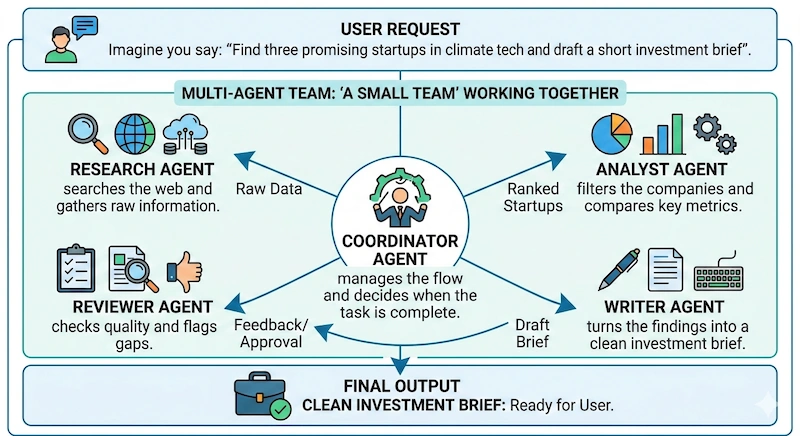
Imagine you say: "Find three promising startups in climate tech and draft a short investment brief".
A well designed multi agent system might handle this like a small team:
Research agent searches the web and gathers raw information.
Analyst agent filters the companies and compares key metrics.
Writer agent turns the findings into a clean investment brief.
Reviewer agent checks quality and flags gaps.
A coordinator agent manages the flow between them and decides when the task is complete.
Each agent is focused on one job, uses different tools, and passes results forward. This is why multi agent systems often outperform a single overloaded prompt on complex, multi-step work.
What Is an AI Agent?
An AI agent is a system that understands a goal, decides what steps are needed, uses tools to take action, and adjusts based on what happens.
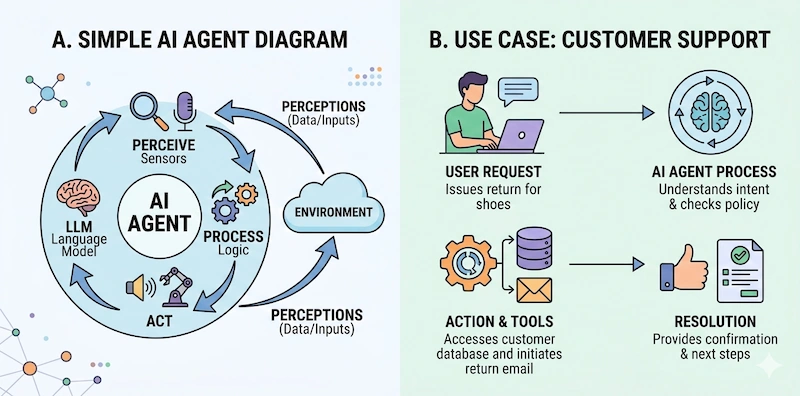
A standalone model like ChatGPT mostly waits for instructions and replies with text. An agent is built to pursue outcomes. It can plan, call tools, check results, and keep going until the job is done.
If models are the brain, agents are the brain connected to hands.
That distinction is the whole game.
Why Models Alone Are Not Enough
Large language models changed what software can do. They can write, summarize, reason, and generate code. With the right prompt, they can produce surprisingly strong results.
But they still have a limitation. They can understand the current context very well, but their behavior is still mostly reactive and short lived.
You ask.
They answer.
The interaction ends.
Real work is rarely that simple. Real tasks look more like this:
Find information
Compare options
Generate output
Save results
Notify someone
Handle errors
Try again if needed
That requires coordination over multiple steps. This is exactly where agents come in.
The First Step Toward Agency
Before full agents existed, modern systems learned how to use tools.
For example, when you ask for an image to ChatGPT, the language model can delegate the work to an image model such as DALL·E. This handoff usually happens through structured function calling.
Think of it in simple terms.
The model decides what should happen.
The tool makes it happen.
Common tools include:
Web search
Code execution
Image generation
Database queries
File operations
The Agent Loop
Under the hood, most agent systems follow a very simple loop:
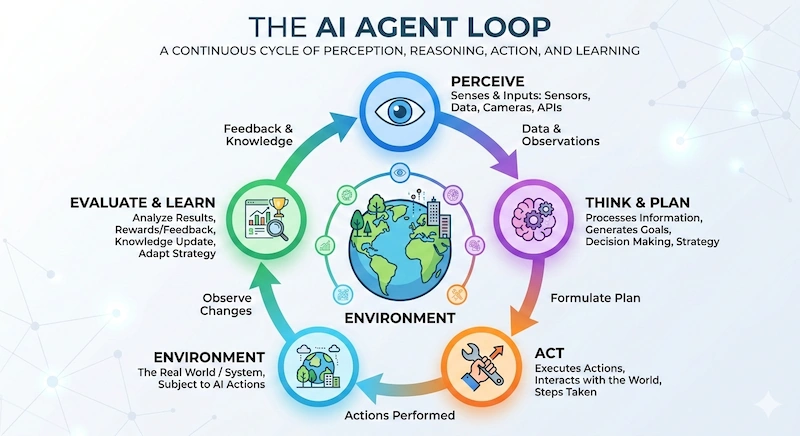
Perceive
Think
Act
Environment
Evaluate
Repeat
That's it. There is no magic beyond this loop. The complexity comes from doing each step reliably at scale.
Here is what that looks like in practice.
Goal: Send a well written outreach email to a company.
Perceive
Agent gathers context about the company.
Think & Plan
Agent decides what information is missing and what steps are needed.
Act
Agent searches the web, drafts the email, and formats it.
Environment
The environment is simply the external world or system the agent acts on, which returns new information after each action.
Evaluate & learn
Agent checks whether the result meets the goal.
Repeat if needed
Good agents converge quickly. Weak agents wander or loop.
A More Intuitive Mental Model
A useful way to understand modern agent systems is to think of a small company.
Instead of one overloaded model trying to do everything, you have a coordinator and a set of specialists.
One component plans
One gathers information
One writes
One executes actions
The coordinator decides who should do what and in which order.
This pattern shows up again and again in production systems because it mirrors how complex work actually gets done.
Core Pieces of a Real Agent System
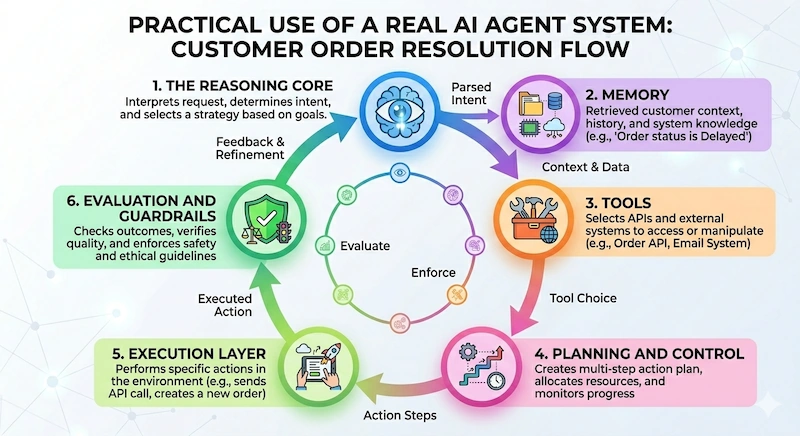
1. The reasoning core
Usually a large language model. Its job is to interpret the goal, break it into steps, and decide what to do next.
This is where most of the "intelligence" lives, but intelligence alone is not enough.
2. Memory
Agents without memory are frustratingly limited.
You typically need two layers.
Short term memory
Current task context
Recent tool outputs
Intermediate reasoning
Long term memory
User preferences
Past runs
Embedded knowledge in vector databases
Memory is what allows agents to maintain continuity and improve over time.
3. Tools
Tools are what make agents useful in the real world.
Typical examples:
Search APIs
File systems
Code runners
Email or messaging services
Internal business APIs
The more carefully you define tool interfaces, the more reliable the agent becomes. Loose, ambiguous tools are one of the fastest ways to create unstable systems.
4. Planning and control
Simple agents take one step at a time. More capable agents explicitly plan.
Common planning patterns include:
Step by step reasoning
Task decomposition
Candidate path exploration
Self critique loops
As tasks get more complex, planning quality becomes the main differentiator between demos and production systems.
5. Execution layer
This is the part many teams underestimate.
In production, the agent must deal with:
API failures
Timeouts
Rate limits
Partial results
Permission boundaries
A surprising number of "AI failures" are actually basic distributed systems problems.
6. Evaluation and guardrails
Agents need feedback loops.
Typical approaches include:
Rule based validators
Model based self review
External scoring systems
Human in the loop checkpoints
Without evaluation, agents tend to drift or falsely believe they succeeded.
Single Agent vs Multi Agent
You will hear a lot of hype around multi agent systems. Use them carefully.
Single agent systems
Best for most real products today.
Pros:
Easier to reason about
Lower latency
Cheaper to run
Simpler to debug
Multi agent systems
Useful when tasks naturally decompose into specialized roles.
Pros:
Clear separation of concerns
Better modularity
Can improve robustness on complex workflows
Cons:
Coordination overhead
More failure modes
Higher cost and latency
Start simple. Add complexity only when the problem demands it.
Frameworks People Use
Most teams do not build agents from scratch. They rely on orchestration frameworks such as:
LangChain
Auto-GPT
CrewAI
These tools help with wiring models, managing memory, and running agent loops. They are useful, but they do not replace good system design.
Framework choice rarely fixes a weak architecture.
Where Agents Work Well Today
Agents perform best in bounded digital environments.
Strong use cases right now include:
Coding assistance
Research workflows
Document processing
Customer support automation
Internal enterprise automation
Where they still struggle:
Open ended autonomous businesses
Long running unsupervised tasks
High risk decision making
Complex physical world robotics
The gap between flashy demos and reliable production is still very real.
Failure Modes You Should Expect
Wrong tool selection
Bad function arguments
Infinite reasoning loops
Hallucinated capabilities
Context overflow
Silent execution failures
Goal drift
None of these are theoretical. Plan for them early.
Practical Advice From the Field
Constrain what the agent is allowed to do.
Prefer structured tool schemas over free text.
Validate every important step.
Log everything for observability.
Keep humans in the loop for risky actions.
Resist the urge to over engineer too early.
Teams that treat agents as real systems engineering work tend to succeed. Teams that treat them as clever prompting exercises usually hit a wall.
Bottom Line
Large language models gave software the ability to reason in natural language.
Agents give software the ability to act on that reasoning.
If you want AI systems that move beyond answering questions and start completing real work, understanding agents is no longer optional.
The cat is neither alive nor dead and honestly, that's the most exciting place to be. There are a lot more layers to uncover.
Previous: Part 6: Foundation Models: Everything, Everywhere, All at Once!
Next: Part 8: Inside the Model Context Protocol
Join the conversation! Your thoughts help the community grow.