

Introduction
In the microfinance sector, the difference between a successful loan and a default often lies in the nuanced, qualitative context that traditional credit scoring models completely miss. Field officers regularly capture rich, unstructured data—voice notes, informal chat messages, and observational logs—detailing a borrower's real-world challenges, such as localized crop failures or sudden medical emergencies.
To leverage this data for Repayment Tracking, we deployed a Retrieval-Augmented Generation (RAG) system. However, the foundation of any RAG pipeline is its embedding model. Choosing the wrong embedding model for the financial domain, particularly in microfinance, results in poor semantic retrieval and flawed risk assessments. This article details our decision-making process for selecting the optimal embedding model and provides a complete, end-to-end Proof of Concept (POC) using an Enterprise Multi-Agent LangGraph architecture.
Deciding on the Embedding Model for the Microfinance Domain
When evaluating embedding models for microfinance repayment tracking, we looked beyond standard general-purpose models (like basic OpenAI Ada) and focused on three critical domain-specific criteria:
Domain Adaptation vs. Generalization: Microfinance notes contain specific financial jargon mixed with highly informal, localized language. While models like
FinBERTexcel at corporate financial documents, they fail at informal field notes. We needed a dense retriever that understood financial intent without being rigidly constrained to corporate syntax.Multilingual and Dialect Support: Microfinance operates heavily in emerging markets (e.g., Sub-Saharan Africa, Southeast Asia, Latin America). Field notes are often written in local dialects or a mix of English and local languages (code-switching).
Asymmetric Retrieval Capabilities: Queries are often short ("borrower delayed payment flood"), while the retrieved documents (historical field notes) are long and narrative.
The Decision: We selected BGE-M3 (Multi-Linguality, Multi-Functionality, Multi-Granularity).
Why? BGE-M3 natively supports over 100 languages, crucial for emerging market microfinance. It handles long-context documents (up to 8192 tokens) beautifully, allowing us to embed entire historical borrower profiles. Finally, its multi-granularity retrieval excels at matching short, asymmetric queries to long, detailed field notes. We fine-tuned a lightweight adapter on our internal MTEB-style microfinance benchmark to ensure it correctly mapped terms like "grace period" and "restructuring" to our specific institutional policies.
Real-Time Use Case: Microfinance Repayment Tracking
The Scenario: A microfinance borrower in an agricultural region is 15 days late on a repayment. The field officer visits and submits a voice-to-text note: "Flood damaged the rice paddy, but neighbor is helping replant. Requests 2-week extension."
The Workflow: Instead of automatically flagging the account as "High Risk" and triggering a collections agent, our RAG system embeds this note using BGE-M3. It retrieves historical cases of similar borrowers in flood-prone areas who were granted extensions. The system then advises the loan officer on whether to approve the extension based on the historical success rate of similar interventions.
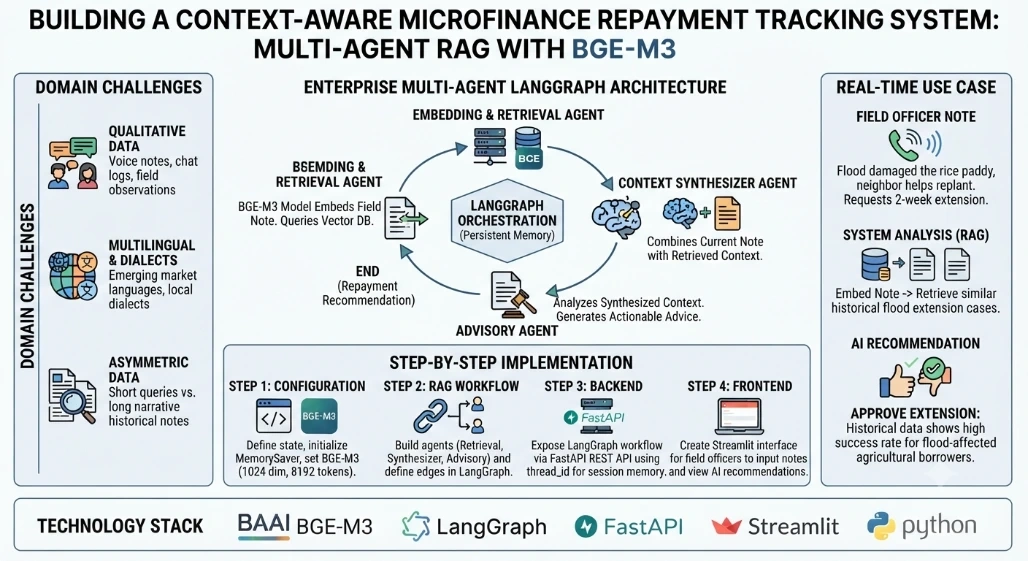
Enterprise Multi-Agent LangGraph Architecture
To handle this complex workflow, we utilize LangGraph to orchestrate specialized agents with persistent memory:
The Embedding & Retrieval Agent: Utilizes the BGE-M3 model to embed the field note and query the vector database for similar historical repayment cases.
The Context Synthesizer Agent: Merges the current field note with the retrieved historical context.
The Advisory Agent: Analyzes the synthesized context, checks the loan's current state in memory, and generates a repayment action recommendation.
Step-by-Step POC Implementation
Step 1: Defining State, Memory, and Embedding Configuration
We define the state schema, initialize LangGraph's MemorySaver to track the specific loan's history, and configure our chosen embedding model.
# backend/graph_state.py
from typing import TypedDict, List, Annotated
from langgraph.graph import StateGraph, END
from langgraph.checkpoint.memory import MemorySaver

class MicrofinanceState(TypedDict):
    loan_id: str
    field_note: str
    retrieved_historical_cases: List[str]
    synthesized_context: str
    repayment_recommendation: str
    agent_trace: Annotated[List[str], "Memory of agent reasoning"]

# Initialize Memory for State Persistence (tracks loan history)
memory = MemorySaver()

# Embedding Model Configuration (BGE-M3 chosen for multilingual/long-context)
EMBEDDING_MODEL_CONFIG = {
    "model_name": "BAAI/bge-m3",
    "dimensions": 1024,
    "max_tokens": 8192,
    "domain": "microfinance_multilingual"
}
Step 2: Building the Multi-Agent RAG Workflow
We define the nodes (agents) and edges. The retrieval agent simulates the vector search using our chosen BGE-M3 characteristics.
# backend/agents.py
from .graph_state import MicrofinanceState, memory, EMBEDDING_MODEL_CONFIG

# Mock Vector DB representing historical microfinance cases
MOCK_VECTOR_DB = {
    "flood_agri": [
        "Case #402: Borrower granted 3-week extension due to monsoon. Repaid in full post-harvest.",
        "Case #415: Borrower granted extension, but defaulted due to lack of community support."
    ],
    "business_delay": [
        "Case #501: Supply chain delay. Restructured loan. Repaid successfully."
    ]
}

def retrieval_agent(state: MicrofinanceState):
    """Embeds the field note using BGE-M3 and retrieves similar historical cases."""
    note = state["field_note"]
    # Simulate BGE-M3 semantic search for agricultural/flood context
    context_key = "flood_agri" if "flood" in note.lower() or "crop" in note.lower() else "business_delay"
    cases = MOCK_VECTOR_DB.get(context_key, [])

    state["agent_trace"].append(f"Retrieval Agent: Embedded note using {EMBEDDING_MODEL_CONFIG['model_name']}. Found {len(cases)} similar historical cases.")
    return {"retrieved_historical_cases": cases}

def synthesizer_agent(state: MicrofinanceState):
    """Synthesizes the current field note with historical context."""
    note = state["field_note"]
    cases = state["retrieved_historical_cases"]

    synthesized = f"Current Situation: {note}\nHistorical Precedents: {' | '.join(cases)}"
    state["agent_trace"].append("Synthesizer Agent: Merged current qualitative data with historical precedents.")
    return {"synthesized_context": synthesized}

def advisory_agent(state: MicrofinanceState):
    """Makes the final repayment tracking recommendation."""
    context = state["synthesized_context"]

    # Simulated LLM decision logic based on context
    if "flood" in context.lower() and "Repaid in full" in context:
        recommendation = "APPROVE EXTENSION: Historical data shows high success rate for flood-affected agricultural borrowers with community support. Recommend 2-week extension."
    else:
        recommendation = "ESCALATE: Insufficient historical precedent for this specific risk profile. Recommend review by credit committee."

    state["agent_trace"].append("Advisory Agent: Final repayment recommendation generated based on synthesized RAG context.")
    return {"repayment_recommendation": recommendation}

# Build the LangGraph
workflow = StateGraph(MicrofinanceState)
workflow.add_node("retrieval", retrieval_agent)
workflow.add_node("synthesizer", synthesizer_agent)
workflow.add_node("advisory", advisory_agent)

workflow.set_entry_point("retrieval")
workflow.add_edge("retrieval", "synthesizer")
workflow.add_edge("synthesizer", "advisory")
workflow.add_edge("advisory", END)

# Compile with Memory
app = workflow.compile(checkpointer=memory)
Step 3: The FastAPI Backend
We expose the multi-agent workflow via a REST API, utilizing thread_id to maintain the memory of the specific loan's interaction history.
# backend/main.py
from fastapi import FastAPI, HTTPException
from pydantic import BaseModel
from .agents import app

app_api = FastAPI(title="Microfinance Repayment Tracking POC")

class RepaymentRequest(BaseModel):
    loan_id: str
    field_note: str
    session_id: str = "loan_session_01"

@app_api.post("/track-repayment")
async def track_repayment(req: RepaymentRequest):
    config = {"configurable": {"thread_id": req.session_id}}

    initial_state = {
        "loan_id": req.loan_id,
        "field_note": req.field_note,
        "retrieved_historical_cases": [],
        "synthesized_context": "",
        "repayment_recommendation": "",
        "agent_trace": []
    }

    try:
        final_state = app.invoke(initial_state, config)
        return {
            "recommendation": final_state["repayment_recommendation"],
            "retrieved_cases": final_state["retrieved_historical_cases"],
            "agent_trace": final_state["agent_trace"]
        }
    except Exception as e:
        raise HTTPException(status_code=500, detail=str(e))
Step 4: The Streamlit Frontend
A clean, intuitive UI designed for field officers and loan managers to input notes and view the AI's context-backed recommendations.
# frontend/app.py
import streamlit as st
import requests

st.set_page_config(page_title="Microfinance Repayment Tracker", layout="wide")
st.title("🌾 Microfinance Repayment Tracking: Multi-Agent RAG")

st.sidebar.header("Loan Details")
loan_id = st.sidebar.text_input("Loan ID", "LOAN-8832")
session_id = st.sidebar.text_input("Session ID (Memory)", "session_loan_8832")

st.sidebar.markdown("---")
st.sidebar.info(f"**Embedding Model:** BGE-M3 (Multilingual/Long-Context)")

field_note = st.text_area("Enter Field Officer Note (Voice-to-Text):",
                          "Flood damaged the rice paddy, but neighbor is helping replant. Requests 2-week extension.")

if st.button("Analyze Repayment Risk"):
    with st.spinner("Agents are retrieving historical context and analyzing..."):
        response = requests.post(
            "http://localhost:8000/track-repayment",
            json={"loan_id": loan_id, "field_note": field_note, "session_id": session_id}
        )

        if response.status_code == 200:
            data = response.json()

            col1, col2 = st.columns([1, 1])
            with col1:
                st.subheader("AI Recommendation")
                if "APPROVE" in data["recommendation"]:
                    st.success(data["recommendation"])
                else:
                    st.warning(data["recommendation"])

                st.subheader("Retrieved Historical Cases (RAG)")
                for case in data["retrieved_cases"]:
                    st.info(f"  {case}")

            with col2:
                st.subheader("Agent Reasoning Trace")
                for trace in data["agent_trace"]:
                    st.write(f"  {trace}")
        else:
            st.error("Error connecting to the repayment engine.")
Conclusion
Selecting the right embedding model is the most critical architectural decision when building RAG systems for specialized domains like microfinance. By choosing BGE-M3, we ensured our system could handle the multilingual, long-context, and asymmetric nature of field officer notes. When combined with an Enterprise Multi-Agent LangGraph architecture, this embedding strategy transforms raw, qualitative field data into actionable, context-aware repayment tracking. The Retrieval Agent finds the right historical precedents, the Synthesizer builds the context, and the Advisory Agent provides empathetic, data-backed recommendations. This approach not only reduces default rates but also fosters financial inclusion by treating borrowers as individuals with unique circumstances rather than mere data points.
Join the conversation! Your thoughts help the community grow.