
Introduction
.NET! C#! If you haven't been inundated with the marketing of Microsoft's new initiatives, you've been living in your cube without a web connection for quite a while. Like a lot of developers, I had installed the .NET SDK and the Beta 1 of Visual Studio .NET and played with it. However, since its release was so far out in the future and I had deadlines to meet, I soon went back to working with the things my customers needed now.
But the press coverage continued. One evening our Vice President of New Technologies noticed me carrying out a book on COM+ on the way out, and asked something like 'COM+? Why aren't you studying .NET and C#?'
Ok, I knew what management was thinking about, it couldn't hurt to give this thing another look...
Being the masochist that I am, I generally learn a new language or technology by jumping in over my head and figuring it out when I've got motivation, like a looming deadline. Since I'm not likely to see any customers asking for .NET work prior to it's release, I needed to come up with something on my own.
I recently started a project on SourceForge, the HSQL Database Engine which is continuing the development of a Java SQL engine project that had been dropped by the original developer. From what I saw and read, C# was a lot like Java, so why not port it? There would be enough changes required to force me to learn the language and environment.
This is the story of that little adventure.
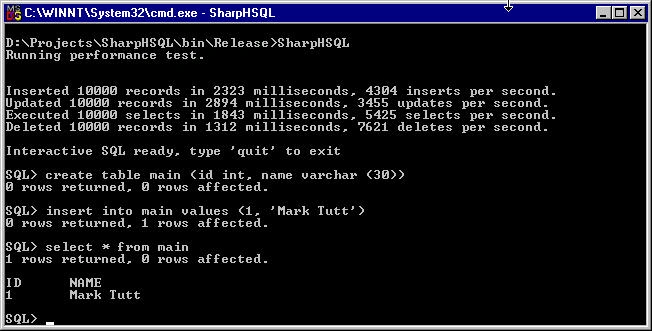
Porting issues
There are enough differences between Java and C# to give you a bit of a headache when porting anything significant. I believe that Microsoft's Java User Migration Path (JUMP) will be a success at converting 80-90% of Java code, but the rest of it is going to be sticky. Doing it manually was a somewhat painful process.
Syntax differences are minor at best. The compiler thankfully complained about these and stopped, so I spent a little over a day making these changes, without being distracted by the next step.
Then came the majority of the porting effort. If my memory serves me right, the first time there were no syntax problems the complier reported over 3000 library/API errors. Almost all of these were due to differences between the Java API and the .NET API.
Rather than go into all of them, I'll elaborate on a few.
In Java, the StringBuffer class is used for building a string to eliminate the overhead of creating multiple String objects when building a complex string. .NET has an equivalent class, StringBuilder. The methods are almost identical, with the exception of the first character of the methods are uppercase, so StringBuffer.append becomes StringBuilder.Append.
The number of keys in a Java Hashtable class object is accessed through the size() method, where the same information for .NET Hashtable class is available through it's Count property.
These kinds of differences are pervasive throughout the .NET API. Most of the JAVA API objects are represented, but have slight differences that could be resolved by a smart parser that understood both languages. Without something like JUMP, or at least a comparative guide available, I had to do a lot of reading to find the classes I needed.
The bad part: C# and .NET do not support the loading of a class at runtime based on it's name. This forced me to drop support for triggers from the C# version of the database engine, as this was central to their design. Additionally, many of the SQL operators were implemented using this technique in the Java version, so the C# version currently does not support as many SQL options as the Java version. If someone was motivated, they could probably add support for them in the C# version in a couple of days.
Here is the Java version of a Result object's constructor
Result(byte b[]) throws SQLException {
ByteArrayInputStream bin = new ByteArrayInputStream(b);
DataInputStream in = new DataInputStream(bin);
try {
iMode = in.readInt();
if (iMode == ERROR) {
throw Trace.getError(in.readUTF());
} else if (iMode == UPDATECOUNT) {
iUpdateCount = in.readInt();
} else if (iMode == DATA) {
int l = in.readInt();
prepareData(l);
iColumnCount = l;
for (int i = 0; i < l; i++) {
iType[i] = in.readInt();
sLabel[i] = in.readUTF();
sTable[i] = in.readUTF();
sName[i] = in.readUTF();
}
while (in.available() != 0) {
add(Column.readData(in, l));
}
}
} catch (IOException e) {
Trace.error(Trace.TRANSFER_CORRUPTED);
}
}
And the C# version
public Result(byte[] b)
{
MemoryStream bin = new MemoryStream(b);
BinaryReader din = new BinaryReader(bin);
try
{
iMode = din.ReadInt32();
if (iMode == ERROR)
{
throw Trace.getError(din.ReadString());
}
else if (iMode == UPDATECOUNT)
{
iUpdateCount = din.ReadInt32();
}
else if (iMode == DATA)
{
int l = din.ReadInt32();
prepareData(l);
iColumnCount = l;
for (int i = 0; i < l; i++)
{
iType[i] = din.ReadInt32();
sLabel[i] = din.ReadString();
sTable[i] = din.ReadString();
sName[i] = din.ReadString();
}
while (din.PeekChar() != -1)
{
add(Column.readData(din, l));
}
}
}
catch (Exception e)
{
Trace.error(Trace.TRANSFER_CORRUPTED);
}
}
As you can see, the two look pretty similar. C# requires a constructor to be declared as public, where as Java simply assumes public visibility, and C# does not use throws. .NET's MemoryStream class is pretty much a direct replacement for ByteArrayInputStream, and BinaryReader is the .NET equivalent to DataInputStream. The ReadXXX methods differ slightly, but the logic and syntax are pretty much identical.
SQL Engine architecture
Each database connection uses a different Channel object. The Channel has a link to a User object and a list of Transaction objects. (a Transaction object is a single row insert or delete in a table)
The result from a database operation is a Result object. (this *may* contains Record objects if the query was a successful select operation)
The query results are a linked list of Record objects, for which the root object is contained in the Result object.
How a statement is processed
The Database creates a Tokenizer that breaks the statement into tokens. If it's a INSERT, UPDATE, DELETE or SELECT, a Parser is created (all other statements are processed by the Database class directly) The Parser creates a Select object if it's a SELECT. This Select contains one or more TableFilter objects (a conditional cursor over a table), expression objects and possibly another Select (if it's a UNION)
Join the conversation! Your thoughts help the community grow.