

Abstract / Overview
Samsung has launched and publicly demonstrated a solid-state battery prototype that replaces liquid electrolytes with solid materials. This battery promises higher energy density, improved safety, longer lifespan, and faster charging compared to conventional lithium-ion batteries. Samsung’s approach targets electric vehicles first, with implications across consumer electronics and grid storage.
At a high level, Samsung’s solid-state battery uses a lithium-metal anode and a sulfide-based solid electrolyte. This combination enables compact cell design and higher performance while mitigating fire and leakage risks inherent in liquid electrolytes.
Conceptual Background
What Is a Solid-State Battery
A solid-state battery is an electrochemical energy storage system in which the electrolyte is solid rather than liquid or gel-based. Ions move through a rigid solid medium instead of a flammable liquid solvent.
Key distinctions from lithium-ion batteries include:
Solid electrolyte instead of liquid electrolyte
Potential use of lithium-metal anodes
Reduced thermal runaway risk
Higher theoretical energy density
Samsung’s Role in Solid-State Development
Samsung, through its battery subsidiary Samsung SDI, has invested more than a decade in solid-state research. Samsung revealed a working prototype at its advanced R&D center, signaling a shift from lab-scale experiments to pilot-line validation.
Samsung’s design focuses on manufacturability rather than laboratory-only performance, a key barrier that has slowed solid-state commercialization industry-wide.
How Samsung’s Solid-State Battery Works

Core Components
Lithium-Metal Anode
Samsung replaces the traditional graphite anode with lithium metal. This significantly increases energy density because lithium metal stores more charge per unit mass.
Solid Electrolyte
Samsung uses a sulfide-based solid electrolyte. Sulfides offer high ionic conductivity comparable to liquids while remaining non-flammable.
High-Nickel Cathode
A high-energy-density cathode material supports long driving ranges and reduced cell volume.
Why This Architecture Matters
Eliminates liquid leakage risk
Suppresses dendrite growth through engineered interfaces
Enables thinner separators and compact cell stacking
Key Performance Claims
Samsung has publicly disclosed several benchmark targets from its prototype testing:
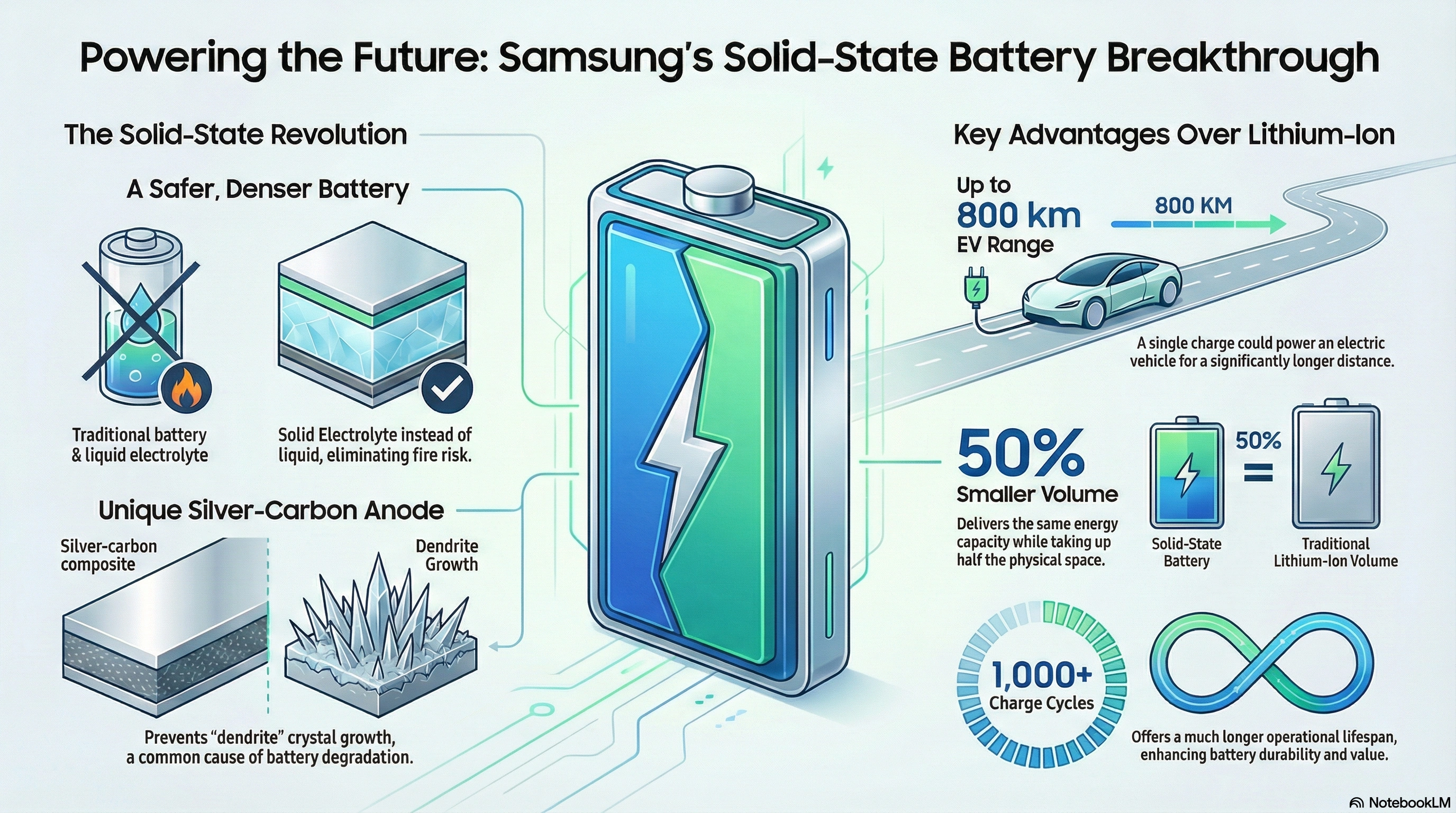
Energy density up to ~900 Wh/L, roughly double conventional lithium-ion cells
Target EV driving range exceeding 800 km per charge
Cycle life of over 1,000 full charge cycles
Reduced fire risk due to non-flammable electrolyte
According to industry analysis, increasing energy density by even 30% can reduce EV battery pack weight by 20–25%. Samsung’s approach aims far beyond that threshold.
Comparison With Conventional Lithium-Ion Batteries
| Attribute | Lithium-Ion Battery | Samsung Solid-State Battery |
|---|---|---|
| Electrolyte | Liquid | Solid |
| Safety Risk | Flammable | Non-flammable |
| Energy Density | Medium | Very high |
| Anode | Graphite | Lithium metal |
| Charging Speed | Moderate | Faster (targeted) |
| Lifespan | 500–1,000 cycles | 1,000+ cycles |
Use Cases and Target Applications
Electric Vehicles
Samsung’s primary focus is on electric vehicles. Solid-state batteries can:
Extend driving range without increasing pack size
Improve crash safety
Reduce cooling system complexity
Automakers prioritize safety and longevity, making solid-state chemistry especially attractive for premium and long-range EV platforms.
Consumer Electronics
Smartphones, laptops, and wearables could benefit from:
Longer battery life in thinner devices
Reduced swelling and degradation
Improved safety during fast charging
Samsung’s vertical integration across electronics positions it uniquely to adopt this technology internally once production matures.
Grid and Industrial Storage
Solid-state batteries offer improved thermal stability, which is critical for stationary storage installations where safety regulations are strict.
Manufacturing and Commercialization Challenges
Despite its advantages, solid-state batteries face significant hurdles:
Scalability
Producing defect-free solid electrolytes at scale is complex. Small cracks or interface imperfections can degrade performance.
Cost
Lithium-metal handling and solid electrolyte synthesis currently cost more than conventional lithium-ion manufacturing.
Interface Stability
Maintaining low resistance between solid layers over thousands of cycles requires advanced materials engineering.
Samsung addresses these challenges by focusing on pilot-line production rather than immediate mass deployment.
Timeline and Market Expectations
Samsung has indicated:
Pilot-scale production is underway
Commercial EV deployment is targeted for the late 2020s
Early adoption is likely in premium vehicles before mass-market rollout
Industry consensus suggests solid-state batteries will complement, not immediately replace, lithium-ion batteries during the transition period.
Expert Perspectives
Battery researchers widely agree that solid-state technology represents the most promising path beyond lithium-ion.
One widely cited industry view states that solid-state batteries “offer the clearest route to higher energy density without compromising safety,” a position echoed across automotive and materials science communities.
Limitations and Considerations
Not yet cost-competitive with lithium-ion
Manufacturing yield remains unproven at gigafactory scale
Performance claims are based on prototypes, not mass-produced cells
These constraints explain why Samsung emphasizes long-term deployment rather than immediate commercialization.
FAQs
Is Samsung’s solid-state battery available today?
No. It exists as a validated prototype and pilot-line product, not a consumer-ready battery.Will this replace lithium-ion batteries completely?
No. Lithium-ion batteries will remain dominant for years due to cost and manufacturing maturity.Why is lithium metal important?
Lithium metal significantly increases energy density but requires solid electrolytes to remain safe.When will EVs use Samsung’s solid-state batteries?
Late 2020s, starting with limited, high-end vehicle applications.
References
Samsung SDI technical briefings and prototype disclosures
Peer-reviewed solid-state battery research
Industry EV battery performance benchmarks
Conclusion
Samsung’s solid-state battery represents a decisive step toward safer, denser, and longer-lasting energy storage. By combining lithium-metal anodes with sulfide-based solid electrolytes, Samsung addresses the core limitations of lithium-ion technology while acknowledging real-world manufacturing constraints.
This launch signals not an immediate revolution, but a clear technological trajectory. Solid-state batteries are moving from theory to engineered reality, and Samsung stands among the leaders shaping their commercial future.
Join the conversation! Your thoughts help the community grow.