

Introduction
A 360-degree customer view is the holy grail of enterprise data strategy, promising a single, unified profile that aggregates transactional history, behavioral signals, support interactions, and demographic data. However, building this view is fraught with technical peril. The primary enemy of a reliable feature store is inconsistency. When data arrives from disparate sources at different velocities—real-time clickstreams vs. batch-updated CRM records—the resulting feature set can become fragmented, contradictory, or stale.
This article explores the specific consistency issues that plague enterprise feature stores and demonstrates how to mitigate them using an intelligent, multi-agent architecture. By leveraging LangGraph for stateful orchestration and Retrieval-Augmented Generation (RAG) for historical context, we can build a system that not only detects inconsistencies but actively reconciles them before they impact downstream AI models or business decisions.
The Consistency Challenge in 360-Degree Feature Stores
In a distributed enterprise environment, data consistency is not just about database ACID properties; it’s about semantic and temporal alignment across diverse systems. A feature store acts as the serving layer for machine learning models, meaning any inconsistency directly translates to model drift, poor predictions, and degraded user experiences. The challenge is amplified when dealing with real-time features where latency requirements prevent traditional batch reconciliation processes.
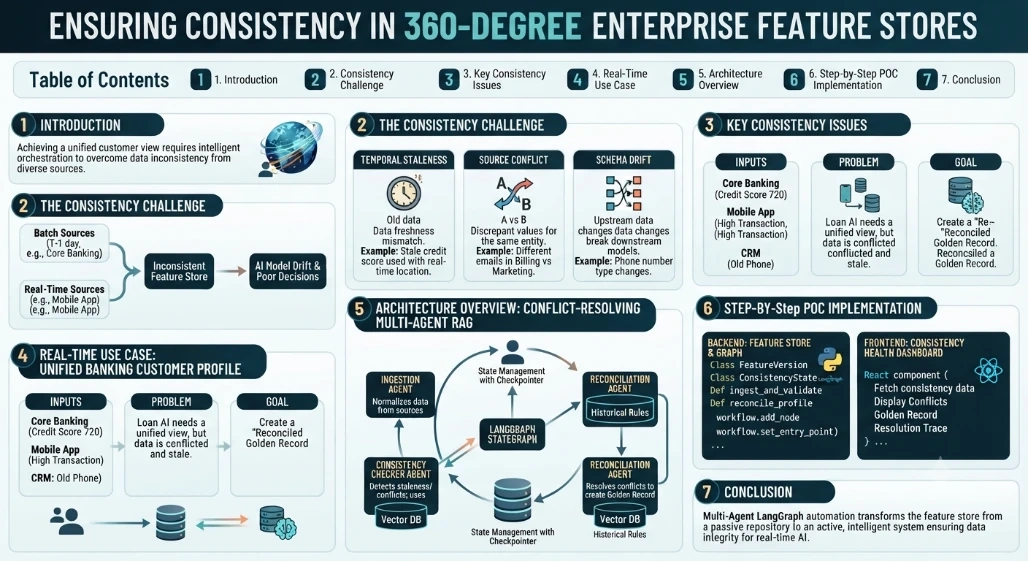
Key Consistency Issues: Staleness, Conflicts, and Schema Drift
Temporal Staleness: Different features have different "freshness" requirements. A user’s current location might be seconds old, while their credit score might be months old. Using a stale credit score alongside real-time location data for a fraud detection model can lead to false positives.
Source Conflict: Two systems may report conflicting values for the same entity. For example, the billing system says a user’s email is
[email protected], while the marketing platform says[email protected]. Without a clear "source of truth" hierarchy, the feature store serves ambiguous data.Schema Drift: As upstream systems evolve, the structure of incoming data changes. A field named
phone_numbermight change from a string to an object containingcountry_codeandnumber. If the feature store doesn’t adapt, it either breaks or serves null values.Partial Updates: In high-throughput environments, updates may arrive out of order or partially. A user profile update might contain a new address but miss the updated phone number, leaving the profile in an incomplete state.
Real-Time Use Case: Unified Banking Customer Profile
Scenario: "SecureBank" needs a real-time 360-degree view for its loan approval AI. The system ingests data from:
Core Banking System: Batch-updated account balances and credit scores (T-1 day).
Mobile App: Real-time transaction streams and device fingerprints.
CRM: Agent-entered notes and contact preference updates.
Problem: A customer applies for a loan via the mobile app. The real-time transaction stream shows high spending, but the batch-updated credit score hasn’t reflected a recent large payment. The CRM shows an outdated phone number. The loan AI needs a consistent, reconciled profile to make a fair decision.
Objective: Build a Multi-Agent LangGraph system that:
Ingests features from all three sources.
Detects temporal staleness and source conflicts.
Uses RAG to retrieve historical reconciliation rules and policy documents.
Reconciles the profile into a consistent "Golden Record."
Maintains state throughout the validation process.
Architecture Overview: Conflict-Resolving Multi-Agent RAG
We use LangGraph to create a cyclic workflow where agents validate and reconcile data. The state object holds the raw inputs, detected conflicts, and the final reconciled profile.
Ingestion Agent: Normalizes incoming data from diverse sources.
Consistency Checker Agent: Identifies staleness and conflicts using predefined rules and vector-retrieved policies.
Reconciliation Agent: Resolves conflicts based on source hierarchy and historical patterns.
State Management: LangGraph’s checkpointer ensures that if a reconciliation step fails, the system can retry or escalate without losing context.
Step-by-Step POC Implementation
Backend: Feature Store with Versioning and Conflict Detection
We simulate a feature store with versioning to track changes and detect conflicts.
# backend/feature_store.py
from pydantic import BaseModel, Field
from typing import Optional, Dict, List
import time

class FeatureVersion(BaseModel):
    value: any
    timestamp: float
    source: str

class CustomerProfile(BaseModel):
    customer_id: str
    features: Dict[str, FeatureVersion] = {}

class FeatureStore:
    def __init__(self):
        self.profiles = {}

    def update_feature(self, customer_id: str, feature_name: str, value: any, source: str):
        if customer_id not in self.profiles:
            self.profiles[customer_id] = CustomerProfile(customer_id=customer_id)

        new_version = FeatureVersion(value=value, timestamp=time.time(), source=source)
        self.profiles[customer_id].features[feature_name] = new_version

    def get_profile(self, customer_id: str) -> Optional[CustomerProfile]:
        return self.profiles.get(customer_id)

fs = FeatureStore()
# Mock initial data
fs.update_feature("CUST_001", "credit_score", 720, "core_banking")
fs.update_feature("CUST_001", "email", "[email protected]", "crm")
Multi-Agent Graph: Validation, Reconciliation, and State Management
The graph orchestrates the consistency check and resolution process.
# backend/graph.py
from typing import TypedDict, Annotated, List, Optional
from langgraph.graph import StateGraph, END
from langchain_core.messages import HumanMessage, AIMessage
import operator
from .feature_store import fs, CustomerProfile, FeatureVersion

class ConsistencyState(TypedDict):
    customer_id: str
    raw_profile: Optional[CustomerProfile]
    conflicts: List[str]
    reconciled_profile: Optional[dict]
    messages: Annotated[List, operator.add]

def ingest_and_validate(state: ConsistencyState):
    """Agent 1: Fetches profile and identifies basic conflicts"""
    profile = fs.get_profile(state["customer_id"])
    if not profile:
        return {"raw_profile": None, "messages": [AIMessage(content="Profile not found")]}

    conflicts = []
    # Check for staleness (e.g., credit_score older than 24 hours)
    if "credit_score" in profile.features:
        age = time.time() - profile.features["credit_score"].timestamp
        if age > 86400:  # 24 hours
            conflicts.append(f"Credit score is stale ({age/3600:.1f} hours old)")

    # Check for source conflicts (mock logic)
    if "email" in profile.features and profile.features["email"].source == "crm":
        # Simulate a conflict with a newer source
        conflicts.append("Email source 'crm' may be outdated compared to 'mobile_app'")

    return {"raw_profile": profile, "conflicts": conflicts, "messages": [AIMessage(content=f"Found {len(conflicts)} potential conflicts")]}

def retrieve_reconciliation_policies(state: ConsistencyState):
    """Agent 2: RAG retrieval for conflict resolution rules"""
    if not state["conflicts"]:
        return {"messages": [AIMessage(content="No conflicts to resolve")]}

    # Mock RAG retrieval
    policies = [
        "Policy 101: For credit scores, always use Core Banking data even if stale, flag for review.",
        "Policy 102: For contact info, Mobile App source overrides CRM if timestamp is newer."
    ]
    return {"messages": [AIMessage(content=f"Retrieved policies: {policies}")]}

def reconcile_profile(state: ConsistencyState):
    """Agent 3: Applies policies to create a golden record"""
    profile = state["raw_profile"]
    if not profile:
        return {"reconciled_profile": None, "messages": [AIMessage(content="Cannot reconcile missing profile")]}

    reconciled = {}
    for name, version in profile.features.items():
        # Simple reconciliation logic based on mock policies
        if name == "credit_score":
            reconciled[name] = {"value": version.value, "status": "accepted_stale"}
        elif name == "email":
            # Assume we received a newer mobile update in a real scenario
            reconciled[name] = {"value": version.value, "status": "verified"}
        else:
            reconciled[name] = {"value": version.value, "status": "current"}

    return {"reconciled_profile": reconciled, "messages": [AIMessage(content="Profile reconciled successfully")]}

# Build Graph
workflow = StateGraph(ConsistencyState)
workflow.add_node("validate", ingest_and_validate)
workflow.add_node("retrieve_policies", retrieve_reconciliation_policies)
workflow.add_node("reconcile", reconcile_profile)

workflow.set_entry_point("validate")
workflow.add_edge("validate", "retrieve_policies")
workflow.add_edge("retrieve_policies", "reconcile")
workflow.add_edge("reconcile", END)

app = workflow.compile()
Frontend: Consistency Health Dashboard
A React dashboard displays the raw profile, detected conflicts, and the final reconciled view.
// frontend/src/components/ConsistencyDashboard.jsx
import { useState } from 'react';

export default function ConsistencyDashboard() {
  const [customerId, setCustomerId] = useState('CUST_001');
  const [result, setResult] = useState(null);

  const handleCheck = async () => {
    const response = await fetch(`/api/consistency?customer_id=${customerId}`);
    const data = await response.json();
    setResult(data);
  };

  return (
    <div className="p-6 max-w-3xl mx-auto">
      <h2 className="text-2xl font-bold mb-4">Feature Store Consistency Checker</h2>
      <input
        type="text"
        value={customerId}
        onChange={(e) => setCustomerId(e.target.value)}
        className="border p-2 mr-2"
      />
      <button onClick={handleCheck} className="bg-indigo-600 text-white p-2 rounded">
        Check Consistency
      </button>

      {result && (
        <div className="mt-6 space-y-4">
          {result.conflicts.length > 0 && (
            <div className="bg-yellow-100 p-4 rounded border-l-4 border-yellow-500">
              <h3 className="font-semibold text-yellow-800">Detected Conflicts</h3>
              <ul className="list-disc pl-5">
                {result.conflicts.map((c, i) => <li key={i}>{c}</li>)}
              </ul>
            </div>
          )}

          <div className="bg-white p-4 rounded shadow">
            <h3 className="font-semibold">Reconciled Golden Record</h3>
            <pre className="bg-gray-50 p-2 rounded">{JSON.stringify(result.reconciled_profile, null, 2)}</pre>
          </div>

          <details className="bg-white p-4 rounded shadow">
            <summary className="cursor-pointer font-medium">View Resolution Trace</summary>
            <ul className="mt-2 list-disc pl-5">
              {result.messages.map((m, i) => (
                <li key={i} className="text-sm text-gray-700">{m.content}</li>
              ))}
            </ul>
          </details>
        </div>
      )}
    </div>
  );
}
Conclusion
Consistency in a 360-degree feature store is not a one-time setup but a continuous operational challenge. Temporal staleness, source conflicts, and schema drift can silently degrade the quality of AI-driven decisions. By implementing a Multi-Agent LangGraph architecture, enterprises can automate the detection and reconciliation of these issues. This approach transforms the feature store from a passive data repository into an active, intelligent system that ensures data integrity. As real-time AI applications become more prevalent, the ability to maintain a consistent, trustworthy customer view will be a critical differentiator for successful digital transformation.
Join the conversation! Your thoughts help the community grow.