

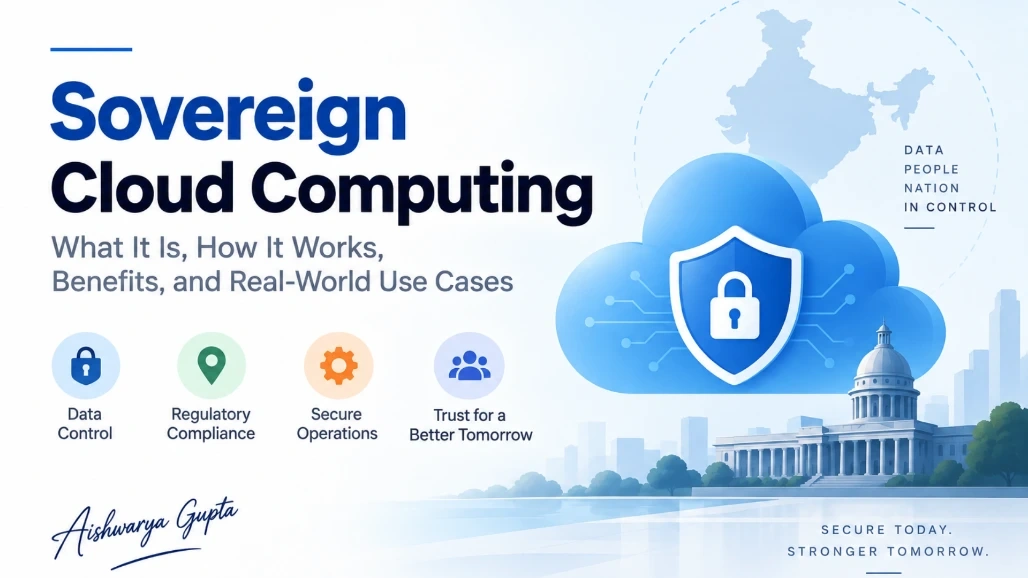
Cloud computing has made it possible for organizations to store data and run applications without owning large amounts of physical infrastructure. A company can deploy an application in a cloud region, scale it when traffic increases, and use managed services for databases, storage, networking, security, and analytics.
But as organizations move more sensitive workloads to the cloud, another question becomes important:
Who controls the data, where is it stored, and which laws apply to it?
This is where sovereign cloud computing comes into the picture.
Sovereign cloud is not simply another type of cloud like public, private, or hybrid cloud. Instead, it is an approach to cloud architecture and governance that gives organizations stronger control over data location, access, operations, and regulatory requirements.
It is particularly important for governments, banks, healthcare organizations, defense organizations, and other businesses that handle sensitive information.
In this article, we will understand sovereign cloud in simple terms, look at how it works, explore its architecture and benefits, and see how developers can design applications for sovereign environments.
What Is Sovereign Cloud Computing?
Sovereign cloud computing is a cloud environment designed to meet specific requirements around data sovereignty, data residency, operational control, security, and legal jurisdiction.
In simple words, it answers questions such as:
Where is my data stored?
Where is my data processed?
Which country's laws apply to the data?
Who can access the data?
Who manages the cloud infrastructure?
Where are backups stored?
Who controls encryption keys?
Can cloud operators access sensitive information?
Can data move outside an approved geographic region?
Data sovereignty means that data is subject to the laws and governance of the jurisdiction where it is located. Data residency is more specifically about the physical location where data is stored or processed.
A sovereign cloud architecture brings these requirements into the design of the cloud environment rather than treating them as an afterthought.
Sovereign Cloud vs Traditional Cloud
Consider a normal cloud application.
A developer might choose a cloud region close to users:
Users
  ↓
Cloud Application
  ↓
Database
  ↓
Cloud Storage
The main concerns may be:
Performance
Availability
Scalability
Cost
Security
For a sensitive workload, additional questions appear:
Where is the data?
        ↓
Where is it processed?
        ↓
Where are backups stored?
        ↓
Who can access it?
        ↓
Who controls the encryption keys?
        ↓
Can the data cross borders?
        ↓
Which laws apply?
This is the difference in mindset.
A sovereign cloud design considers location, legal jurisdiction, operational control, and governance along with normal cloud requirements.
What Is Data Residency?
Data residency is one of the easiest sovereign-cloud concepts to understand.
It simply refers to where data is physically stored or processed.
For example, suppose an organization has a requirement that customer information must remain within India.
A basic architecture might be:
                    India
                      |
              ----------------
              |              |
          Application      Database
              |              |
              --------Cloud--------
The organization must make sure that the relevant data stays within approved Indian regions.
This can also affect:
Backups
Replicas
Disaster recovery
Logs
Monitoring data
Temporary storage
Data processing services
This is important because an application may appear to be deployed in one country while a supporting service, backup, or replicated dataset operates somewhere else.
Therefore, simply choosing a local cloud region does not automatically guarantee complete sovereignty.
What Is Data Sovereignty?
Data sovereignty goes beyond physical location.
It considers the laws and regulatory requirements that apply to data based on its location and handling.
For example:
Data Location
     +
Applicable Laws
     +
Access Rules
     +
Security Controls
     +
Data Movement
Together, these determine how an organization can manage and protect its data.
AWS describes data sovereignty as data being subject to the laws and regulations of its physical location, while also distinguishing it from data residency.
This distinction is important for developers.
If a project requirement says:
"Customer data must remain in India."
you should not interpret that as only:
"Put the database in an Indian region."
You should also ask:
Where does the application process the data?
Where are backups stored?
Where are logs stored?
Does the service replicate data?
Where are encryption keys managed?
Can administrators access the environment remotely?
Does any third-party service receive the data?
These questions help turn a general compliance requirement into an actual technical architecture.
Why Is Sovereign Cloud Becoming Important?
Organizations are putting increasingly sensitive information into cloud environments.
Examples include:
Government records
Banking information
Healthcare records
Identity information
Intellectual property
Financial transactions
Defense-related information
AI training data
At the same time, cloud environments are becoming more distributed.
An application might use:
Frontend
   ↓
API
   ↓
AI Service
   ↓
Database
   ↓
Object Storage
   ↓
Analytics
   ↓
Backup
Each service can potentially introduce a different data location or access requirement.
Sovereign cloud provides a framework for controlling these dependencies.
The Main Components of a Sovereign Cloud
There is no single architecture that fits every organization.
However, several controls are commonly important.
1. Data Residency
Sensitive data is kept within approved geographic boundaries.
For example:
Approved Region
       ↓
Application
       ↓
Database
       ↓
Storage
       ↓
Backup
Policies can prevent developers from accidentally deploying sensitive resources into an unapproved region.
2. Encryption
Encryption protects data from unauthorized access.
There are three important situations:
Data at Rest
     ↓
Stored data

Data in Transit
     ↓
Data moving across networks

Data in Use
     ↓
Data being processed
Encryption at rest protects stored information.
Encryption in transit protects information moving between systems.
Confidential computing can provide protection for data while it is being processed by using hardware-based trusted execution environments. Microsoft includes encryption and confidential computing among its core sovereign-cloud controls.
3. Encryption Key Control
Encryption is only part of the story.
Organizations may also want control over the keys used to encrypt their sensitive information.
For example:
Application
    ↓
Encrypted Data
    ↓
Customer-Managed Key
    ↓
Key Management System
This can provide greater control over who can decrypt the data.
For highly sensitive workloads, customer-managed keys or external key-management systems may be part of the architecture.
4. Operational Control
Another important question is:
Who can operate the cloud environment?
An organization may have requirements around:
Administrator access
Remote support
Privileged access
Approval workflows
Access logging
Personnel location
Operational monitoring
This becomes particularly important for government and regulated workloads.
5. Governance
Technical controls are not enough.
Organizations also need policies that define:
What data is sensitive?
        ↓
Where can it be stored?
        ↓
Who can access it?
        ↓
Which services are allowed?
        ↓
What encryption is required?
        ↓
How is compliance monitored?
Modern cloud platforms can use policy-as-code and landing-zone approaches to enforce these requirements consistently. Microsoft, for example, documents sovereign landing zones and policy initiatives for enforcing residency, encryption, and other controls.
A Simple Sovereign Cloud Architecture
Let's consider a healthcare application.
The application stores patient records and should keep sensitive information within an approved national boundary.
A simplified architecture could look like this:
                    Users
                      |
                      ↓
                 Web Application
                      |
                      ↓
                  API Layer
                      |
          -------------------------
          |                       |
          ↓                       ↓
     Application             Authentication
       Services                  Service
          |
          ↓
       Database
          |
          ↓
    Encrypted Storage
          |
          ↓
   Approved Backup Region
Around this architecture, additional controls are applied:
          Sovereign Controls
                 |
    -----------------------------
    |       |       |           |
 Residency Encryption Access  Governance
The application still behaves like a normal cloud application, but its infrastructure and policies are designed around sovereignty requirements.
A Practical Example: Banking Application
Imagine a bank building a mobile banking application.
The application handles:
Customer names
Account numbers
Transactions
Payment information
Statements
The bank decides that sensitive customer data must remain within an approved jurisdiction.
A developer might initially build:
Mobile App
    ↓
API
    ↓
Cloud Database
But the architecture needs more detail.
Step 1: Classify the Data
Not every piece of information has the same sensitivity.
For example:
Public
  ↓
Bank branch address

Internal
  ↓
Internal documentation

Confidential
  ↓
Customer profile

Highly Sensitive
  ↓
Financial transactions
Different classifications can require different controls.
Step 2: Choose Approved Regions
The database, storage, backups, and other relevant services must use approved locations.
Step 3: Apply Encryption
Sensitive data should be encrypted at rest and in transit.
Step 4: Control Access
Only authorized employees and services should access customer data.
Step 5: Monitor Access
The organization should be able to answer:
Who accessed this data and when?
Step 6: Prevent Misconfiguration
Cloud policies should prevent developers from accidentally deploying sensitive resources into an unapproved region.
This is where automation becomes important.
Sovereign Cloud and AI
Sovereignty becomes even more interesting when AI is involved.
Consider an AI-powered healthcare application.
The application might process:
Patient Data
     ↓
AI Application
     ↓
Model
     ↓
Inference
     ↓
Result
Now the organization must consider more than database location.
It may also need to know:
Where inference happens
Where prompts are processed
Where embeddings are stored
Where vector indexes are stored
Where model artifacts are stored
Where logs are stored
Who can access AI workloads
Whether data is used for model training
For AI workloads, sovereignty requirements can therefore apply to both the data and the AI infrastructure that processes it. Microsoft specifically identifies residency for training, fine-tuning, inference data, embeddings, vector indexes, and model artifacts as part of AI sovereignty considerations.
A simplified architecture could be:
Sensitive Data
      |
      ↓
Data Classification
      |
      ↓
Approved Cloud Region
      |
      ↓
AI Application
      |
      ↓
AI Model / Inference
      |
      ↓
Result
Every stage needs to follow the required sovereignty controls.
Sovereign Cloud and Disaster Recovery
Disaster recovery creates an interesting challenge.
Normally, an organization may replicate data to another geographic region:
Primary Region
      |
      ↓
Secondary Region
This improves resilience.
But what if regulations say that the data cannot leave the country?
Then the secondary region must also be inside the approved sovereignty boundary.
For example:
             Country Boundary
        ---------------------------
        |                         |
        |  Primary     Secondary  |
        |  Region  →   Region     |
        |                         |
        ---------------------------
Microsoft's current sovereignty guidance explicitly highlights the tension between sovereignty and resilience and recommends planning approved regions and disaster-recovery locations together.
This is an important architecture lesson:
Security, sovereignty, availability, and disaster recovery cannot always be designed independently.
Sovereign Cloud vs Private Cloud
Sovereign cloud and private cloud are not the same thing.
A private cloud focuses mainly on dedicated or controlled infrastructure.
A sovereign cloud focuses on requirements such as:
Data location
Legal jurisdiction
Operational control
Encryption
Access governance
Regulatory compliance
You can have:
Sovereign Public Cloud
or:
Sovereign Private Cloud
or:
Hybrid Sovereign Architecture
The correct choice depends on the organization's requirements.
Microsoft's current sovereign-cloud architecture, for example, includes public, private, and partner-operated deployment models rather than treating sovereignty as synonymous with private infrastructure.
Sovereign Cloud vs Public Cloud
This is another common misunderstanding.
Sovereign cloud does not necessarily mean:
"Do not use public cloud."
Instead, it can mean:
"Use cloud infrastructure with additional controls that satisfy specific sovereignty requirements."
Hyperscale cloud providers are building sovereign capabilities into their platforms.
For example, AWS provides digital-sovereignty controls focused on areas such as data location and operational choices, while Microsoft provides sovereign cloud capabilities across different deployment models.
The important point is that sovereignty is increasingly becoming an architecture and governance layer on top of cloud infrastructure.
Common Challenges of Sovereign Cloud
Sovereign cloud provides stronger control, but it can also introduce additional complexity.
1. Limited Service Availability
Not every cloud service may be available in every approved region.
Before selecting a service, architects need to verify:
Is the service available?
        ↓
Where does it process data?
        ↓
Where does it store data?
        ↓
Does it support required controls?
Cloud providers themselves recommend checking service availability and sovereignty capabilities before onboarding workloads.
2. Higher Operational Complexity
You may need additional:
Policies
Monitoring
Access controls
Encryption management
Auditing
Documentation
3. Potential Cost Increase
Specialized infrastructure, additional controls, dedicated environments, and operational requirements can increase costs.
4. Reduced Architecture Flexibility
A normal application may freely use global services.
A sovereign workload may have to stay within a smaller set of approved services and regions.
5. Disaster Recovery Planning
If data cannot cross a geographic boundary, designing a highly resilient architecture can become more difficult.
Best Practices for Developers
Sovereign cloud is not only an architect's responsibility.
Developers also play an important role.
Understand Data Classification
Before writing code, know what type of data the application processes.
Know Where Data Goes
Do not only check the main database.
Consider:
Logs
Caches
Backups
Analytics
Search indexes
AI embeddings
Monitoring systems
Use Infrastructure as Code
Infrastructure as Code can help standardize deployments.
For example, instead of manually selecting regions, policies can enforce approved locations.
Apply Least Privilege
Services and users should only have the permissions they need.
Encrypt Sensitive Data
Use appropriate encryption for data at rest and in transit, and consider encryption-in-use technologies for workloads with stronger requirements.
Automate Compliance
Manual compliance checks become difficult as infrastructure grows.
Policy-as-code can help prevent configuration mistakes before they reach production.
Check Third-Party Services
Your application may be sovereign, but a third-party API could still receive sensitive information.
Always understand where external services process and store data.
When Should You Consider Sovereign Cloud?
Not every application needs a sovereign cloud architecture.
It becomes particularly relevant when an application handles:
Government data
Financial information
Healthcare records
Defense information
Personally identifiable information
Critical infrastructure data
Sensitive intellectual property
Regulated AI workloads
For a public blog or a simple portfolio website, these requirements may be unnecessary.
The correct approach is to match the level of sovereignty controls with the sensitivity and regulatory requirements of the workload.
A Simple Decision-Making Process
When designing a cloud application, ask these questions:
1. What data does the application process?
                ↓
2. How sensitive is that data?
                ↓
3. Where is the data allowed to reside?
                ↓
4. Where is it allowed to be processed?
                ↓
5. Who can access it?
                ↓
6. Who controls the encryption keys?
                ↓
7. Where can backups and logs be stored?
                ↓
8. What happens during disaster recovery?
                ↓
9. Which cloud services meet these requirements?
                ↓
10. How will compliance be continuously enforced?
This approach is more useful than simply asking:
"Which sovereign cloud should we buy?"
Sovereignty is fundamentally a workload-design problem.
The Future of Sovereign Cloud
Sovereign cloud is likely to become increasingly important as more sensitive workloads move to the cloud.
The growth of AI makes this even more relevant.
Organizations want the benefits of cloud computing:
Scalability
Managed services
Global technology
Automation
AI capabilities
High availability
But they also want greater control over:
Data
Infrastructure
Encryption keys
Operations
Access
Legal jurisdiction
This is pushing cloud providers toward more flexible sovereignty models, including sovereign public clouds, private environments, local or partner-operated infrastructure, confidential computing, stronger key management, and policy-driven governance.
For developers, this means that cloud architecture will increasingly include regulatory and sovereignty requirements alongside performance and scalability requirements.
Summary
Sovereign cloud computing is about giving organizations stronger control over how their cloud workloads, data, and operations are governed.
The most important concepts are data residency, data sovereignty, encryption, key management, operational access, governance, and regulatory compliance.
Data residency answers where data is stored and processed. Data sovereignty goes further by considering the laws and governance that apply to that data. A well-designed sovereign cloud environment combines these requirements with normal cloud capabilities such as scalability, availability, security, and automation.
For developers, the key lesson is simple: putting an application in the correct cloud region is only the beginning. You also need to consider backups, logs, APIs, AI services, encryption keys, disaster recovery, administrator access, and third-party services.
Sovereign cloud does not mean giving up the advantages of cloud computing. Instead, it is about using cloud technology while maintaining the level of control required by the organization, industry, or country.
As cloud and AI continue to become part of critical business and government systems, understanding sovereignty will become an increasingly valuable skill for cloud developers, architects, DevOps engineers, and security professionals.
Join the conversation! Your thoughts help the community grow.