

Introduction
Most developers spend years mastering coding. They solve algorithm problems, build projects, and learn frameworks. But when it comes to senior-level interviews — one round becomes the real filter:
System Design.
It is the stage where companies evaluate whether you can build software that works not just on your laptop — but for millions of real users.
For developers in India and across the global tech industry, System Design is now a career-defining skill.
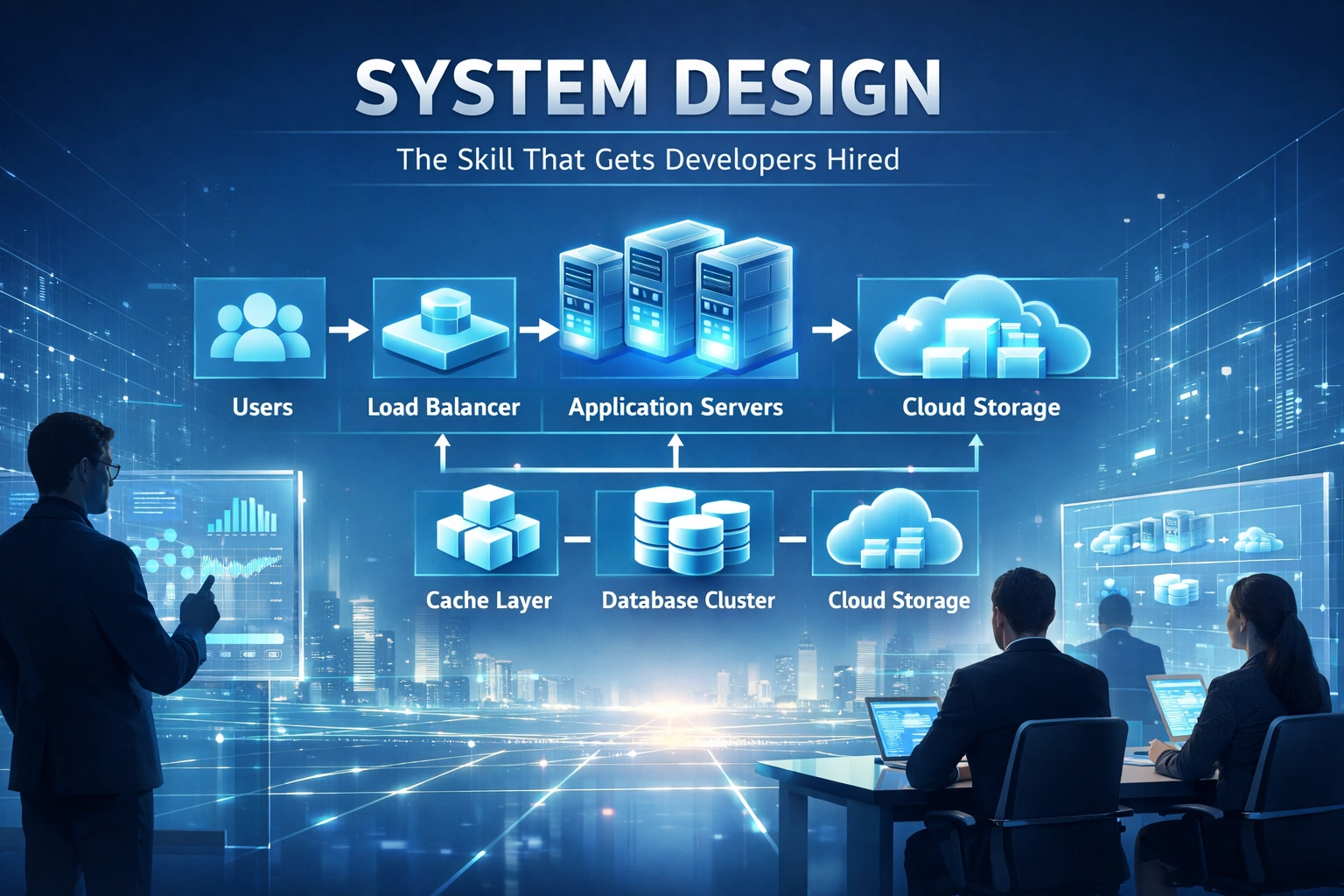
What Is System Design?
System Design is the process of planning how a software application will work at scale.
Instead of writing code for one feature, you design:
How users connect to the system
How requests are handled
Where data is stored
How traffic is managed
How failures are handled
In simple terms:
Coding builds features.
System Design builds real-world products.
Why Companies Test System Design
Top tech companies such as Google, Amazon, Netflix, Microsoft, and fast-growing startups all test System Design in interviews.
They want engineers who can:
Think beyond single modules
Plan scalable architectures
Handle high traffic systems
Design reliable and fault-tolerant applications
This is why many developers clear coding rounds — but fail System Design interviews.
A Simple Example: Designing YouTube
When designing a platform like YouTube, questions arise such as:
Where are videos stored?
How do millions stream videos simultaneously?
How are recommendations generated?
How are comments stored and retrieved?
The solution involves:
CDNs for video delivery
Distributed databases for metadata
Caching for fast access
Load balancers for traffic distribution
Microservices for modular scalability
This planning process is System Design.
Five Core Concepts Every Developer Must Know
If you're starting System Design preparation, focus on:
Scalability
Load Balancing
Caching
Database Design
Fault Tolerance
Understanding these five concepts builds the foundation for solving almost any System Design problem.
Why System Design Impacts Your Career
Senior Developer, Tech Lead, and Software Architect roles require System Design expertise.
Companies trust engineers who can:
Design production-ready systems
Anticipate growth challenges
Reduce infrastructure costs
Improve application reliability
In simple terms:
Coding gets you the job.
System Design gets you the high-paying job.
India and the Global Demand for System Design Skills
India’s software ecosystem is rapidly expanding in:
SaaS startups
Fintech platforms
EdTech products
Enterprise software services
Globally, companies are hiring developers who can design:
Scalable cloud-native systems
Distributed applications
High-availability services
Developers who master System Design gain:
Better salary opportunities
Faster career growth
Access to global remote roles
How to Start Learning System Design
Begin with:
Understanding real-world application architectures
Studying case studies (YouTube, WhatsApp, Netflix)
Learning cloud fundamentals
Practicing mock interview problems
Like coding, System Design improves through practice.
Final Thoughts
The future of software engineering is not just about writing code.
It is about building systems that scale, perform, and survive real-world usage.
For developers in India and worldwide, mastering System Design today means unlocking senior roles, global opportunities, and long-term career growth.
Join the conversation! Your thoughts help the community grow.