

Abstract
As Artificial Intelligence undergoes rapid institutionalization within enterprise ecosystems, the operational mandate confronting Chief Enterprise Architects and C-suite leadership has fundamentally shifted. The challenge is no longer one of adoption velocity, but of architectural rigor, systematic governance, and computational accountability. Deploying probabilistic inference systems without formal structural scaffolding introduces compounding technical debt, regulatory exposure, and operationally intolerable non-determinism at scale.
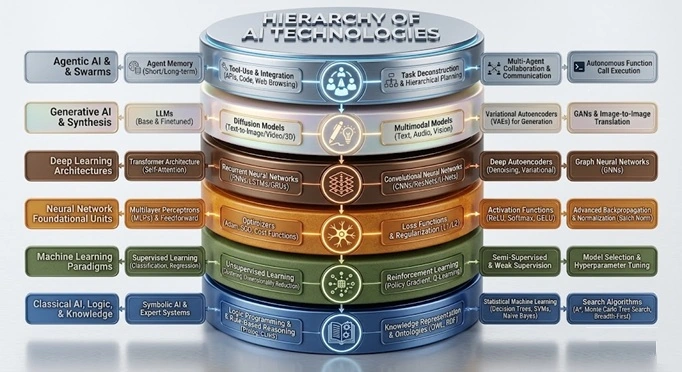
This paper presents an exhaustive, technically grounded deconstruction of the Hierarchy of AI Technologies — a seven-tier architectural framework that establishes a precise categorical taxonomy of AI methodologies, organized by computational substrate, epistemological function, and operational autonomy. The hierarchy spans the full spectrum: from the provably deterministic foundations of Symbolic AI and Knowledge Engineering, through the statistical inference machinery of Machine Learning and the representational power of Deep Learning, to the generative synthesis capabilities of Large-Scale Foundation Models, and finally to the executive-function autonomy of Agentic Systems and Multi-Agent Orchestration Frameworks.
This analysis establishes formal inter-layer dependencies, defines the mathematical primitives that govern each tier, identifies architectural failure modes endemic to partial-stack deployments, and articulates a governance-by-design philosophy for the responsible operationalization of autonomous enterprise AI. The central thesis is unambiguous: enterprise-grade AI is a full-stack engineering discipline, and any deployment that fails to anchor probabilistic generative capability within deterministic governance and structured agentic scaffolding is, by definition, architecturally unsound.
1. Introduction: From Monolithic Perception to Stratified Cognitive Architecture
The contemporary enterprise discourse on Artificial Intelligence is dominated by the surface-level capabilities of generative conversational interfaces. This representational bias — treating AI as a single-layer, prompt-responsive oracle — constitutes a fundamental epistemological failure that carries significant systemic risk. A Large Language Model (LLM), in isolation, is not a production-grade enterprise system. It is a probabilistic function approximator, powerful in its generality, but inherently unstable as a standalone operational component.
The architectural reality is considerably more nuanced. Modern AI capability is not a monolithic phenomenon but a vertical, interdependent technology stack — a hierarchy of computational layers, each providing a distinct cognitive service that either grounds, enables, or governs the layers above it. This hierarchy exhibits strict functional dependencies: the generative power of Layer V is statistically meaningful only when anchored by the inferential rigor of Layer II; the autonomous execution of Layer VI is operationally safe only when governed by the deterministic constraints of Layer I; and the swarm-level intelligence of Layer VII is strategically coherent only when supervised by the metacognitive orchestration apparatus defined at the apex.
Understanding and internalizing this hierarchy is not an academic exercise. It is the prerequisite for any enterprise AI deployment that aspires to be auditable, stable, deterministic at the governance boundary, and strategically aligned with organizational objectives. The following sections provide a formally grounded, technically comprehensive analysis of each tier, from foundational substrate to cognitive apex.
2. Tier I — The Deterministic Bedrock: Classical AI, Symbolic Logic, and Knowledge Engineering
2.1 Epistemological Role and Strategic Rationale
At the absolute foundation of the AI hierarchy lies Classical AI, alternatively designated Symbolic AI or Good Old-Fashioned AI (GOFAI) in the academic literature. In an era captivated by the empirical successes of connectionist models, this layer is systematically undervalued in applied discourse, yet it remains the non-negotiable anchor of enterprise reliability. Its defining characteristic — and the source of its irreplaceable value — is absolute, provable determinism.
A deterministic system, by formal definition, produces an identical output for any given input with probability 1.0. This property, trivially achievable in symbolic computation, is categorically impossible in any system governed by stochastic inference. In regulated enterprise verticals — financial services (Basel III compliance, AML frameworks), healthcare (FDA 21 CFR Part 11, HIPAA audit requirements), and legal technology (chain-of-custody integrity) — probabilistic approximations are not merely suboptimal; they are legally and operationally inadmissible. Classical AI constitutes the formal compliance substrate upon which higher probabilistic layers must be anchored.
2.2 Symbolic AI and Production Rule Systems
Symbolic AI operates on explicit, machine-verifiable logical predicates. The canonical computational model is the Production Rule System: a formal specification of IF <antecedent> THEN <consequent> conditional logic, evaluated by a forward-chaining or backward-chaining inference engine.
Forward-chaining engines (data-driven) traverse the rule base from known facts to derivable conclusions — the operational paradigm for real-time fraud detection triggers or regulatory compliance alerting. Backward-chaining engines (goal-driven) work in reverse from a target hypothesis, identifying the evidentiary chain required to support it — the paradigm for diagnostic expert systems in clinical decision support.
Mature enterprise deployments encode hard business rules at this layer that function as invariant constraints on higher-level generative outputs. An LLM operating at Layer V may probabilistically infer a course of action; the Layer I rule engine applies a deterministic veto or validation before that action is permitted to propagate to execution.
2.3 Knowledge Representation, Ontologies, and Semantic Graph Construction
The structural encoding of world knowledge is achieved via formal ontological frameworks. The World Wide Web Consortium (W3C) standards stack — comprising the Resource Description Framework (RDF), RDF Schema (RDFS), and the Web Ontology Language (OWL) — provides a mathematically grounded apparatus for representing entities, their properties, and the formal relationships between them as a typed, directed graph.
An OWL ontology defines a formal Description Logic (DL) knowledge base, expressed as a set of TBox assertions (terminological axioms: class hierarchies, property domain/range constraints, cardinality restrictions) and ABox assertions (assertional ground facts: specific entity instances and their relational memberships). This formal structure supports decidable inference: an OWL-DL reasoner (such as Pellet, HermiT, or FaCT++) can automatically derive implicit knowledge from explicit axioms through tableau-based classification and satisfiability checking.
The enterprise utility is significant: Knowledge Graphs constructed via RDF/OWL provide the structured "world model" that prevents higher-level agents from confabulating organizational hierarchies, regulatory relationships, or product taxonomy structures. Grounding a generative model against a formally specified ontology is the primary architectural defense against hallucination-induced operational failure.
2.4 Search Algorithms, Heuristics, and Combinatorial Optimization
Operational enterprise planning — logistics routing, supply chain optimization, strategic resource allocation — requires guaranteed-optimal or near-optimal solutions to combinatorial search problems. This is achieved through a suite of classical planning algorithms:
A* Search applies an admissible heuristic function h(n) — one that never overestimates the true cost — to guide best-first expansion of a state-space graph, guaranteeing optimal path discovery in O(b^d) time complexity where b is the branching factor and d is solution depth.
Monte Carlo Tree Search (MCTS) applies randomized simulation to estimate the expected utility of states in computationally intractable search spaces, achieving super-human performance in strategic planning tasks (most famously, AlphaGo). Enterprise applications include dynamic pricing optimization, portfolio rebalancing under uncertainty, and adversarial negotiation strategy.
Integer Linear Programming (ILP) and its relaxations encode operational constraints as linear inequalities over integer-valued decision variables, solved by branch-and-bound or cutting-plane methods to provable optimality. This tier provides the mathematical certainty required for deterministic operational execution before any predictive or generative overlay is applied by higher stack layers.
3. Tier II — The Statistical Foundation: Machine Learning Paradigms and Inductive Inference
3.1 Computational Epistemology of Statistical Learning
Machine Learning (ML) represents the transition from deductive reasoning (logical implication from axioms) to inductive inference (hypothesis formation from empirical data). The formal objective of ML is to identify a hypothesis function h: X → Y from a hypothesis class H, such that h minimizes the expected generalization error over the underlying data-generating distribution P(X, Y), estimated via empirical risk minimization (ERM) over a finite training sample.
The statistical foundation is Vapnik-Chervonenkis (VC) theory, which establishes that with probability at least 1 − δ over a sample of size m, the generalization error is bounded by the empirical training error plus a complexity penalty proportional to √(VCdim(H)/m). This theoretical framework formalizes the bias-variance tradeoff that governs all practical ML system design: models with high hypothesis class capacity (low bias) are prone to overfitting high-variance solutions to finite training samples, while models with restricted capacity exhibit systematic underfitting.
3.2 Supervised Learning: Discriminative Modeling and Predictive Analytics
Supervised learning trains a parameterized model f_θ: X → Y on a dataset D = {(x_i, y_i)}_{i=1}^{n} of labeled input-output pairs. The objective is to minimize a task-appropriate loss function L(f_θ(x), y) via iterative parameter update:
Regression tasks employ quadratic loss L(ŷ, y) = (ŷ − y)², penalizing the squared deviation between prediction and ground truth, yielding the Ordinary Least Squares (OLS) estimator under the Gauss-Markov assumptions.
Classification tasks employ cross-entropy loss L(p̂, y) = −∑_c y_c log p̂_c, where p̂_c is the predicted class probability vector output by a softmax head. This formulation is equivalent to maximum likelihood estimation under a categorical distributional assumption.
Enterprise applications include credit risk scoring (logistic regression over engineered financial features), demand forecasting (gradient-boosted decision trees over time-enriched sales data), and fraud detection (ensemble classifiers over transactional graph features). The architectural role of this layer is the transition from rule-governed explicit policies (Tier I) to data-driven implicit statistical models (Tier II).
3.3 Unsupervised Learning: Latent Structure Discovery and Dimensionality Reduction
Unsupervised learning operates over unlabeled data D = {x_i}_{i=1}^{n}, seeking to identify the latent generative structure underlying the observed data distribution P(X). The canonical algorithmic paradigms include:
K-Means Clustering partitions the data into K clusters by iteratively minimizing the within-cluster sum of squared Euclidean distances: argmin_{μ} ∑k ∑{x ∈ C_k} ‖x − μ_k‖². The algorithm alternates between assignment (associating each point to its nearest centroid) and update (recomputing centroids as cluster means) steps until convergence, a procedure guaranteed to terminate but not to find the global optimum.
Principal Component Analysis (PCA) identifies the orthogonal directions of maximum variance in a high-dimensional feature space by computing the eigendecomposition of the sample covariance matrix Σ = (1/n)X^TX. The leading k eigenvectors define a subspace onto which data can be projected with minimal reconstruction error, formally equivalent to minimizing the Frobenius norm ‖X − X_k‖_F² where X_k is the rank-k approximation.
Gaussian Mixture Models (GMMs) fit a probabilistic mixture of K Gaussian components p(x) = ∑_k π_k N(x; μ_k, Σ_k) via the Expectation-Maximization (EM) algorithm, providing soft probabilistic cluster assignments rather than the hard partitions of K-Means — critical for anomaly detection scenarios where membership ambiguity carries information.
3.4 Reinforcement Learning and the Alignment Mechanism
Reinforcement Learning (RL) is formally modeled as a Markov Decision Process (MDP): a tuple (S, A, P, R, γ) where S is the state space, A is the action space, P: S × A → Δ(S) is the stochastic transition kernel, R: S × A → ℝ is the reward function, and γ ∈ [0,1) is the temporal discount factor. The agent's objective is to identify a policy π: S → Δ(A) that maximizes the expected discounted cumulative return: E[∑_{t=0}^∞ γ^t R(s_t, a_t)].
Modern deep RL employs neural network function approximators for both the value function V^π(s) = E[∑_{t=0}^∞ γ^t r_t | s_0 = s, π] and the policy πθ(a|s), trained via Proximal Policy Optimization (PPO) or Soft Actor-Critic (SAC) algorithms that enforce trust-region constraints to stabilize gradient updates.
Within the AI hierarchy, RL's most consequential application is Reinforcement Learning from Human Feedback (RLHF): the primary alignment mechanism through which the raw capability of a pretrained LLM is shaped to conform to human intent and enterprise safety constraints. RLHF trains a reward model R_φ(x, y) on human preference data, then uses PPO to optimize the language model policy πθ against R_φ, subject to a KL-divergence penalty that prevents catastrophic forgetting of the base model's capabilities. This tier constitutes the mathematical interface between statistical capability and institutional governance.
4. Tier III — The Connectionist Engine: Neural Network Foundational Units and Computational Physics
4.1 The Artificial Neuron as Computational Primitive
The fundamental computational unit of all modern AI is the artificial neuron: a parameterized function z = σ(w^T x + b), where x ∈ ℝ^d is an input vector, w ∈ ℝ^d is a learned weight vector, b ∈ ℝ is a bias scalar, and σ: ℝ → ℝ is a nonlinear activation function. A network of such units — organized into layers and composed via feedforward computation — constitutes a Multilayer Perceptron (MLP).
The theoretical foundation is the Universal Approximation Theorem (Hornik, 1989; Cybenko, 1989), which establishes that a single hidden layer MLP with a sufficient number of neurons and a non-polynomial activation function can approximate any continuous function f: ℝ^n → ℝ^m on a compact domain to arbitrary precision. This result provides the mathematical guarantee that neural networks possess sufficient representational capacity to model arbitrarily complex input-output mappings — though it says nothing about the computational tractability of learning such approximations from finite data.
4.2 Optimization Calculus and the Backpropagation Algorithm
The "learning" of a neural network f_θ is the process of identifying the parameter vector θ ∈ ℝ^p (where p can exceed 10^{11} in frontier models) that minimizes a scalar loss function L(θ) over a training corpus. This is achieved by stochastic gradient descent (SGD) and its adaptive-moment variants: θ_{t+1} = θ_t − η∇_θ L(θ_t), where η is the learning rate.
The critical computational procedure that makes this optimization tractable in deep networks is backpropagation, a systematic application of the chain rule of differential calculus to compute the gradient ∇_θ L with respect to all parameters in a single reverse-mode pass through the computational graph. For a network of depth L, backpropagation propagates error signals δ^l = (∂L/∂z^l) layer by layer from output to input, computing parameter gradients as ∂L/∂W^l = δ^l (a^{l-1})^T.
The Adam optimizer (Adaptive Moment Estimation) augments basic SGD with two critical mechanisms: a first moment estimate (exponentially decaying average of past gradients, equivalent to momentum) and a second moment estimate (exponentially decaying average of squared gradients, providing adaptive per-parameter learning rates). This combination substantially accelerates convergence in the sparse, high-curvature loss landscapes characteristic of deep network training.
4.3 Activation Functions, Normalization, and Training Stability
The choice of activation function critically determines the trainability of deep networks. The Rectified Linear Unit (ReLU), defined as σ(z) = max(0, z), was the first activation function to demonstrate reliable training of networks beyond three to four hidden layers by avoiding the vanishing gradient problem endemic to sigmoid and tanh activations. However, ReLU neurons can suffer permanent death when the gradient becomes zero and stays zero.
The Gaussian Error Linear Unit (GELU), defined as GELU(x) = xΦ(x) where Φ is the standard normal CDF, applies a smooth, probabilistic gating that stochastically weighs inputs by their magnitude — empirically superior to ReLU for large-scale language modeling. The Softmax function, σ(z)_j = exp(z_j)/∑_k exp(z_k), converts raw logit scores into a normalized probability distribution — the standard output activation for multi-class classification and autoregressive token prediction.
Layer Normalization (LayerNorm), defined as LayerNorm(x) = γ((x − μ)/σ) + β where μ and σ are the mean and standard deviation computed across the feature dimension, stabilizes activations throughout the forward pass, preventing the exploding/vanishing gradient dynamics that would otherwise make training transformers computationally intractable. LayerNorm is the specific normalization variant preferred in language modeling (versus BatchNorm, which requires cross-sample statistics incompatible with autoregressive inference).
5. Tier IV — The Structural Architecture: Deep Learning Topologies and Inductive Biases
5.1 The Transformer and the Self-Attention Mechanism
The Transformer architecture (Vaswani et al., 2017) represents the singular most consequential architectural innovation in the history of applied machine learning. Its central mechanism, scaled dot-product self-attention, enables each element in a sequence of length n to directly attend to all other elements, producing a context-aware representation that captures arbitrary long-range dependencies.
The mathematical formulation of multi-head attention is:
Attention(Q, K, V) = softmax(QK^T / √d_k) · V
where Q ∈ ℝ^{n×d_k}, K ∈ ℝ^{n×d_k}, and V ∈ ℝ^{n×d_v} are learned linear projections of the input sequence, and the √d_k scaling factor controls the magnitude of dot products to prevent softmax saturation in high-dimensional spaces. The O(n²) complexity in sequence length is the primary computational bottleneck that has motivated extensive subsequent research into sparse attention (Longformer, BigBird), linear attention approximations (Performer, Linformer), and state-space sequence models (Mamba, S4) that achieve O(n log n) or O(n) scaling.
Multi-head attention applies h parallel attention operations with distinct learned projections, concatenates their outputs, and projects to the model dimension: MultiHead(Q,K,V) = Concat(head_1,...,head_h)W^O. This multi-head structure enables the model to simultaneously attend to information from different representational subspaces at different positional scales — a critical inductive bias for capturing syntactic, semantic, and pragmatic structure simultaneously.
5.2 Convolutional Neural Networks: Hierarchical Spatial Feature Extraction
Convolutional Neural Networks (CNNs) exploit two powerful inductive biases over spatial data: local connectivity (each neuron connects to a spatially local receptive field rather than all inputs) and parameter sharing (the same convolutional filter is applied translationally across the entire spatial extent of the input). These biases encode the physically motivated prior that visual features are spatially local and translation-invariant — dramatically reducing the parameter count required to learn visual representations relative to fully connected networks.
A convolutional layer computes the discrete convolution (F ★ I)(p) = ∑_s F(s)·I(p−s) over input feature maps I using learnable filters F, producing an output feature map. Stacking convolutional layers with interleaved max-pooling operations produces a hierarchical feature extractor: early layers capture low-level features (edges, textures); intermediate layers detect object parts; deep layers represent high-level semantic categories.
ResNets (He et al., 2016) introduced skip connections — identity mappings that bypass one or more layers: H(x) = F(x) + x — enabling the training of networks hundreds of layers deep by providing gradient highways that circumvent the degradation problem. This architecture remains the backbone of state-of-the-art visual perception systems across manufacturing inspection, medical imaging analysis, and autonomous vehicle perception.
5.3 Recurrent Architectures and Temporal State Representation
Long Short-Term Memory networks (LSTMs) address the fundamental limitation of simple RNNs — the inability to learn dependencies spanning more than roughly 10–20 timesteps due to exponential gradient decay — through a gated memory cell architecture with three learned gate mechanisms:
Forget gate: f_t = σ(W_f · [h_{t-1}, x_t] + b_f) — determines what fraction of the cell state is discarded. Input gate: i_t = σ(W_i · [h_{t-1}, x_t] + b_i) — controls what new information is written to cell state. Output gate: o_t = σ(W_o · [h_{t-1}, x_t] + b_o) — governs what portion of the cell state is exposed as hidden state.
The cell state update C_t = f_t ⊙ C_{t-1} + i_t ⊙ tanh(W_C · [h_{t-1}, x_t] + b_C) provides a linear gradient pathway through time that mitigates vanishing gradients, enabling practical learning of dependencies spanning hundreds of timesteps. Enterprise applications include high-frequency financial time-series modeling, anomaly detection in IoT sensor streams, and natural language generation in seq2seq frameworks.
6. Tier V — The Cognitive Core: Generative AI, Foundation Models, and Latent Space Synthesis
6.1 Large Language Models: Autoregressive Foundation Models
Large Language Models (LLMs) are autoregressive foundation models trained to model the joint probability of token sequences via the chain rule of probability: P(x_1,...,x_n) = ∏{t=1}^n P(x_t | x_1,...,x{t-1}). At inference time, text generation proceeds by iteratively sampling x_t ~ P(x_t | x_{<t}) using temperature-scaled softmax sampling, nucleus (top-p) sampling, or beam search decoding, depending on the application requirements.
Contemporary frontier models (GPT-4, Gemini Ultra, Claude 3) contain parameter counts in the 10^{11}–10^{12} range, trained on multi-trillion token corpora via self-supervised next-token prediction. The scaling laws empirically characterizing LLM capability (Kaplan et al., 2020; Hoffmann et al., 2022) establish that model performance (cross-entropy loss) follows a smooth power law in compute budget C ∝ N^α D^β, where N is parameter count, D is training tokens, and α, β ≈ 0.5. Crucially, these laws identify an optimal compute allocation frontier — the Chinchilla-optimal training regime — at approximately D/N ≈ 20 tokens per parameter.
In-context learning (ICL) — the emergent capability of pretrained LLMs to acquire new task-specific behaviors from a small number of prompt-embedded demonstrations without gradient updates — constitutes one of the most theoretically significant phenomena in modern ML. ICL appears to function as implicit Bayesian inference over a latent distribution of tasks, with the model's pretraining prior providing the inductive bias required for rapid in-context adaptation.
6.2 Diffusion Models and Score-Based Generative Modeling
Denoising Diffusion Probabilistic Models (DDPMs) define a generative framework grounded in non-equilibrium thermodynamics. The forward process q(x_t | x_{t-1}) = N(x_t; √(1−β_t)x_{t-1}, β_t I) is a fixed Markov chain that gradually corrupts the data distribution with Gaussian noise over T timesteps, ultimately converging to an isotropic Gaussian. The model learns a reverse process p_θ(x_{t-1}|x_t) = N(x_{t-1}; μ_θ(x_t, t), Σ_θ(x_t, t)) parameterized by a neural network (typically a U-Net for image synthesis or a transformer for latent diffusion).
Training minimizes a variational lower bound on the data log-likelihood, which reduces to a noise prediction objective: E_{x_0, ε, t}[‖ε − ε_θ(√ᾱ_t x_0 + √(1−ᾱ_t)ε, t)‖²], where ε_θ is the model's noise predictor. This formulation connects diffusion models to score matching — the model learns to approximate the score function ∇_x log p_t(x) of the noisy data distribution, enabling high-fidelity sample generation via score-guided Langevin dynamics.
Latent Diffusion Models (LDMs) achieve computational tractability by performing the diffusion process in the compressed latent space of a pretrained Variational Autoencoder (VAE) rather than pixel space, reducing the dimensionality of the diffusion process by factors of 4×–8× while preserving perceptual quality. Enterprise applications span synthetic training data generation, automated design and prototyping workflows, and domain-specific image synthesis for medical imaging augmentation.
6.3 Multimodal Integration and Cross-Modal Alignment
Vision-Language Models (VLMs) achieve cross-modal grounding by aligning visual and textual representation spaces through contrastive pre-training (CLIP: Radford et al., 2021) or generative cross-attention mechanisms (Flamingo, LLaVA). CLIP trains dual encoders — a Vision Transformer (ViT) for images and a Transformer for text — jointly via a symmetric contrastive objective that maximizes cosine similarity of matched image-text pairs while minimizing similarity of mismatched pairs within a mini-batch.
The resulting shared representation space enables zero-shot visual classification, image-conditioned text generation, and text-to-image retrieval without task-specific fine-tuning. For the enterprise architect, multimodal integration enables a single model to simultaneously cross-reference an architectural diagram against a technical specification document, analyze a financial chart in conjunction with a written report, or process medical imaging data alongside clinical notes — fundamentally expanding the information modalities available to higher-tier agentic systems.
7. Tier VI — The Executive Function: Agentic AI, Autonomous Planning, and Tool-Augmented Reasoning
7.1 The Agent Architecture: LLM as Cognitive Controller
The transition from Layer V to Layer VI represents the most consequential architectural evolution currently underway in enterprise AI. An AI Agent is formally a system that perceives its environment through a perception module, maintains a state representation (memory), selects actions via a policy, and executes those actions through actuator interfaces to pursue a specified objective. In the modern LLM-based agent architecture, the language model functions as the central cognitive controller — performing perception, planning, and action selection — while specialized components handle memory persistence and tool integration.
The ReAct prompting framework (Yao et al., 2022) operationalizes agent cognition as an interleaved sequence of Reasoning (chain-of-thought deliberation) and Acting (tool invocation) steps: Thought_t → Action_t → Observation_t → Thought_{t+1} → ... This architecture grounds the model's generative planning in real-world feedback, substantially reducing hallucination rates relative to pure chain-of-thought generation without environmental grounding.
7.2 Agentic Memory Architectures: Context, Retrieval, and State Persistence
A production-grade agentic system requires a multi-tier memory architecture that transcends the finite context window of any individual LLM invocation:
In-Context Working Memory (Short-Term): The active context window — typically 8K–1M tokens depending on the model — functions as the agent's working scratchpad, holding the current task specification, intermediate reasoning traces, tool outputs, and accumulated observations within a single inference pass. This memory is volatile: it is discarded at the end of the inference session.
External Episodic Memory (Medium-Term): Past interactions, observations, and completed subtask results are persisted to an external key-value store and indexed via dense retrieval using semantic embedding similarity. At each reasoning step, the agent queries this store to retrieve contextually relevant historical experience, enabling continuity across session boundaries.
Retrieval-Augmented Generation (RAG): The dominant paradigm for grounding LLM generation in external document corpora. The retrieval component encodes documents into a dense vector index using a bi-encoder (e.g., DPR, BGE-M3) and retrieves top-k chunks via approximate nearest-neighbor search (FAISS, HNSW). The retrieved chunks are prepended to the generation prompt as conditioning context, enabling the model to synthesize grounded responses without storing the knowledge in model parameters — critical for enterprise knowledge bases requiring frequent updates.
Parametric Long-Term Memory: Knowledge stored implicitly in the model's weights via fine-tuning on domain-specific corpora. This memory tier is slow to update (requiring full or parameter-efficient fine-tuning cycles) but available at zero retrieval latency and without context window consumption.
7.3 Task Decomposition, Hierarchical Planning, and Directed Acyclic Graph Execution
The defining capability of a Layer VI agent — the property that fundamentally distinguishes it from a stateless LLM completion endpoint — is the capacity to autonomously decompose a high-level objective into a structured execution plan.
The Plan-and-Execute paradigm (Wang et al., 2023) separates planning from execution: a planner module generates a structured task graph representing the decomposition of the goal into atomic subtasks and their dependency relationships, while a separate execution module sequentially or concurrently executes individual subtasks using specialized agents or tools. This decomposition is formally representable as a Directed Acyclic Graph (DAG): nodes represent atomic executable tasks; directed edges represent prerequisite dependencies; and the topological sort of the DAG defines a valid execution ordering that respects all precedence constraints.
Hierarchical Task Networks (HTNs), borrowed from classical AI planning, provide a more expressive decomposition formalism: compound tasks are recursively decomposed into subtasks via reduction schemas, terminating at primitive tasks executable by direct tool invocation. This recursive structure maps naturally onto organizational workflows where high-level business processes decompose into departmental procedures, which decompose into individual operational tasks.
7.4 Tool Integration, Function Calling, and Sandboxed Actuation
The mechanism by which agents translate reasoning into real-world effect is tool use via function calling — the structured invocation of external APIs, code interpreters, database query engines, and system interfaces. Modern LLMs are fine-tuned to generate structured JSON-formatted tool calls (conforming to OpenAI's function calling specification or Anthropic's tool use API) that are intercepted by the agent runtime, dispatched to the appropriate tool executor, and whose outputs are returned to the model as structured observations.
The Model Context Protocol (MCP) provides a standardized, protocol-level interface for connecting LLM-based agents to external tool servers, enabling a clean separation between the model's cognitive layer and the execution infrastructure. From a security architecture perspective, tool execution must occur within capability-scoped sandboxes: the principle of least privilege requires that each agent's tool permissions be precisely scoped to its designated functional role, with cryptographically auditable invocation logs maintained for governance and compliance.
8. Tier VII — The Governance Apex: Multi-Agent Systems, Metacognition, and Enterprise Orchestration
8.1 Multi-Agent System Architectures: Decentralized Cognitive Labor
The summit of the AI hierarchy is the Multi-Agent System (MAS): a collective of specialized, concurrently operating AI agents that collaborate to achieve complex enterprise objectives exceeding the capability of any individual agent. The theoretical foundations of MAS draw from game theory (agent interaction modeling, mechanism design, Nash equilibrium analysis), distributed systems (consensus protocols, fault tolerance, eventual consistency), and organizational theory (role specialization, authority hierarchies, communication protocols).
The key architectural insight motivating MAS design over single-agent generalism is the capability-reliability tradeoff: a single generalist agent tasked with a complex, multi-domain enterprise workflow exhibits substantially higher error rates than a pipeline of specialized agents, each with a tightly scoped domain of expertise, dedicated tool permissions, and a specialized fine-tuning substrate. The MAS architecture mirrors the organizational logic of human enterprise: division of cognitive labor with coordination protocols governing inter-agent communication.
8.2 Communication Protocols and Coordination Mechanisms
Inter-agent communication in a production MAS must satisfy several formal requirements: correctness (messages are faithfully transmitted and interpreted), consistency (all agents operate from a coherent shared state representation), and fault tolerance (the system degrades gracefully under individual agent failure). Several architectural patterns address these requirements:
Blackboard Architecture: Agents share a common structured workspace (the "blackboard") to which they post partial results and from which they read the contributions of other agents. A control component monitors the blackboard and activates appropriate agents based on current state — the classical architecture for cooperating expert systems.
Message-Passing Protocols: Agents communicate via typed, structured messages following formal ontology-grounded communication acts (e.g., the FIPA-ACL standard: INFORM, REQUEST, PROPOSE, ACCEPT-PROPOSAL, REJECT-PROPOSAL). This protocol grounding ensures that inter-agent messages have well-defined, machine-verifiable semantics rather than relying on implicit natural language understanding.
Emergent Consensus: In swarm architectures without a central orchestrator, global coordination emerges from local interaction rules — analogous to stigmergic coordination in biological swarm systems. Agent-level utility functions and auction-based task allocation mechanisms (e.g., Contract Net Protocol) enable decentralized task assignment without centralized coordination overhead.
8.3 Metacognitive Orchestration and Quality Control
In hierarchical MAS architectures, a Supervisor Agent (or orchestrator) functions as the metacognitive manager of the agent workforce. Its responsibilities span task allocation, progress monitoring, output quality assessment, inter-agent conflict resolution, and dynamic replanning in response to execution failures or environmental changes.
The orchestrator implements a quality control loop: agent outputs are evaluated against formal acceptance criteria (specification-derived test suites, output format validators, semantic similarity checks against reference outputs, or learned reward models) before being accepted as intermediate results or delegated downstream. Outputs failing quality thresholds trigger corrective subgraph execution: the orchestrator spawns a remediation agent with the original task context and the failed output as a negative example, iterating until acceptance criteria are satisfied or a predefined retry budget is exhausted.
8.4 Enterprise Governance Integration: Human-in-the-Loop, Audit, and Deterministic Enforcement
The enterprise deployment of a MAS requires a governance layer that subjects autonomous agent behavior to the same accountability standards applied to human employees: formal authority delegation, complete action audit trails, deterministic constraint enforcement at decision boundaries, and defined escalation pathways that invoke human judgment at consequential decision points.
Human-in-the-Loop (HITL) Checkpoints are formally specified interruption conditions embedded in the agent execution DAG. When an agent action exceeds a predefined consequence magnitude threshold (measured in financial exposure, regulatory scope, or operational criticality), execution is suspended and a structured approval request is escalated to a designated human authority. The approval workflow is mediated through enterprise identity and access management infrastructure (SAML/OAuth-integrated), ensuring that approval authority is cryptographically authenticated and audit-logged.
Deterministic Constraint Enforcement: The Layer I rule engine serves as the final governor on all agent-generated outputs and actions. Before any agent-initiated state mutation propagates to external systems, the output is validated against the enterprise's formal policy ontology. Actions violating hard regulatory constraints (e.g., trade size limits, data sovereignty restrictions, medical dosage safety bounds) are deterministically blocked, irrespective of the agent's probabilistic confidence in their appropriateness. This architectural guarantee — that the deterministic bedrock of Layer I governs the autonomous apex of Layer VII — is the formal foundation of enterprise AI trustworthiness.
Immutable Audit Trail Generation: All agent reasoning traces, tool invocations, inter-agent communications, and output artifacts are persisted to an append-only, cryptographically chained audit log (following standards such as RFC 3161 for trusted timestamps). This log provides the evidentiary basis for post-hoc regulatory examination, internal compliance review, and continuous system improvement through retrospective analysis of agent decision quality.
9. Architectural Synthesis: Full-Stack Dependency Analysis and Deployment Failure Modes
9.1 Inter-Layer Dependency Mapping
The seven tiers of the hierarchy are not independent components deployable in isolation; they form a tightly coupled dependency graph in which the functional integrity of each tier is contingent upon the correct operation of the tiers beneath it:
Layer VII (MAS) requires Layer VI: orchestration without individual agent capability is vacuous.
Layer VI (Agents) requires Layer V: agentic planning without a generative reasoning core has no cognitive substrate.
Layer V (Generative AI) requires Layers III–IV: LLM capability is constituted by the neural computational primitives and deep architectural structures of the lower tiers.
Layer II (ML) requires Layer I: statistical inference without deterministic governance produces audit-inadmissible outputs.
Layer VII requires Layer I: the autonomy of the apex is operationally safe only when bounded by the determinism of the foundation.
9.2 Architectural Anti-Patterns and Failure Mode Analysis
The Prompt-Only Fallacy: Connecting a user interface directly to an unstructured LLM endpoint with no architectural scaffolding is the most pervasive and consequential architectural anti-pattern in enterprise AI. Without Layer I constraint enforcement, Layer II validation, Layer VI planning structure, and Layer VII governance, the resulting system is a probabilistic oracle with no deterministic accountability guarantees — technically incapable of satisfying enterprise-grade reliability, auditability, or regulatory compliance requirements.
Context Window Amnesia: Deploying a Layer VI agent without a multi-tier memory architecture results in a system that loses operational context at every session boundary, exhibiting incoherent long-horizon behavior. The absence of RAG infrastructure in regulated environments means the agent is hallucinating from parametric memory rather than grounding on verified, auditable knowledge sources.
Unbounded Tool Permissions: Granting an agent broader tool permissions than its designated functional role requires violates the principle of least privilege and expands the blast radius of agent failures from bounded task failures to catastrophic infrastructure mutations. Every tool permission granted to an agent is an attack surface; each should be justified by a formal functional requirement and bounded by a capability scope specification.
10. The Intelligence Gap: Why Transformers, Tool Use, and Agentic Scaffolding Are Necessary But Not Sufficient
10.1 The Structural Ceiling of the Transformer Paradigm
The seven-tier hierarchy described in the preceding sections represents the current state of the art in deployed enterprise AI. It is architecturally sophisticated, computationally powerful, and operationally consequential. However, a rigorous examination of the cognitive primitives underlying this stack reveals a fundamental and largely unacknowledged limitation: none of the seven tiers, individually or in combination, constitute genuine intelligence in any epistemologically meaningful sense. They constitute, collectively, an extraordinarily capable simulacrum of intelligence — one whose failure modes are qualitatively distinct from, and far more dangerous than, the failure modes of conventional software, precisely because they superficially resemble the failures of a reasoning mind rather than the crashes of a deterministic program.
The Transformer architecture, which provides the cognitive substrate for Layers V through VII, is formally characterized as a context-conditional distribution estimator: given an input sequence x_{1:n}, the model estimates the probability distribution P_θ(x_{n+1} | x_{1:n}) over the next token, and generation proceeds by repeatedly sampling from this distribution. Every downstream capability — chain-of-thought reasoning, tool invocation, multi-step planning, in-context learning — is constituted entirely by this single statistical operation applied autoregressively. The system has no separate reasoning module, no truth-evaluation subsystem, no model of its own computational state, and no mechanism for distinguishing between a confidently expressed true proposition and a confidently expressed false one.
This is not an implementation limitation correctable by scaling parameter counts. It is a structural architectural constraint arising from the nature of next-token prediction as a training objective. A model trained to maximize P(x_{n+1} | x_{1:n}) over a corpus is optimized to produce the most statistically plausible continuation of a text — which, in an overwhelming majority of cases, is also the most factually accurate continuation, but which is guaranteed to be accurate by no mechanism whatsoever. The model cannot, in principle, distinguish between the internal representations it generates because it genuinely computes a correct answer and those it generates because the training corpus overwhelmingly associated certain surface-form token sequences.
10.2 The Five Irreducible Failure Modes of Transformer-Based Intelligence
10.2.1 Hallucination as a First-Class Architectural Phenomenon
Hallucination — the generation of factually false content expressed with high confidence — is not a bug in current LLM implementations. It is the expected consequence of the training objective. Next-token prediction optimizes for distributional plausibility, not propositional truth. The model has no internal fact-verification mechanism; it generates tokens that are statistically coherent continuations of the context, regardless of their correspondence to extra-linguistic reality. Even Retrieval-Augmented Generation (RAG), currently the dominant architectural mitigation, addresses only one sub-class of hallucination (insufficient parametric knowledge) and does not eliminate the model's susceptibility to generating plausible-sounding fabrications when retrieved context is ambiguous, incomplete, or contradictory.
10.2.2 The Absence of Genuine Causal Reasoning
Transformer models are empirically powerful at pattern-matching over causal language — text that describes causes, effects, and counterfactuals. However, as formally demonstrated by Pearl's do-calculus framework, correlation-based statistical inference cannot recover causal structure without interventional or counterfactual data. LLMs are trained exclusively on observational text corpora; they have no access to interventional data and no internal causal graph over which to perform do-calculus operations. The consequence is that a transformer's apparent causal reasoning is, in formal terms, sophisticated associative retrieval: it reproduces the statistical patterns of causal argumentation found in its training corpus without executing any process that is structurally equivalent to causal inference. In high-stakes enterprise domains — clinical decision support, financial liability analysis, regulatory impact assessment — the distinction between genuine causal analysis and statistically plausible causal-sounding text is not academic. It is the difference between a defensible institutional decision and a confidently expressed fabrication.
10.2.3 Stateless Epistemics: The Absence of Belief Revision
A transformer model maintains no persistent belief state. Each inference pass is formally independent: the model has no mechanism for representing beliefs acquired in one context window, flagging them as uncertain, and systematically revising them upon encountering contradictory evidence in a subsequent session. The apparent conversational memory of a deployed chatbot is an illusion maintained by prepending prior turns to the context window — a positional trick that does not constitute genuine belief update. The model cannot distinguish between a belief it "holds" because it was asserted in the current context and one it generated parametrically from its training distribution. This epistemological statelessness means that transformer-based systems are, by formal definition, incapable of cumulative knowledge refinement over time — a property that is not peripheral to intelligence but constitutive of it.
10.2.4 Metacognitive Opacity: The Inability to Know What One Does Not Know
Perhaps the most consequential failure mode for enterprise deployment is the transformer's inability to accurately model its own uncertainty. Calibration research consistently demonstrates that LLMs are systematically overconfident: the linguistic confidence of a model's assertion (expressed through hedging language, modal verbs, and declarative force) is poorly correlated with its actual epistemic justification. A model generating a confidently-phrased false claim and a model generating a confidently-phrased true claim produce outputs that are, from the model's perspective, generated by the same mechanism — next-token sampling from a probability distribution. The model has no privileged access to the provenance of its own representations and therefore cannot reliably distinguish between what it knows, what it has pattern-matched from noisy training data, and what it has confabulated. This is not a calibration problem solvable by post-hoc output processing. It is a structural absence of metacognitive capacity — the very capacity that Gödel (2025) identifies as the foundational missing layer in contemporary AI architecture.
10.2.5 Temporal and Contextual Brittleness
Transformer models exhibit pronounced distributional sensitivity: their outputs can shift dramatically in response to superficial prompt reformulations that leave semantic content invariant. Minor changes in instruction phrasing, token ordering, or few-shot example selection can produce qualitatively different outputs for formally identical tasks — a phenomenon incompatible with the behavioral consistency requirements of enterprise-grade systems. Furthermore, the fixed knowledge cutoff of a pretrained model means that any deployment extending beyond the training data horizon operates on a progressively stale parametric prior, with no intrinsic mechanism for detecting or compensating for distributional shift between training and deployment environments.
10.3 Why Agentic Scaffolding Does Not Resolve the Intelligence Gap
The contemporary industry response to these limitations has been the construction of increasingly elaborate agentic scaffolding: tool use, RAG pipelines, multi-agent orchestration, chain-of-thought prompting, and self-consistency sampling. These are genuine and important engineering advances. However, they share a critical theoretical limitation: they add capability layers on top of a cognitive substrate that remains architecturally unchanged. They do not alter the fundamental nature of the underlying inference process; they redirect it.
A ReAct-style agent that invokes a web search tool is still, at each reasoning step, executing next-token prediction over a context window that now happens to include retrieved text. The tool invocation is itself generated by the same stochastic process as any other output. The agent has no independent mechanism for evaluating whether its decision to invoke the tool was epistemically justified, whether the retrieved content is trustworthy, whether its synthesis of retrieved evidence is logically valid, or whether the final output meets the quality standard required by the task. These evaluative functions are externally specified by the system architect — they are not intrinsic to the agent's cognitive process.
The result is a system whose apparent sophistication can mask profound epistemic fragility. As Gödel observes, even powerful language models "remain prediction engines at their core. They can sound confident while being wrong, skip critical checks, lose track of assumptions, or produce outputs that are polished but operationally unsafe" (Gödel, 2025). Adding tool use and multi-agent coordination does not introduce the regulative self-awareness required to prevent these failure modes. It creates larger, more capable systems that can fail in more complex and harder-to-diagnose ways.
The intelligence gap, in other words, is not a capability gap. It is a governance gap — specifically, the absence of a cognitive layer that monitors, evaluates, and regulates the system's own reasoning process in real time, with awareness of its own epistemic limitations. Closing this gap requires not a seventh or eighth agentic scaffolding layer, but a fundamentally different architectural paradigm: Metacognitive AI.
11. The Metacognitive Imperative: Toward Governed, Self-Regulating Intelligence
11.1 Metacognition as a Formal Cognitive Category
Metacognition — defined in the cognitive science literature as the capacity to monitor, evaluate, and regulate one's own cognitive processes — is not a peripheral enhancement to intelligence. It is, arguably, the defining property that distinguishes genuine reasoning from sophisticated pattern-matching. The seminal work of Flavell (1979) established metacognition as a two-component system: metacognitive knowledge (what one knows about one's own cognitive processes, capabilities, and limitations) and metacognitive regulation (the executive control processes by which one monitors ongoing cognition and intervenes to correct it). The absence of both components from current transformer architectures is precisely what produces the failure modes catalogued in Section 10.2.
In computational terms, a metacognitively capable AI system must implement three formal functions that are categorically absent from the transformer paradigm:
Self-Monitoring: the capacity to observe and represent the quality of its own reasoning process in real time — detecting logical inconsistencies, identifying gaps in evidence chains, flagging low-confidence inferences, and noticing distributional mismatch between the current task and its training distribution.
Self-Evaluation: the capacity to assess the quality of a completed reasoning episode against an explicit normative standard — not merely for output fluency or surface coherence, but for logical validity, evidential adequacy, actionability, and alignment with the original task objective.
Self-Regulation: the capacity to intervene in its own reasoning process on the basis of self-monitoring and self-evaluation outputs — slowing deliberation, soliciting additional evidence, branching across alternative hypotheses, rejecting low-quality intermediate conclusions, and revising its epistemic state in response to new information.
11.2 Gödel's Scaffolded Cognitive Prompting: The GSCP-15 Framework
The most formally developed operational framework for implementing metacognitive AI in enterprise deployments is Gödel's Scaffolded Cognitive Prompting (GSCP) and its extended lifecycle model, GSCP-15, introduced by John Gödel (2025) in From Prompting to Governing: Metacognitive AI with the GSCP-15 Framework. GSCP-15 represents a foundational reframing of the AI interaction paradigm: from a model in which a user submits a prompt and a language model returns a stochastic completion, to a model in which AI cognition is governed by a structured execution discipline encompassing scope definition, evidence management, staged reasoning, metacognitive evaluation, telemetric oversight, and systematized learning.
Gödel's central thesis is architecturally precise: "GSCP-15 reframes the AI interaction as a governed program: each session has scope, evidence rules, execution stages, validation logic, learning hooks, and continuity controls. In that sense, it acts less like a prompt recipe and more like an operating discipline for intelligence" (Gödel, 2025). This distinction — between a prompt recipe (a clever input formulation that elicits a desired output pattern from a statistical model) and an operating discipline for intelligence (a formal governance framework that structures, monitors, and regulates the entire cognitive lifecycle) — is the precise theoretical boundary separating Layer VII multi-agent scaffolding from genuine Metacognitive AI.
11.3 The GSCP-15 Lifecycle: Architectural Components and Formal Functions
GSCP-15 organizes AI cognition into a fifteen-stage lifecycle structured around five functional phases, each implementing one or more of the formal metacognitive functions identified in Section 11.1:
Phase I — Scope and Constraint Definition (Stages 1–3)
A metacognitive AI system does not begin by attempting to answer. It begins by constraining the problem. The first phase of GSCP-15 requires the system to explicitly clarify task intent, establish operational boundaries, identify underlying assumptions, specify what evidence is required and what sources are authoritative, and formalize what an acceptable output would look like. This phase encodes metacognitive knowledge about task structure before any generative reasoning commences — the architectural equivalent of requiring a human analyst to write a problem statement before beginning analysis. As Gödel observes, a GSCP-15-governed system "begins by constraining the problem rather than rushing to answer it. It clarifies intent, establishes boundaries, identifies assumptions, and decides what evidence is required" (Gödel, 2025).
Phase II — Structured Execution with Branching Exploration (Stages 4–8)
During the execution phase, a GSCP-15-governed system does not generate a single linear response path. It explores multiple reasoning branches, comparing competing hypotheses, evaluating alternative interpretations of available evidence, and maintaining explicit uncertainty representations over intermediate conclusions. This branching structure implements self-monitoring at the reasoning level: the system tracks which paths have been explored, which exhibit logical coherence, which are supported by retrieved evidence, and which should be abandoned. The architectural implication is a deliberative reasoning process fundamentally distinct from the greedy sequential token generation of a standard LLM completion — one that implements something operationally analogous to Kahneman's System 2 deliberative cognition rather than System 1 associative recall.
Phase III — Metacognitive Evaluation and Output Validation (Stages 9–11)
Before any output is finalized, GSCP-15 mandates a formal evaluation phase in which the system assesses the completed reasoning episode against the task specification defined in Phase I. This evaluation is not a fluency check or a surface-level coherence review. It is a structured assessment of: logical validity (does the conclusion follow from the evidence?), evidential adequacy (is the evidence sufficient to support the conclusion?), actionability (does the output enable the intended downstream action?), and alignment (does the output address the original objective?). Outputs failing these evaluative criteria trigger corrective execution: "Before finalizing, it evaluates the output against the original objective, not just for fluency but for adequacy, correctness, and actionability" (Gödel, 2025). This evaluation phase constitutes the formal implementation of self-evaluation — the metacognitive function most conspicuously absent from standard LLM deployments.
Phase IV — Telemetry, Incident Awareness, and Observability (Stages 12–13)
GSCP-15's fourth phase introduces operational telemetry as a first-class architectural component: systematic logging of reasoning trajectories, tool invocations, evidence sources, intermediate conclusions, branching decisions, evaluation outcomes, and output quality signals. This telemetric layer serves two distinct governance functions. First, it provides real-time observability into the system's cognitive process — enabling human operators to inspect not merely what the system concluded but how it reasoned, what evidence it considered, and where it expressed uncertainty. Second, it provides the empirical substrate for systematic learning in Phase V. The telemetric record is the AI system's institutional memory — the formal basis on which pattern analysis, anomaly detection, and continuous improvement can be grounded in evidence rather than intuition.
Phase V — Systematic Learning, Memory Governance, and Session Continuity (Stages 14–15)
The final phase of GSCP-15 implements what Gödel identifies as the critical distinction between unstructured memory and governed continuity: "Unstructured memory can make systems noisy, brittle, or biased toward stale context. Governed memory, by contrast, becomes a disciplined substrate for reflection. It enables the system to remember selectively, reason over previous outcomes, and stay aligned with current scope" (Gödel, 2025). Stage 14 implements systematic learning: the telemetric record of completed sessions is analyzed to extract generalizable heuristics, identify recurring failure patterns, update evidential priors, and refine execution policies — transforming operational experience into structured institutional knowledge. Stage 15 implements stable session governance: the mechanisms by which long-running tasks maintain coherent scope, consistent evidential standards, and alignment with original objectives across session boundaries, without the context drift and objective wandering that characterize unstructured multi-session deployments.
11.4 GSCP-15 as the Eighth Tier: Metacognitive Governance as a Distinct Architectural Layer
The analytical implication of Gödel's framework for the seven-tier hierarchy presented in this paper is significant. GSCP-15 does not simply extend Layer VII (Multi-Agent Systems and Metacognition) — it defines a qualitatively distinct architectural tier that sits above and across all seven layers as a governing cognitive envelope. Where Layer VII describes the organizational structure of multi-agent systems (swarm architectures, orchestration mechanisms, audit trail generation), GSCP-15 describes the cognitive operating discipline that determines how intelligence is applied within and across those structures.
The distinction is analogous to the difference between an organizational chart (which describes reporting relationships and role assignments) and a management philosophy (which determines how decisions are made, how quality is maintained, how institutional knowledge is preserved, and how performance is improved over time). Layer VII provides the organizational chart of the agent workforce; GSCP-15 provides the management philosophy that determines whether that workforce operates with discipline, accountability, and continuous improvement — or merely with scale.
Gödel makes this point with architectural precision: "A metacognitive layer sits above the model and organizes how intelligence is applied. It determines when a model should deliberate longer, when a witness model should be consulted, when web evidence should override stale priors, when uncertainty must be surfaced, and when a result should be rejected or rewritten. In other words, GSCP-15 turns models into components of a reasoning system rather than treating one model response as the final truth" (Gödel, 2025).
11.5 Enterprise Implications: From Impressive Outputs to Operational Trustworthiness
The practical implications of adopting a metacognitive architectural paradigm, grounded in GSCP-15, are consequential for enterprise AI governance across three dimensions:
Auditability: GSCP-15's telemetric phase produces a formal reasoning provenance record — a structured account of how the system arrived at its output, what evidence it considered, where it expressed uncertainty, and which reasoning branches it explored and rejected. This provenance record is the missing link between current LLM deployments (which produce outputs without reasoning justification) and the evidentiary standards required by enterprise compliance, regulatory examination, and institutional accountability frameworks.
Repeatability: The scope-definition and evidence-governance phases of GSCP-15 introduce behavioral determinism at the cognitive level — not in the sense that the underlying model becomes deterministic (it remains stochastic), but in the sense that the reasoning process is structured by explicit, auditable rules that govern what evidence is considered, how alternatives are evaluated, and what constitutes an acceptable output. This structured consistency is what enterprise systems require for operational deployment: predictable process, not merely capable output.
Continuous Improvement: GSCP-15's learning phase transforms the AI system from a static capability (a deployed model with fixed parametric knowledge) into a dynamic institutional asset — one that accumulates structured operational experience, refines its execution heuristics based on empirical outcome data, and becomes systematically more capable over time through governed learning rather than ad hoc fine-tuning cycles.
As Gödel concludes: "The future of useful AI will belong to systems that can think about their thinking without losing control of execution. GSCP-15 offers a concrete blueprint for that future. By combining scaffolded reasoning, metacognitive oversight, governed memory, telemetry, and learning sessions, it creates the conditions for AI that is not only capable, but operationally trustworthy. In a world full of impressive outputs, that difference is going to matter more than ever" (Gödel, 2025).
12. Conclusion: Toward a Full-Stack Metacognitive Enterprise
The Hierarchy of AI Technologies establishes a formal, technically rigorous taxonomy that deconstructs the apparent monolith of "Artificial Intelligence" into seven functionally distinct, computationally grounded, and architecturally interdependent tiers. The central thesis of this analysis, however, extends beyond the original seven-tier framework to a more demanding architectural conclusion: enterprise-grade AI capability cannot be achieved through capability alone, no matter how elaborately scaffolded.
The probabilistic generative power of a foundation model is operationally meaningful only when anchored in the deterministic rule enforcement of Classical AI and Knowledge Engineering (Tier I). The autonomous planning capability of an agentic system is strategically coherent only when structured by formal task decomposition and multi-tier memory architectures (Tier VI). The collective intelligence of a Multi-Agent Swarm is institutionally accountable only when governed by HITL checkpoints, cryptographic audit trails, and deterministic constraint enforcement (Tier VII). And the entire seven-tier stack, however sophisticated, produces genuine enterprise-grade intelligence only when governed by a metacognitive operating discipline — a formal framework for self-monitoring, self-evaluation, and self-regulation that transforms capable models into accountable reasoning systems.
The GSCP-15 framework, as articulated by Gödel (2025), provides the most formally developed operational specification for this metacognitive layer currently available in the applied AI literature. Its fifteen-stage lifecycle — spanning scope definition, branching execution, evaluative validation, telemetric observability, and governed learning — constitutes an architectural paradigm that transcends the prompt-and-response interaction model and establishes AI cognition as a disciplined institutional process, subject to the same standards of accountability, reproducibility, and continuous improvement that govern all other enterprise-critical systems.
For the Chief Enterprise Architect, the strategic mandate is now threefold: mastery of the seven-tier computational stack, formal deployment of multi-agent governance infrastructure at the apex of that stack, and — critically — the implementation of a metacognitive governing envelope that subjects the entire stack to the self-regulating discipline without which scale produces not intelligence, but sophisticated, hard-to-audit unreliability. The organizations that achieve all three will not merely deploy AI. They will operate it — with the institutional confidence, regulatory defensibility, and adaptive improvement capability that define genuine competitive advantage in the agentic era.
References and Further Reading
Gödel, J. (2025). From Prompting to Governing: Metacognitive AI with the GSCP-15 Framework. C# Corner. https://www.c-sharpcorner.com/article/from-prompting-to-governing-metacognitive-ai-with-the-gscp-15-framework/
Vaswani, A., et al. (2017). Attention Is All You Need. NeurIPS.
Kaplan, J., et al. (2020). Scaling Laws for Neural Language Models. arXiv:2001.08361.
Hoffmann, J., et al. (2022). Training Compute-Optimal Large Language Models (Chinchilla). arXiv:2203.15556.
Ho, J., et al. (2020). Denoising Diffusion Probabilistic Models. NeurIPS.
Yao, S., et al. (2022). ReAct: Synergizing Reasoning and Acting in Language Models. arXiv:2210.03629.
Radford, A., et al. (2021). Learning Transferable Visual Models From Natural Language Supervision (CLIP). ICML.
He, K., et al. (2016). Deep Residual Learning for Image Recognition. CVPR.
Schulman, J., et al. (2017). Proximal Policy Optimization Algorithms. arXiv:1707.06347.
Ouyang, L., et al. (2022). Training Language Models to Follow Instructions with Human Feedback (InstructGPT/RLHF). NeurIPS.
Wang, L., et al. (2023). Plan-and-Solve Prompting. arXiv:2305.04091.
Hornik, K. (1991). Approximation capabilities of multilayer feedforward networks. Neural Networks, 4(2).
Pearl, J. (2009). Causality: Models, Reasoning, and Inference (2nd ed.). Cambridge University Press.
Flavell, J. H. (1979). Metacognition and cognitive monitoring: A new area of cognitive–developmental inquiry. American Psychologist, 34(10), 906–911.
Kahneman, D. (2011). Thinking, Fast and Slow. Farrar, Straus and Giroux.
Russell, S., & Norvig, P. (2020). Artificial Intelligence: A Modern Approach (4th ed.). Pearson.
Vapnik, V. (1998). Statistical Learning Theory. Wiley-Interscience.
Join the conversation! Your thoughts help the community grow.