

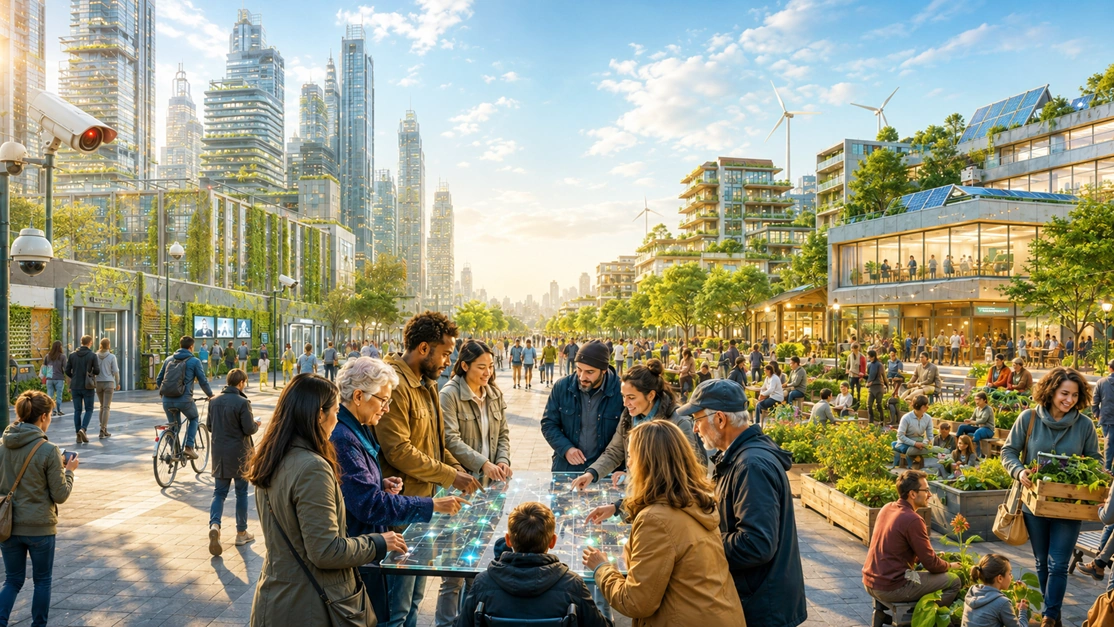
Humanity stands at a critical historical crossroads. The rapid acceleration of artificial intelligence (AI), automation, and decentralized data networks has granted us an unprecedented capacity to reorganize society. For the first time in history, the logistical tools required to transition from a centralized, coercive state apparatus to a decentralized, self-governing commune are within our reach.
Yet, technology itself is entirely neutral. It possesses no innate moral compass; it mirrors the property relations of the economic system that births it. If left unchecked under current conditions, these tools will not liberate us. Instead, they risk trapping humanity in a permanent digital panopticon.
To prevent this dystopian future, we must aggressively champion a framework of Democratic Techno-Socialism. This model leverages advanced technology not to fortify the state or enrich corporations, but to systematically dissolve bureaucratic power and return governance to organic human communities.
Boundaries and Dangers: Techno-Socialism or Techno-Feudalism?
If algorithms and data centers remain in the hands of a few giant monopolies (such as Google, Meta, Amazon, etc.) or authoritarian states as they are today, they will lead humanity not to a withered-away state, but on the contrary, to a digital dictatorship—a state of Techno-Feudalism.
Under Techno-Feudalism, corporate algorithms act as invisible, unelected planners. They track our movements, commodify our social interactions, and dictate economic access based on proprietary metrics. When combined with authoritarian state power, this creates a hyper-centralized surveillance apparatus that makes the totalitarian bureaucracies of the 20th century look primitive. Instead of liberating the individual or restoring the communal safety net of the extended family, technology under capitalism exacerbates loneliness, atomization, and absolute dependency on the market.
For this technology to serve the withering away of the state, it is imperative that data centers and artificial intelligence codes are under social ownership—completely open-source and public.
   [ Corporate/State Monopolies ] -----> TECHNO-FEUDALISM (Digital Dictatorship & Isolation)
                ^
                | (The Choice)
                v
   [ Open-Source / Social Ownership ] -> DEMOCRATIC TECHNO-SOCIALISM (Withering State & Community)
De-Centering the State: Algoritmik Koordinasyon (Algorithmic Coordination)
In a Democratic Techno-Socialist framework, social ownership transforms AI from an instrument of profit or surveillance into a tool of public coordination. Friedrich Engels once famously predicted that a liberated society would transition from "the government of people to the administration of things." Socially owned AI makes this a tangible reality.
Replacing the Bureaucrat: The hantal (cumbersome) and corruptible state planners of past Soviet-style models are replaced by transparent, peer-reviewed algorithms.
Real-Time Distribution: Instead of a central committee dictating production quotas from above, decentralized networks log the material and social needs of local neighborhoods in real time.
Optimized Logistical Planning: Resources, medicine, and food are tracked and distributed directly to where they are needed, bypassing both the capitalist market price mechanism and the state gatekeeper.
Reclaiming the "Extended Family" Through Automated Leisure
The ultimate metric of success for Democratic Techno-Socialism is not the growth of GDP, but the expansion of free time. Capitalism maintains control by keeping the working class in a state of perpetual precariousness, forcing individuals to sell their labor simply to survive in isolation.
The Radical Reduction of Work: By automating dangerous, repetitive, and administrative labor through public AI, the mandatory workweek can be systematically reduced to a fraction of its current state.
Organic Resocialization: With the burden of survival lifted, individuals are no longer isolated atomic units spinning in the capitalist wheel.
Reviving the Commune: Free time allows humanity to rebuild the deep, non-transactional social bonds historically provided by the extended family. Communities can self-organize local childcare, elders are reintegrated into daily communal life rather than institutionalized, and human connection is divorced from financial calculation.
The Path Forward: Public Infrastructure, Not Private Monopolies
To achieve Democratic Techno-Socialism, we must look beyond local lifestyle enclaves and target the material base of the digital economy. The immediate political demands of our era must center on the democratization of tech infrastructure:
Nationalizing Data Commons: Data must be legally recognized as a public good, generated collectively by humanity and owned by no single corporation.
Open-Source Mandates: All public-facing algorithms, resource-allocation software, and foundational AI models must be fully transparent, auditable, and modifiable by local assemblies.
Decentralized Municipal Tech: Cities and communes must build their own server infrastructure, run on clean energy, to host local direct-democracy platforms and coordinate regional resource pooling.
Technology has granted us the tools to finally realize a society where the state withers away, and where the cold, mechanical alienation of capitalism is replaced by the warm, vibrant solidarity of a global commune. The algorithms are ready; the only question remaining is who will own them.
Join the conversation! Your thoughts help the community grow.